
Homework Answers
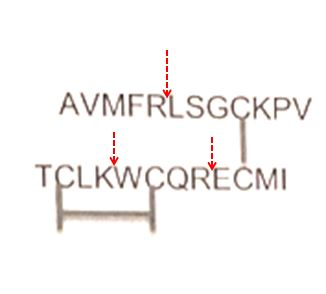
The given protein contains two
polypeptide chains linked together by disulfide bonds.
Trypsin is a protease that cleaves at the C-terminal end of
positively charged amino acids such as Lysine and Arginine.
Lysine = K
Arginine = R
In the given peptide, there are two
arginines and two lysines. However, one lysine residue is followed
by Proline. So, it cannot be cleaved by trypsin.
Even after the proteolytic cleavage, the disulfide bond remains
intact (Under nonreducing conditions).
So, the number of fragments produced = 3
If disulfide bonds are reduced by
treatment with beta-mercaptoethanol,
The number of fragments produced = 5
See the image

Add Answer to:
please help me explain how to do this
If the protein below were digested with trypsin,...
Please help me solve this genetics problem, my professor wasn't able to explain it clearly!! Please...
 Please help me solve this genetics problem, my professor wasn't
able to explain it clearly!! Please give details on how to some
this problem.. Thanks
4. Mutation and effects The following protein fragments (amino acid sequences) were found. Wildtype (non-mutated) a. Knowing this information, what nucleotides could encode this protein fragment. Fill in the table using capital letters for nucleotides you know know for certain and lower case letters or the underscore for those you are unsure of -be as...
Please help me solve this genetics problem, my professor wasn't
able to explain it clearly!! Please give details on how to some
this problem.. Thanks
4. Mutation and effects The following protein fragments (amino acid sequences) were found. Wildtype (non-mutated) a. Knowing this information, what nucleotides could encode this protein fragment. Fill in the table using capital letters for nucleotides you know know for certain and lower case letters or the underscore for those you are unsure of -be as...
anyone can help me with it? A protein biochemist attempted to determine the amino acid sequence...
 anyone can help me with it?
A protein biochemist attempted to determine the amino acid sequence of a decapeptide. Use the results from the trypsin, chymotrypsin, and cyanogen bromide treatments to suggest the amino acid sequence of this decapeptide. Trypsin digestion gave two fragments with multiple residues (not in order): • T1: Ala, Arg, Phe, Gly, Thr, Trp, Tyr • T2: Lys, Met, Val Chymotrypsin digestion gave four fragments with multiple residues (not in order): • CT1: Ala, Phe •...
anyone can help me with it?
A protein biochemist attempted to determine the amino acid sequence of a decapeptide. Use the results from the trypsin, chymotrypsin, and cyanogen bromide treatments to suggest the amino acid sequence of this decapeptide. Trypsin digestion gave two fragments with multiple residues (not in order): • T1: Ala, Arg, Phe, Gly, Thr, Trp, Tyr • T2: Lys, Met, Val Chymotrypsin digestion gave four fragments with multiple residues (not in order): • CT1: Ala, Phe •...
Please explain, Thanks! The following image shows the 20 amino acids found in proteins. OH CH...
 Please explain, Thanks!
The following image shows the 20 amino acids found in proteins. OH CH H HNCOOH Glycine HN HẠN CHO Alanine HẠN COOH Serine н соон Threonine Cysteine HAN COOHHN COOH Nлсоон н соон Methionine Valine Leucine Isoleucine Proline OOH MNCOOHHN COOH HN COOH H COOH HẠNỐIOOH Apartic Acid Phenylalanine Tyrosine Tryptophan Glutamic Acid HNCOOHH COOH Asparagine Glutamine HNCOOHNCOOH Histidine Lysine н соон Arginine Imagine that in a protein, a lysine amino acid is replaced with an isoleucine....
Please explain, Thanks!
The following image shows the 20 amino acids found in proteins. OH CH H HNCOOH Glycine HN HẠN CHO Alanine HẠN COOH Serine н соон Threonine Cysteine HAN COOHHN COOH Nлсоон н соон Methionine Valine Leucine Isoleucine Proline OOH MNCOOHHN COOH HN COOH H COOH HẠNỐIOOH Apartic Acid Phenylalanine Tyrosine Tryptophan Glutamic Acid HNCOOHH COOH Asparagine Glutamine HNCOOHNCOOH Histidine Lysine н соон Arginine Imagine that in a protein, a lysine amino acid is replaced with an isoleucine....
You are given the below piece of Template DNA (the same as the previous question). How...
 You are given the below piece of Template DNA (the same as the previous question). How many amino acids are in the protein encoded by this gene? 3'AATACGGGGAGCITTACAGAATTCAAATCA5' SECOND POSITION с A G U phenyl- alanine tyrosine cysteine U serine stop leucine stop tryptophan stop U с A G U с A histidine с leucine proline arginine FIRST POSITION glutamine THIRD POSITION G isoleucine asparagine serine U с A А threonine methionine lysine arginine valine aspartic acid glutamic U с...
How many peptide fragments would result from cleaving the sequence with...
A protein has the amino acid sequence:DSRLSKTMYSIEAPAKLDWEQNMALHow many peptide fragments would result from cleaving the sequence with....a: cyanogen bromideb: trypsinc: Which of these reagents gives the smallest single fragment (in number of amino acid residues)?Please explain how to work out this problem. Thanks!
1. Partial hydrolysis of lysozyme yielded an octapeptide that was later identified as the N-terminal segment of...
1. Partial hydrolysis of lysozyme yielded an octapeptide that was later identified as the N-terminal segment of the protein. From the following information, determine the sequence of this octapeptide. a. The following amino acids were identified after complete hydrolysis of the octapeptide: Arginine (Arg) Glycine (Gly) Phenylalanine (Phe) Cysteine (Cys) Leucine (Leu) Valine (Val) Glutamic Acid (Glu) Lysine (Lys) b. Treatment of the octapeptide with dinitroflurobenzene (Sanger reagent) followed by complete hydrolysis gave lysine (Lys) labeled with two dinitrophenyl (DNP) groups. c. Treatment of the octapeptide with trypsin gave lysine...
1. Partial hydrolysis of lysozyme yielded an octapeptide that was later identified as the N-terminal segment of...
1. Partial hydrolysis of lysozyme yielded an octapeptide that was later identified as the N-terminal segment of the protein. From the following information, determine the sequence of this octapeptide. a. The following amino acids were identified after complete hydrolysis of the octapeptide: Arginine (Arg) Glycine (Gly) Phenylalanine (Phe) Cysteine (Cys) Leucine (Leu) Valine (Val) Glutamic Acid (Glu) Lysine (Lys) b. Treatment of the octapeptide with dinitroflurobenzene (Sanger reagent) followed by complete hydrolysis gave lysine (Lys) labeled with two dinitrophenyl (DNP) groups. c. Treatment of the octapeptide with trypsin gave lysine...
Explain this question please! Name (4 ofer to the Table of Amino Acids at the beginning of the exam to help solve this problem. Polypeptide I is a 12-mer and has the following amino acid compositi...
 Explain this question please!
Name (4 ofer to the Table of Amino Acids at the beginning of the exam to help solve this problem. Polypeptide I is a 12-mer and has the following amino acid composition: Ala, Arg, 2 His, Leu, 2 Lys, 2 Phe, Ser, Thr, Trp Edman degradation of I shows that its N-terminal amino acid is His. Chymotrypsin cleavage of I yields peptide fragments A-D.Trypsin cleavage of I gives peptide fragments E-G. Shown below is the amino...
Explain this question please!
Name (4 ofer to the Table of Amino Acids at the beginning of the exam to help solve this problem. Polypeptide I is a 12-mer and has the following amino acid composition: Ala, Arg, 2 His, Leu, 2 Lys, 2 Phe, Ser, Thr, Trp Edman degradation of I shows that its N-terminal amino acid is His. Chymotrypsin cleavage of I yields peptide fragments A-D.Trypsin cleavage of I gives peptide fragments E-G. Shown below is the amino...
Please explain Exercise 4-determine the position of the disulfide bonds in the intact protein . Treatment...
 Please explain
Exercise 4-determine the position of the disulfide bonds in the intact protein . Treatment of a small protein with 2-mercaptoethanol yields 2 polypeptides with the following sequences: o Y-K-C-F-R-H-T-K-C-S o A-V-C-R-T-G-C-K-N-F-L Treatment of the intact protein with trypsin yields fragments with the following amino acid compositions (note, these are no the sequences!) o (A,R,C,c.s,v) o (R,C,C,G,K.T.F o (N,L,F o (H,K,T) o (K,Y)
Please explain
Exercise 4-determine the position of the disulfide bonds in the intact protein . Treatment of a small protein with 2-mercaptoethanol yields 2 polypeptides with the following sequences: o Y-K-C-F-R-H-T-K-C-S o A-V-C-R-T-G-C-K-N-F-L Treatment of the intact protein with trypsin yields fragments with the following amino acid compositions (note, these are no the sequences!) o (A,R,C,c.s,v) o (R,C,C,G,K.T.F o (N,L,F o (H,K,T) o (K,Y)
In part A, yes you should reconstitute the full-length protein sequence from the fragments. However, you...
 In part A, yes you should reconstitute the full-length protein
sequence from the fragments. However, you do not need to write out
the amino acid sequence - you can just provide the order of the
fragment numbers (from either set of fragments). For
example (and this is not the answer), you could say:
"Using the Pro-IAPP fragment set, starting from the N-terminus, the
fragment order is '5-4-6-3-2-1' " and that would fully address the
question.
In part B, the hint...
In part A, yes you should reconstitute the full-length protein
sequence from the fragments. However, you do not need to write out
the amino acid sequence - you can just provide the order of the
fragment numbers (from either set of fragments). For
example (and this is not the answer), you could say:
"Using the Pro-IAPP fragment set, starting from the N-terminus, the
fragment order is '5-4-6-3-2-1' " and that would fully address the
question.
In part B, the hint...
 Please help me solve this genetics problem, my professor wasn't
able to explain it clearly!! Please give details on how to some
this problem.. Thanks
4. Mutation and effects The following protein fragments (amino acid sequences) were found. Wildtype (non-mutated) a. Knowing this information, what nucleotides could encode this protein fragment. Fill in the table using capital letters for nucleotides you know know for certain and lower case letters or the underscore for those you are unsure of -be as...
Please help me solve this genetics problem, my professor wasn't
able to explain it clearly!! Please give details on how to some
this problem.. Thanks
4. Mutation and effects The following protein fragments (amino acid sequences) were found. Wildtype (non-mutated) a. Knowing this information, what nucleotides could encode this protein fragment. Fill in the table using capital letters for nucleotides you know know for certain and lower case letters or the underscore for those you are unsure of -be as...
 anyone can help me with it?
A protein biochemist attempted to determine the amino acid sequence of a decapeptide. Use the results from the trypsin, chymotrypsin, and cyanogen bromide treatments to suggest the amino acid sequence of this decapeptide. Trypsin digestion gave two fragments with multiple residues (not in order): • T1: Ala, Arg, Phe, Gly, Thr, Trp, Tyr • T2: Lys, Met, Val Chymotrypsin digestion gave four fragments with multiple residues (not in order): • CT1: Ala, Phe •...
anyone can help me with it?
A protein biochemist attempted to determine the amino acid sequence of a decapeptide. Use the results from the trypsin, chymotrypsin, and cyanogen bromide treatments to suggest the amino acid sequence of this decapeptide. Trypsin digestion gave two fragments with multiple residues (not in order): • T1: Ala, Arg, Phe, Gly, Thr, Trp, Tyr • T2: Lys, Met, Val Chymotrypsin digestion gave four fragments with multiple residues (not in order): • CT1: Ala, Phe •...
 Please explain, Thanks!
The following image shows the 20 amino acids found in proteins. OH CH H HNCOOH Glycine HN HẠN CHO Alanine HẠN COOH Serine н соон Threonine Cysteine HAN COOHHN COOH Nлсоон н соон Methionine Valine Leucine Isoleucine Proline OOH MNCOOHHN COOH HN COOH H COOH HẠNỐIOOH Apartic Acid Phenylalanine Tyrosine Tryptophan Glutamic Acid HNCOOHH COOH Asparagine Glutamine HNCOOHNCOOH Histidine Lysine н соон Arginine Imagine that in a protein, a lysine amino acid is replaced with an isoleucine....
Please explain, Thanks!
The following image shows the 20 amino acids found in proteins. OH CH H HNCOOH Glycine HN HẠN CHO Alanine HẠN COOH Serine н соон Threonine Cysteine HAN COOHHN COOH Nлсоон н соон Methionine Valine Leucine Isoleucine Proline OOH MNCOOHHN COOH HN COOH H COOH HẠNỐIOOH Apartic Acid Phenylalanine Tyrosine Tryptophan Glutamic Acid HNCOOHH COOH Asparagine Glutamine HNCOOHNCOOH Histidine Lysine н соон Arginine Imagine that in a protein, a lysine amino acid is replaced with an isoleucine....
 You are given the below piece of Template DNA (the same as the previous question). How many amino acids are in the protein encoded by this gene? 3'AATACGGGGAGCITTACAGAATTCAAATCA5' SECOND POSITION с A G U phenyl- alanine tyrosine cysteine U serine stop leucine stop tryptophan stop U с A G U с A histidine с leucine proline arginine FIRST POSITION glutamine THIRD POSITION G isoleucine asparagine serine U с A А threonine methionine lysine arginine valine aspartic acid glutamic U с...
 Explain this question please!
Name (4 ofer to the Table of Amino Acids at the beginning of the exam to help solve this problem. Polypeptide I is a 12-mer and has the following amino acid composition: Ala, Arg, 2 His, Leu, 2 Lys, 2 Phe, Ser, Thr, Trp Edman degradation of I shows that its N-terminal amino acid is His. Chymotrypsin cleavage of I yields peptide fragments A-D.Trypsin cleavage of I gives peptide fragments E-G. Shown below is the amino...
Explain this question please!
Name (4 ofer to the Table of Amino Acids at the beginning of the exam to help solve this problem. Polypeptide I is a 12-mer and has the following amino acid composition: Ala, Arg, 2 His, Leu, 2 Lys, 2 Phe, Ser, Thr, Trp Edman degradation of I shows that its N-terminal amino acid is His. Chymotrypsin cleavage of I yields peptide fragments A-D.Trypsin cleavage of I gives peptide fragments E-G. Shown below is the amino...
 Please explain
Exercise 4-determine the position of the disulfide bonds in the intact protein . Treatment of a small protein with 2-mercaptoethanol yields 2 polypeptides with the following sequences: o Y-K-C-F-R-H-T-K-C-S o A-V-C-R-T-G-C-K-N-F-L Treatment of the intact protein with trypsin yields fragments with the following amino acid compositions (note, these are no the sequences!) o (A,R,C,c.s,v) o (R,C,C,G,K.T.F o (N,L,F o (H,K,T) o (K,Y)
Please explain
Exercise 4-determine the position of the disulfide bonds in the intact protein . Treatment of a small protein with 2-mercaptoethanol yields 2 polypeptides with the following sequences: o Y-K-C-F-R-H-T-K-C-S o A-V-C-R-T-G-C-K-N-F-L Treatment of the intact protein with trypsin yields fragments with the following amino acid compositions (note, these are no the sequences!) o (A,R,C,c.s,v) o (R,C,C,G,K.T.F o (N,L,F o (H,K,T) o (K,Y)
 In part A, yes you should reconstitute the full-length protein
sequence from the fragments. However, you do not need to write out
the amino acid sequence - you can just provide the order of the
fragment numbers (from either set of fragments). For
example (and this is not the answer), you could say:
"Using the Pro-IAPP fragment set, starting from the N-terminus, the
fragment order is '5-4-6-3-2-1' " and that would fully address the
question.
In part B, the hint...
In part A, yes you should reconstitute the full-length protein
sequence from the fragments. However, you do not need to write out
the amino acid sequence - you can just provide the order of the
fragment numbers (from either set of fragments). For
example (and this is not the answer), you could say:
"Using the Pro-IAPP fragment set, starting from the N-terminus, the
fragment order is '5-4-6-3-2-1' " and that would fully address the
question.
In part B, the hint...
Most questions answered within 3 hours.
-
Where is the error in this code sequence?
String s1 = "Hello";
String s2 = "ello";...
asked 10 months ago -
Financial data for Joel de Paris, Inc., for last year
follow:
Joel de Paris, Inc.
Balance...
asked 10 months ago -
Consider this reaction:
Al2(SO4)3 (aq)+ BaCl3
(aq) Al2Cl6 (aq)- +
3BaSO4(s) . What is the...
asked 10 months ago -
Suppose that Savneet is considering increasing her
recent random sample from 20 car rentals to 40...
asked 10 months ago -
Trucks arrive at an unloading terminal at an average rate of 120
per hour.
Trucks arrive...
asked 10 months ago -
Why are methanol and ethanol completely soluble in water while
octanol is not very little soluble....
asked 10 months ago -
A facilities manager at a university reads in a research report
that the mean amount of...
asked 10 months ago -
When the CuSO4 is rehydrated by adding water to the anhydrous
compound, is this an endothermic...
asked 10 months ago -
A ray of sunlight is passing from diamond into crown glass; the
angle of incidence is...
asked 10 months ago -
A block of mass 0.249 kg is placed on top of a light, vertical
spring of...
asked 10 months ago -
how do the kidneys compensate in the presences of acidosis
a) trigger hyperventilate
b) reserve acid...
asked 10 months ago -
Question 501 pts
The rental rate of capital to the firm increases. Which of the
following...
asked 10 months ago