
Homework Answers
Answer - D, (A) and (B)
Explanation
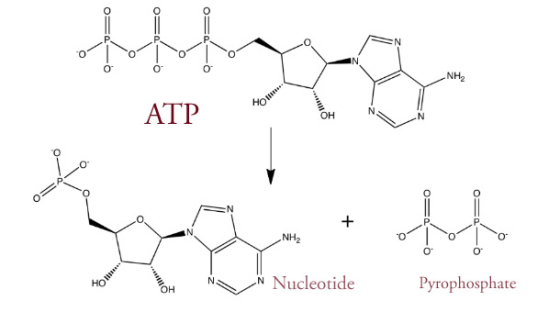
ATP
 Ribonucleotide
+ Pyrophosphate
Ribonucleotide
+ Pyrophosphate
During the synthesis of RNA nucleotide, ATP is 1 of the four nucleotides incorporated directly into RNA molecules by RNA polymerase enzymes. Primase synthesizes RNA primers complementary to the DNA strand, so that the primer contain ribonucleotides not deoxyribonucleotides. DNA polymerase III only adds deoxyribonucleotides to the primary.
Here, the nucleotide formed is the ribonucleotide because oxygen is present on the 5th position of ribose sugar. DNA polymerase 3 can add deoxyribonucleotides not ribonucleotides.
Add Answer to:
Use the following figure to answer the next two (2) questions. In the structures shown, the...
1a.) Which of the following characteristics is not associated with E. coli primase? A.) it synthesizes...
1a.) Which of the following characteristics is not associated with E. coli primase? A.) it synthesizes the RNA primer in DNA replication B.) it synthesizes a primer with a free 3'−OH end C.) it is essential for DNA replication D.) it is essential for RNA replication 1b.) Which of the following is not required for optimal DNA replication? A.) Gyrase B.) Primase C.) Single strand binding proteins. D.) All of these are necessary. E.) DNA Polymerase II.
Which of the following enzymes catalyzes the elongation of a nucleic strand in the 3'-->5' direction?...
Which of the following enzymes catalyzes the elongation of a nucleic strand in the 3'-->5' direction? A) DNA polymerase I ***This is the answer choice I originally put and it was incorrect*** B) DNA polymerase III C) RNA primase D) Reverse transcriptase E) All of the above
16. Which of the following enzymes adds DNA to the ends or material with duplication? a....
 16. Which of the following enzymes adds DNA to the ends or material with duplication? a. Telomerase b. Polymerase d. Primase e. Ligase 1. Which of the following structures indicates where DNA replication begins a. DNA polymerase III b. Replication fork C. Helicase d. Origin of replication e. Centromeres 18. A select mutation is causing a cell lineape to be unable to replicate DNA SUccessfully NA successfully. When observed under a microscope, researchers observe that the DNA is able to...
Question 2. True / False (10 marks) Tor F The DNA sequences shown below are complementary...
 Question 2. True / False (10 marks) Tor F The DNA sequences shown below are complementary to each other. AATTGCTACGTT AATTGCTACGTT I or F T or F b. Primase carries polymerase activity. c. In prokaryotes, RNA polymerases synthesize RNA at a lower rate than DNA polymerases because it takes time for RNA polymerase to perform proofreading. d. Reverse transcriptase activity is observed in DNA polymerase I in prokaryotes. The base in the following nucleotide is adenine. This nucleotide can be...
NA primase is TRUE? 27. Which ONE of the following statements about DNA primase is in...
 NA primase is TRUE? 27. Which ONE of the following statements about DNA primase is in polymerase cannot extend a new A) It is necessary for DNA synthesis because DNA polymerase canno strand in the 3 to 5' direction. B) It proofreads bases added by DNA polymerase. C) It is a type of RNA polymerase. D) It has terminal transferase activity. 28. How many of the following statements about PCNA are TRUE? • It encircles ssDNA. • It is an...
Question 14: The answers on 14 and 9 are incorrect. Answer the question 14 and question...
 Question 14:
The answers on 14 and 9 are incorrect.
Answer the question 14 and question 9 plz, thanks a lot.
Helicase strand Refer to the above diagrams and match the components of the replisome with the description of their function A Extends an Okazaki fragment Single-stranded binding Holds DNA polymerase in place proteins (SSBPs) during strand extension H Topoisomerase Catalyzes the breaking of hydrogen bonds between base pairs to open Primase - leading strand the double helix D. Catalyzes...
Question 14:
The answers on 14 and 9 are incorrect.
Answer the question 14 and question 9 plz, thanks a lot.
Helicase strand Refer to the above diagrams and match the components of the replisome with the description of their function A Extends an Okazaki fragment Single-stranded binding Holds DNA polymerase in place proteins (SSBPs) during strand extension H Topoisomerase Catalyzes the breaking of hydrogen bonds between base pairs to open Primase - leading strand the double helix D. Catalyzes...
50) During DNA DNA? replication, which of the following enzymes covalently connects segments of A) helicase...
 50) During DNA DNA? replication, which of the following enzymes covalently connects segments of A) helicase B) DNA polymerase III C) ligase D) DNA polymerase I E) primase 51) The nitrogenous base adenine is found in all members of which of the following groups of molecules? A) proteins, triglycerides, and testosterone B) proteins, ATP, and DNA C) ATP, RNA, and DNA D) glucose, ATP, and DNA E) proteins, carbohydrates, and ATP 52) A particular triplet of bases in the template...
Answer the following genetics questions: a. In detail describe the process of DNA replication. Be sure...
Answer the following genetics questions: a. In detail describe the process of DNA replication. Be sure to include all the major enzymes (gyrase, helicase, ligase, polymerase, primase), SSBs, replication fork, Okazaki fragments, and strand types (leading v. lagging). Draw and label a diagram of a replication bubble and replication forks. b. Describe and differentiate among the primary, secondary, and tertiary structures of a protein. To what kinds of interactions can each of these stages be ascribed? c. What are...
1)Repairing damaged DNA is essential to maintaining the integrity of the genome. One type of repair...
1)Repairing damaged DNA is essential to maintaining the integrity of the genome. One type of repair is known as nucleotide excision repair. In this system, which order do the necessary enzymes act? A) exonuclease, DNA polymerase III, RNA primase B) helicase, DNA polymerase I, DNA ligase C) DNA ligase, nuclease, helicase D) DNA polymerase I, DNA polymerase III, DNA ligase E) endonuclease, DNA polymerase II, DNA ligase 2) What might be the result if all cells had functioning telomerase? A)...
29. The initiator RNA attaches at the ribosome's site. A. A B. translocon C. E DP...
 29. The initiator RNA attaches at the ribosome's site. A. A B. translocon C. E DP E. O 30. Which one of the following, if missing, would usually prevent translation from starting? A. one of several exons in a mRNA B. poly-A tail C. AUG codon D. spliceosome E. RNA polymerase 31. Which of the following statements about DNA synthesis is true? A. Nucleotides are added in a random fashion to single-stranded DNA. B. DNA polymerase adds dNTP monomers in...
 16. Which of the following enzymes adds DNA to the ends or material with duplication? a. Telomerase b. Polymerase d. Primase e. Ligase 1. Which of the following structures indicates where DNA replication begins a. DNA polymerase III b. Replication fork C. Helicase d. Origin of replication e. Centromeres 18. A select mutation is causing a cell lineape to be unable to replicate DNA SUccessfully NA successfully. When observed under a microscope, researchers observe that the DNA is able to...
 Question 2. True / False (10 marks) Tor F The DNA sequences shown below are complementary to each other. AATTGCTACGTT AATTGCTACGTT I or F T or F b. Primase carries polymerase activity. c. In prokaryotes, RNA polymerases synthesize RNA at a lower rate than DNA polymerases because it takes time for RNA polymerase to perform proofreading. d. Reverse transcriptase activity is observed in DNA polymerase I in prokaryotes. The base in the following nucleotide is adenine. This nucleotide can be...
 NA primase is TRUE? 27. Which ONE of the following statements about DNA primase is in polymerase cannot extend a new A) It is necessary for DNA synthesis because DNA polymerase canno strand in the 3 to 5' direction. B) It proofreads bases added by DNA polymerase. C) It is a type of RNA polymerase. D) It has terminal transferase activity. 28. How many of the following statements about PCNA are TRUE? • It encircles ssDNA. • It is an...
 Question 14:
The answers on 14 and 9 are incorrect.
Answer the question 14 and question 9 plz, thanks a lot.
Helicase strand Refer to the above diagrams and match the components of the replisome with the description of their function A Extends an Okazaki fragment Single-stranded binding Holds DNA polymerase in place proteins (SSBPs) during strand extension H Topoisomerase Catalyzes the breaking of hydrogen bonds between base pairs to open Primase - leading strand the double helix D. Catalyzes...
Question 14:
The answers on 14 and 9 are incorrect.
Answer the question 14 and question 9 plz, thanks a lot.
Helicase strand Refer to the above diagrams and match the components of the replisome with the description of their function A Extends an Okazaki fragment Single-stranded binding Holds DNA polymerase in place proteins (SSBPs) during strand extension H Topoisomerase Catalyzes the breaking of hydrogen bonds between base pairs to open Primase - leading strand the double helix D. Catalyzes...
 50) During DNA DNA? replication, which of the following enzymes covalently connects segments of A) helicase B) DNA polymerase III C) ligase D) DNA polymerase I E) primase 51) The nitrogenous base adenine is found in all members of which of the following groups of molecules? A) proteins, triglycerides, and testosterone B) proteins, ATP, and DNA C) ATP, RNA, and DNA D) glucose, ATP, and DNA E) proteins, carbohydrates, and ATP 52) A particular triplet of bases in the template...
 29. The initiator RNA attaches at the ribosome's site. A. A B. translocon C. E DP E. O 30. Which one of the following, if missing, would usually prevent translation from starting? A. one of several exons in a mRNA B. poly-A tail C. AUG codon D. spliceosome E. RNA polymerase 31. Which of the following statements about DNA synthesis is true? A. Nucleotides are added in a random fashion to single-stranded DNA. B. DNA polymerase adds dNTP monomers in...
Most questions answered within 3 hours.
-
Where is the error in this code sequence?
String s1 = "Hello";
String s2 = "ello";...
asked 10 months ago -
Financial data for Joel de Paris, Inc., for last year
follow:
Joel de Paris, Inc.
Balance...
asked 10 months ago -
Consider this reaction:
Al2(SO4)3 (aq)+ BaCl3
(aq) Al2Cl6 (aq)- +
3BaSO4(s) . What is the...
asked 10 months ago -
Suppose that Savneet is considering increasing her
recent random sample from 20 car rentals to 40...
asked 10 months ago -
Trucks arrive at an unloading terminal at an average rate of 120
per hour.
Trucks arrive...
asked 10 months ago -
Why are methanol and ethanol completely soluble in water while
octanol is not very little soluble....
asked 10 months ago -
A facilities manager at a university reads in a research report
that the mean amount of...
asked 10 months ago -
When the CuSO4 is rehydrated by adding water to the anhydrous
compound, is this an endothermic...
asked 10 months ago -
A ray of sunlight is passing from diamond into crown glass; the
angle of incidence is...
asked 10 months ago -
A block of mass 0.249 kg is placed on top of a light, vertical
spring of...
asked 10 months ago -
how do the kidneys compensate in the presences of acidosis
a) trigger hyperventilate
b) reserve acid...
asked 10 months ago -
Question 501 pts
The rental rate of capital to the firm increases. Which of the
following...
asked 10 months ago