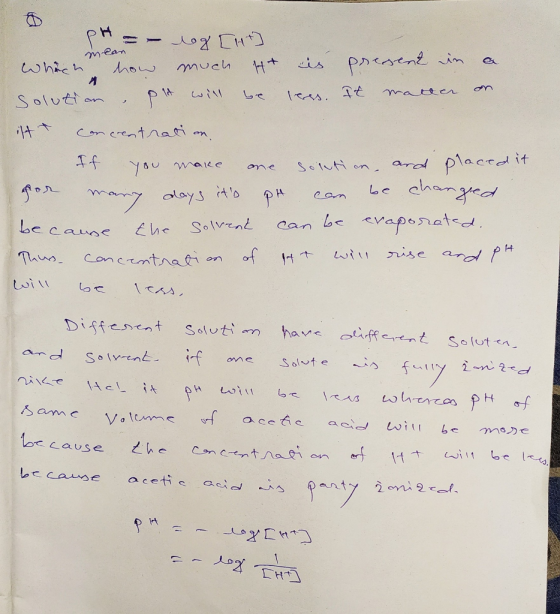
What is the direct cause of the fluctuation of pH of the solution in our lab...
Homework Answers
Add Answer to:
What is the direct cause of the fluctuation of pH of the solution
in our lab...
Lab 8 - photosynthesis: What hypothesis is being tested in this exercise? 1. Brighter lights produce...
 Lab 8 - photosynthesis:
What
hypothesis is being tested in this exercise?
1. Brighter lights
produce more glucose during photosynthesis.
2. Carbon dioxide is
required for photosynthesis to occur.
3. Brighter lights
increase the rate of photosynthesis.
4. NADPH is a product
of the light reactions of photosynthesis.
Photosynthesis: 6 CO2 + 6 H20+ Energy-→ C,H1206 + 6 O2 Respiration: C,H 1206 + 6 O2-→ 6 co, + 6 H2O+ Energy Figure 8-2. Summary equations for photosynthesis and cellular respiration....
Lab 8 - photosynthesis:
What
hypothesis is being tested in this exercise?
1. Brighter lights
produce more glucose during photosynthesis.
2. Carbon dioxide is
required for photosynthesis to occur.
3. Brighter lights
increase the rate of photosynthesis.
4. NADPH is a product
of the light reactions of photosynthesis.
Photosynthesis: 6 CO2 + 6 H20+ Energy-→ C,H1206 + 6 O2 Respiration: C,H 1206 + 6 O2-→ 6 co, + 6 H2O+ Energy Figure 8-2. Summary equations for photosynthesis and cellular respiration....
1. Published findings in an article written by G. Schmitz report that measured pH values for...
1. Published findings in an article written by G. Schmitz report that measured pH values for 0.10 M acetic acid and for acetic acid/acetate buffer solutions agree well with the calculated values. (For our purposes we will say that good agreement means that the measured and the calculated values agree with each other to within about three tenths of a pH unit or less.) However, measured pH values for 0.10 M sodium acetate are found to be always significantly lower...
In the lab procedure you are told to calibrate the pH meter using (1) a solution...
In the lab procedure you are told to calibrate the pH meter using (1) a solution that is pH 4 and (2) a solution that is pH 7 before you measure the pH of any of the solutions that you have made. Imagine that you skip that step, you don’t calibrate the pH meter and instead you simply plug it into the LabQuest, turn it on and measure the pH of your solutions. How would that impact the following of...
7. In certain species of plants, mutations can cause the electron transport chain connecting PSII to...
 7. In certain species of plants, mutations can cause the electron transport chain connecting PSII to PSI to flip orientation. This change in orientation causes the electron transport chain to become ordered in terms of decreasing electronegativity instead of increasing electronegativity. What portions of photosynthesis will be affected by this change in the orientation of the electron transport chain? Why? 8. A mutation in the genome of a plant prevents proper folding of rubisco. How would this impact the Calvin...
Need help with reviewing my lab report -- Question on Germinating Seeds Plants and plants have...
Need help with reviewing my lab report -- Question on Germinating Seeds Plants and plants have been studied for hundreds of years, dating back to the geological era of the Holocene, which began around 11,700 years ago. How to study its effects was by noting the effects of the plants on humans, i.e. herbal medicine, which is the doctrine of how to use herbs in various ways to promote health. Fast-forward to 1665 and using an early microscope to detect...
We used the technique of extraction in this lab. After extraction, what was left in solution?...
We used the technique of extraction in this lab. After extraction, what was left in solution? Why is it acceptable for those chemicals to be left to sit for a week? Think about the possible reactions that would or would not occur during the week? In our extraction, we used NaCl solution. Why did we choose to use that vs. water? In this experiment, we did a Fischer Esterification using excess acetic acid, isopentyl alcohol, and sulfuric acid to form...
does anyone know D? Lab 8 Spring 2020 The Light Reactions The light reactions begin with...
 does anyone know D?
Lab 8 Spring 2020 The Light Reactions The light reactions begin with the photolysis of water. Photolysis refers to the process by which, in the Intact thylakoid membranes and light. water is split into oxygen protons and electrons. Therefore, was primary electron donor in photosynthesis. Conversion of water, a very stable molecule, to oxygen is er unfavorable and would not occur to any significant extent without input of light energy in photosystem e process by which,...
does anyone know D?
Lab 8 Spring 2020 The Light Reactions The light reactions begin with the photolysis of water. Photolysis refers to the process by which, in the Intact thylakoid membranes and light. water is split into oxygen protons and electrons. Therefore, was primary electron donor in photosynthesis. Conversion of water, a very stable molecule, to oxygen is er unfavorable and would not occur to any significant extent without input of light energy in photosystem e process by which,...
Create graphs for Figures 1-4 (circled on pages 111 & 114) based on the data given in Tables ...
 Create graphs for Figures 1-4 (circled on pages 111 & 114)
based on the data given in Tables 2 & 4.
Lab # 8 Cellular Respiration and Fermentation I. Goals and Objectives At the completion of this laboratory exercise, students will be able to: A Differentiate between the intermediates and products of fermentation versus acrobic cellular respiration in yeast. Relate rates of fermentation with sugar availability in yeast. Utilize a reduction-oxidation dye to determine the effect of varying yeast concentration...
Create graphs for Figures 1-4 (circled on pages 111 & 114)
based on the data given in Tables 2 & 4.
Lab # 8 Cellular Respiration and Fermentation I. Goals and Objectives At the completion of this laboratory exercise, students will be able to: A Differentiate between the intermediates and products of fermentation versus acrobic cellular respiration in yeast. Relate rates of fermentation with sugar availability in yeast. Utilize a reduction-oxidation dye to determine the effect of varying yeast concentration...
Preparation of Phosphate Buffer Rxn: Purpose: The purpose of lab this week is to prepare a...
Preparation of Phosphate Buffer Rxn: Purpose: The purpose of lab this week is to prepare a 0.05M sodium phosphate buffer, use a pH meter to adjust the pH of this buffer, and to calculate theoretical pH changes upon addition of acid/ base. Your theory will then be correlated against your actual observational pH changes. Solutions to be made Molecular Weight Table Solution Volume 1.0M HCL 10ML 1.0 M NaOH 20ml 0.05M Sodium Phosphate: *?g NaH2PO4 H2O + *?g Na2HPO4 7H2O,...
I will be negalite control a positive control * Homework before The Hill Reaction Lab, your...
 I will be negalite control a positive control * Homework before The Hill Reaction Lab, your group should do the following: 1) Write a question that you would like to answer about how different conditions alleet the Hill reaction. Remember, a possible answer to this question should be your hypothesis, not predictions about the specific outcome of an experiment Here is an example: Question: Is there a specific temperature range within which photosynthesis can continue to operate? Hypothesis: There is...
 Lab 8 - photosynthesis:
What
hypothesis is being tested in this exercise?
1. Brighter lights
produce more glucose during photosynthesis.
2. Carbon dioxide is
required for photosynthesis to occur.
3. Brighter lights
increase the rate of photosynthesis.
4. NADPH is a product
of the light reactions of photosynthesis.
Photosynthesis: 6 CO2 + 6 H20+ Energy-→ C,H1206 + 6 O2 Respiration: C,H 1206 + 6 O2-→ 6 co, + 6 H2O+ Energy Figure 8-2. Summary equations for photosynthesis and cellular respiration....
Lab 8 - photosynthesis:
What
hypothesis is being tested in this exercise?
1. Brighter lights
produce more glucose during photosynthesis.
2. Carbon dioxide is
required for photosynthesis to occur.
3. Brighter lights
increase the rate of photosynthesis.
4. NADPH is a product
of the light reactions of photosynthesis.
Photosynthesis: 6 CO2 + 6 H20+ Energy-→ C,H1206 + 6 O2 Respiration: C,H 1206 + 6 O2-→ 6 co, + 6 H2O+ Energy Figure 8-2. Summary equations for photosynthesis and cellular respiration....
 7. In certain species of plants, mutations can cause the electron transport chain connecting PSII to PSI to flip orientation. This change in orientation causes the electron transport chain to become ordered in terms of decreasing electronegativity instead of increasing electronegativity. What portions of photosynthesis will be affected by this change in the orientation of the electron transport chain? Why? 8. A mutation in the genome of a plant prevents proper folding of rubisco. How would this impact the Calvin...
 does anyone know D?
Lab 8 Spring 2020 The Light Reactions The light reactions begin with the photolysis of water. Photolysis refers to the process by which, in the Intact thylakoid membranes and light. water is split into oxygen protons and electrons. Therefore, was primary electron donor in photosynthesis. Conversion of water, a very stable molecule, to oxygen is er unfavorable and would not occur to any significant extent without input of light energy in photosystem e process by which,...
does anyone know D?
Lab 8 Spring 2020 The Light Reactions The light reactions begin with the photolysis of water. Photolysis refers to the process by which, in the Intact thylakoid membranes and light. water is split into oxygen protons and electrons. Therefore, was primary electron donor in photosynthesis. Conversion of water, a very stable molecule, to oxygen is er unfavorable and would not occur to any significant extent without input of light energy in photosystem e process by which,...
 Create graphs for Figures 1-4 (circled on pages 111 & 114)
based on the data given in Tables 2 & 4.
Lab # 8 Cellular Respiration and Fermentation I. Goals and Objectives At the completion of this laboratory exercise, students will be able to: A Differentiate between the intermediates and products of fermentation versus acrobic cellular respiration in yeast. Relate rates of fermentation with sugar availability in yeast. Utilize a reduction-oxidation dye to determine the effect of varying yeast concentration...
Create graphs for Figures 1-4 (circled on pages 111 & 114)
based on the data given in Tables 2 & 4.
Lab # 8 Cellular Respiration and Fermentation I. Goals and Objectives At the completion of this laboratory exercise, students will be able to: A Differentiate between the intermediates and products of fermentation versus acrobic cellular respiration in yeast. Relate rates of fermentation with sugar availability in yeast. Utilize a reduction-oxidation dye to determine the effect of varying yeast concentration...
 I will be negalite control a positive control * Homework before The Hill Reaction Lab, your group should do the following: 1) Write a question that you would like to answer about how different conditions alleet the Hill reaction. Remember, a possible answer to this question should be your hypothesis, not predictions about the specific outcome of an experiment Here is an example: Question: Is there a specific temperature range within which photosynthesis can continue to operate? Hypothesis: There is...
Most questions answered within 3 hours.
-
Where is the error in this code sequence?
String s1 = "Hello";
String s2 = "ello";...
asked 11 months ago -
Financial data for Joel de Paris, Inc., for last year
follow:
Joel de Paris, Inc.
Balance...
asked 11 months ago -
Consider this reaction:
Al2(SO4)3 (aq)+ BaCl3
(aq) Al2Cl6 (aq)- +
3BaSO4(s) . What is the...
asked 11 months ago -
Suppose that Savneet is considering increasing her
recent random sample from 20 car rentals to 40...
asked 11 months ago -
Trucks arrive at an unloading terminal at an average rate of 120
per hour.
Trucks arrive...
asked 11 months ago -
Why are methanol and ethanol completely soluble in water while
octanol is not very little soluble....
asked 11 months ago -
A facilities manager at a university reads in a research report
that the mean amount of...
asked 11 months ago -
When the CuSO4 is rehydrated by adding water to the anhydrous
compound, is this an endothermic...
asked 11 months ago -
A ray of sunlight is passing from diamond into crown glass; the
angle of incidence is...
asked 11 months ago -
A block of mass 0.249 kg is placed on top of a light, vertical
spring of...
asked 11 months ago -
how do the kidneys compensate in the presences of acidosis
a) trigger hyperventilate
b) reserve acid...
asked 11 months ago -
Question 501 pts
The rental rate of capital to the firm increases. Which of the
following...
asked 11 months ago