
Homework Answers
Alveoli
Gas exchange is the delivery of oxygen from the lungs to the bloodstream, and the elimination of carbon dioxide from the bloodstream to the lungs. It occurs in the lungs between the alveoli and a network of tiny blood vessels called capillaries, which are located in the walls of the alveoli.
Add Answer to:
QUESTION 20 Which of the following structures in the lungs is designed to facilitate gas exchange?...
6. a correct order of events of a muscle contraction stars correct Which of the following (A-E) represents with the...
 6. a correct order of events of a muscle contraction stars correct Which of the following (A-E) represents with the binding of ATP to the myosin head? (I point) 9. 1- () The myosin head binds to the actin filament to form a cross bridge myosin and actin separate (3) ATP is hydrolyzed to ADP and P (4) The power stroke is initiated A. 1, 2, 3,4 B. 2, 1. 4, 3 C. 3, 2, 1, 4 D. 2, 3,...
The path of air resembles the path of blood in the circulatory system. It starts off...
 The path of air resembles the path of blood in the circulatory system. It starts off with bigger tubes, and as it moves in deeper into the lungs, it goes through intensive and extensive branching to reach the site of gas exchange (alveoli). Study the anatomy of the lungs and follow the path of air through the respiratory structures. View Available Hint(s) Reset Help External nares Alveoli Nasal cavity Pharynx Larynx Trachea Bronchi Respiratory bronchioles Terminal bronchioles Internal nares
1. Gas exchange in the respiratory system occurs between the A and B , C is...
 1. Gas exchange in the respiratory system occurs between the A and B , C is inhaled and D is removed from the body by expiration. Answer: a) A: alveoli, B: capillaries, C: 02, D: CO2 b) A: alveoli, B: capillaries, C: CO2, D: 02 c) A: bronchi, B: capillaries, C: 02, D: CO2 d) A: bronchi, B: capillaries, C: CO2, D: 02 2. The lower respiratory tract consist the trachea, bronchi, bronchioles, and alveoli. Answer: a) True b) False...
QUESTION 15 Correct the following statement to make it true. Note you may need to rearrange...
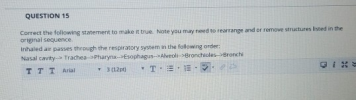 QUESTION 15 Correct the following statement to make it true. Note you may need to rearrange and or remove structures listed in the original sequence. Inhaled air passes through the respiratory system in the following order: Nasal cavity. Trachea - Pharynx->Esophagus.->Alveoli-Bronchioles--Bronchi TTT Arial 3( 12T . . . > QUESTION 15 Correct the following statement to make it true. Note you may need to rearrange and or remove structures listed in the original sequence Inhaled air passes through the respiratory...
Answer these correctly please, thanks! LAB REPORT 31 Nam Respiratory Structures Section checklist for your study...
 Answer these correctly please, thanks!
LAB REPORT 31 Nam Respiratory Structures Section checklist for your study of the human model and the shore luck. Use your textbook for help with the this tableasach that asks for functions. Pluck Structure Functions) Naual cavity Nasal septum Nes internal, external Hard palate Sart palate Cache: superior, middle inferior Purnal sinuses: maxillary. frontal, ethmoid, sphenoid Nesopharynx Oropharynx Laryngopharynx Laryngeal cartilages Vestibular folds TOODOO O OOOOOOOOOOOOOOOOO OOOOOOOOOOOOOOOOOOOOOOOO Vocal folds Trachea Primary bronchi Secondary bronchi Tertiary...
Answer these correctly please, thanks!
LAB REPORT 31 Nam Respiratory Structures Section checklist for your study of the human model and the shore luck. Use your textbook for help with the this tableasach that asks for functions. Pluck Structure Functions) Naual cavity Nasal septum Nes internal, external Hard palate Sart palate Cache: superior, middle inferior Purnal sinuses: maxillary. frontal, ethmoid, sphenoid Nesopharynx Oropharynx Laryngopharynx Laryngeal cartilages Vestibular folds TOODOO O OOOOOOOOOOOOOOOOO OOOOOOOOOOOOOOOOOOOOOOOO Vocal folds Trachea Primary bronchi Secondary bronchi Tertiary...
Which of the following is true? a. Mammals have the most efficient lungs of any living...
Which of the following is true? a. Mammals have the most efficient lungs of any living vertebrates b. Breathing rate is largely determined by blood O2 concentration c. Gas exchange in water is far more efficient than gas exchange in air. d. In a mammalian lung there is no functional gas exchange across the trachea, bronchus or bronchioles
1) Which of the following term describes the amount of air remaining in the lungs following...
1) Which of the following term describes the amount of air remaining in the lungs following a normal exhalation? a. Residual Volume b. Expiratory Reserve Volume c. Functional Residual Capacity d. Vital Capacity 2) Most gas exchange occurs a. at the alveoli b. in the primary bronchi c. in the trachea d. in the bronchioles 3) The content of inhaled air includes a. 78% oxygen; 21% nitrogen; .04% carbon dioxide b. 21% oxygen; 78% nitrogen; .04% carbon dioxide c. 21%...
BioFlix Activity: Gas Exchange- Path of Air Can you trace the path that air follows to...
 BioFlix Activity: Gas Exchange- Path of Air Can you trace the path that air follows to reach the lungs? To review the path of air into the lungs, watch this BoFlix animation: Oas Exchange The Pan of Arinto he Lng Part A-Path of air Drag each label to the appropriate location on the flowchart Reset Help Air reaches all Ai sacs called alveoli. the nose or mouth. trachea and then d alveol. the nose or mouth.smaller ad smaller enters the...
Question 37 Which of the following increases oxygen unloading? decreased BPG e decreased pCO2 in the...
 Question 37 Which of the following increases oxygen unloading? decreased BPG e decreased pCO2 in the plasma All of these answers are correct. increased blood pH increased body temperature Question 38 What is a classic scenario, as described in class, where oxygen unloading would be increased? while eating food during exercise during tidal volume breathing while drinking water divas → XCIO D Question 39 Which of the following is FALSE regarding breathing? It requires skeletal muscles for normal, quiet exhalation....
After air enters the nasopharynx, where does it travel before entering the lungs? Question 1 options:...
After air enters the nasopharynx, where does it travel before entering the lungs? Question 1 options: Through the oropharynx, laryngopharynx, and esophagus. Through the laryngopharynx, epiglottis, and trachea. Through the oropharynx, laryngopharynx. larynx, and trachea. Through the esophagus and trachea. The larynx is surrounded by many different types of cartilage. Which of the following is not a cartilage type associated with the larynx? Question 4 options: Arytenoid cartilage C shaped cartilage Thyroid cartilage Cricoid cartilage An individual recently suffered an...
 6. a correct order of events of a muscle contraction stars correct Which of the following (A-E) represents with the binding of ATP to the myosin head? (I point) 9. 1- () The myosin head binds to the actin filament to form a cross bridge myosin and actin separate (3) ATP is hydrolyzed to ADP and P (4) The power stroke is initiated A. 1, 2, 3,4 B. 2, 1. 4, 3 C. 3, 2, 1, 4 D. 2, 3,...
 The path of air resembles the path of blood in the circulatory system. It starts off with bigger tubes, and as it moves in deeper into the lungs, it goes through intensive and extensive branching to reach the site of gas exchange (alveoli). Study the anatomy of the lungs and follow the path of air through the respiratory structures. View Available Hint(s) Reset Help External nares Alveoli Nasal cavity Pharynx Larynx Trachea Bronchi Respiratory bronchioles Terminal bronchioles Internal nares
 1. Gas exchange in the respiratory system occurs between the A and B , C is inhaled and D is removed from the body by expiration. Answer: a) A: alveoli, B: capillaries, C: 02, D: CO2 b) A: alveoli, B: capillaries, C: CO2, D: 02 c) A: bronchi, B: capillaries, C: 02, D: CO2 d) A: bronchi, B: capillaries, C: CO2, D: 02 2. The lower respiratory tract consist the trachea, bronchi, bronchioles, and alveoli. Answer: a) True b) False...
 QUESTION 15 Correct the following statement to make it true. Note you may need to rearrange and or remove structures listed in the original sequence. Inhaled air passes through the respiratory system in the following order: Nasal cavity. Trachea - Pharynx->Esophagus.->Alveoli-Bronchioles--Bronchi TTT Arial 3( 12T . . . > QUESTION 15 Correct the following statement to make it true. Note you may need to rearrange and or remove structures listed in the original sequence Inhaled air passes through the respiratory...
 Answer these correctly please, thanks!
LAB REPORT 31 Nam Respiratory Structures Section checklist for your study of the human model and the shore luck. Use your textbook for help with the this tableasach that asks for functions. Pluck Structure Functions) Naual cavity Nasal septum Nes internal, external Hard palate Sart palate Cache: superior, middle inferior Purnal sinuses: maxillary. frontal, ethmoid, sphenoid Nesopharynx Oropharynx Laryngopharynx Laryngeal cartilages Vestibular folds TOODOO O OOOOOOOOOOOOOOOOO OOOOOOOOOOOOOOOOOOOOOOOO Vocal folds Trachea Primary bronchi Secondary bronchi Tertiary...
Answer these correctly please, thanks!
LAB REPORT 31 Nam Respiratory Structures Section checklist for your study of the human model and the shore luck. Use your textbook for help with the this tableasach that asks for functions. Pluck Structure Functions) Naual cavity Nasal septum Nes internal, external Hard palate Sart palate Cache: superior, middle inferior Purnal sinuses: maxillary. frontal, ethmoid, sphenoid Nesopharynx Oropharynx Laryngopharynx Laryngeal cartilages Vestibular folds TOODOO O OOOOOOOOOOOOOOOOO OOOOOOOOOOOOOOOOOOOOOOOO Vocal folds Trachea Primary bronchi Secondary bronchi Tertiary...
 BioFlix Activity: Gas Exchange- Path of Air Can you trace the path that air follows to reach the lungs? To review the path of air into the lungs, watch this BoFlix animation: Oas Exchange The Pan of Arinto he Lng Part A-Path of air Drag each label to the appropriate location on the flowchart Reset Help Air reaches all Ai sacs called alveoli. the nose or mouth. trachea and then d alveol. the nose or mouth.smaller ad smaller enters the...
 Question 37 Which of the following increases oxygen unloading? decreased BPG e decreased pCO2 in the plasma All of these answers are correct. increased blood pH increased body temperature Question 38 What is a classic scenario, as described in class, where oxygen unloading would be increased? while eating food during exercise during tidal volume breathing while drinking water divas → XCIO D Question 39 Which of the following is FALSE regarding breathing? It requires skeletal muscles for normal, quiet exhalation....
Most questions answered within 3 hours.
-
Where is the error in this code sequence?
String s1 = "Hello";
String s2 = "ello";...
asked 10 months ago -
Financial data for Joel de Paris, Inc., for last year
follow:
Joel de Paris, Inc.
Balance...
asked 10 months ago -
Consider this reaction:
Al2(SO4)3 (aq)+ BaCl3
(aq) Al2Cl6 (aq)- +
3BaSO4(s) . What is the...
asked 10 months ago -
Suppose that Savneet is considering increasing her
recent random sample from 20 car rentals to 40...
asked 10 months ago -
Trucks arrive at an unloading terminal at an average rate of 120
per hour.
Trucks arrive...
asked 10 months ago -
Why are methanol and ethanol completely soluble in water while
octanol is not very little soluble....
asked 10 months ago -
A facilities manager at a university reads in a research report
that the mean amount of...
asked 10 months ago -
When the CuSO4 is rehydrated by adding water to the anhydrous
compound, is this an endothermic...
asked 10 months ago -
A ray of sunlight is passing from diamond into crown glass; the
angle of incidence is...
asked 10 months ago -
A block of mass 0.249 kg is placed on top of a light, vertical
spring of...
asked 10 months ago -
how do the kidneys compensate in the presences of acidosis
a) trigger hyperventilate
b) reserve acid...
asked 10 months ago -
Question 501 pts
The rental rate of capital to the firm increases. Which of the
following...
asked 10 months ago