
Homework Answers
Add Answer to:
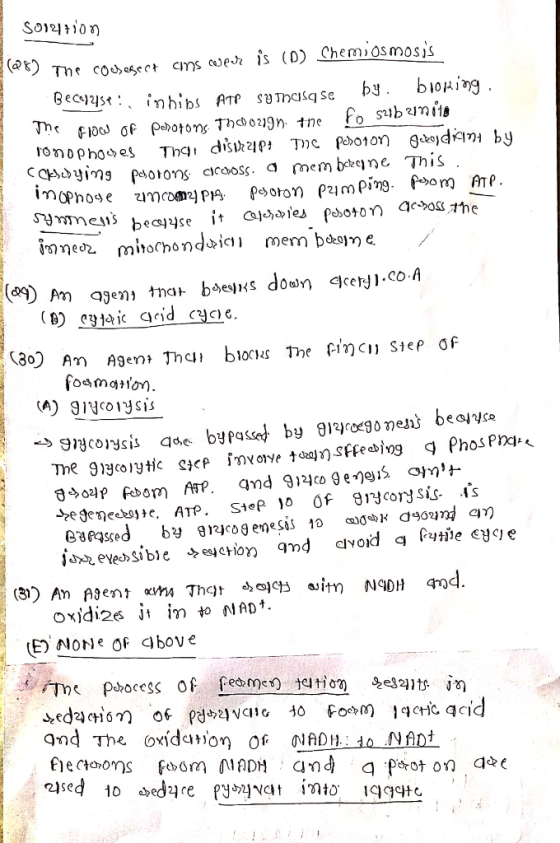
Questions 28 to 31. For each of the following hypothetical metabolic agents, indicate which respiration process...
27) Which one of the following best describes the electron transport chain? A) Electrons are passed...
 27) Which one of the following best describes the electron transport chain? A) Electrons are passed from one carrier to another releasing a little energy at each B) Hydrogen atoms are added to CO2 to make an energy-rich compound. C) Electrons are pumped across a membrane by active transport. D) Glucose is broken down to a three-carbon compound 28) After completion of the citric acid cycle, most of the usable energy from the one molecule is in the form of...
What is the reducing agent (or electron donor) in the following reaction? Pyruvate + NADH +...
 What is the reducing agent (or electron donor) in the following reaction? Pyruvate + NADH + H^+ rightarrow Lactate + NAD^+ A. oxygen B. NADH+H^+ C. NAD^+ D. lactate E. pyruvate Reactants capable of interacting to form products in a chemical reaction must first overcome a thermodynamic barrier known as the reaction's A. entropy B. heat content. C. activation energy. D. endothermic level. E. free-energy content. What does the chemiosmotic process in mitochondria involve? A. establishment of a proton gradient...
1. There's a branching point in cellular respiration involving pyruvate. Pyruvate can undergo lactic acid fermentation...
1. There's a branching point in cellular respiration involving pyruvate. Pyruvate can undergo lactic acid fermentation or enter the mitochondria to enter the citric acid cycle. What determines what happens to pyruvate? A. Energy demands of the cell B. 15% concentrated power of will C. pH of the intracellular fluid D. Presence/absence of oxygen In the fed state, how is glucose used in the body? Select all correct answer choices. A. Used in glycogenesis to create glycogen in skeletal muscles...
no explaination is needed 28) Which of the following is true for all exergonic reactions? A)...
 no explaination is needed
28) Which of the following is true for all exergonic reactions? A) The reaction proceeds with a net release of free energy B) The products have more total energy than the reactants. C) A net input of energy from the surroundings is required for the reactions to proceed. D) The reactions are nonspontaneous 29) When ATP releases some energy, it also releases Inorganic phosphate. What purpose does this serve (if any) in the cell? A) It...
no explaination is needed
28) Which of the following is true for all exergonic reactions? A) The reaction proceeds with a net release of free energy B) The products have more total energy than the reactants. C) A net input of energy from the surroundings is required for the reactions to proceed. D) The reactions are nonspontaneous 29) When ATP releases some energy, it also releases Inorganic phosphate. What purpose does this serve (if any) in the cell? A) It...
QUESTION 1 Which of the following options lists the stages in cellular respiration in the correct...
 QUESTION 1 Which of the following options lists the stages in cellular respiration in the correct order? A. glycolysis, oxidative phosphorylation, pyruvate oxidation, and the citric acid cycle B glycolysis, pyruvate oxidation, the citric acid cycle, and oxidative phosphorylation C. pyruvate oxidation, oxidative phosphorylation, glycolysis, and the citric acid cycle D. the citric acid cycle, oxidative phosphorylation, pyruvate oxidation, and glycolysis QUESTION 2 When a glucose molecule loses a hydrogen atom as the result of an oxidation-reduction reaction, the glucose...
4. For each of the following sentences, fill in the blanks with the best word or...
 4. For each of the following sentences, fill in the blanks with the best word or phrase selected from the list below. Not all words or phrases will be used; each word or phrase can be used more than once. (2 point each; 34 points total) ADP lysosome oxidation phosphorylation NAD pyruvate plasma membrane oxidative phosphorylation acetyl CoA cytosol carbon dioxide nucleus NADH sucrose ubiquitination GTP electrons FADH2 reduction B-sheets matrix ATP FAD kinase vacuole H* mitochondria NADH inner membrane...
this are very difficult questions for my environmental biology class. These are examples from the practice...
 this are very difficult questions for my environmental biology
class. These are examples from the practice homework so can anyone
please help me check my answers.
-) The temperature classes of microorganisms are based on optimum temperatures of microbi A) cell wall C) cell membrane B) enzymes D) All of the above 20) Aerobic respiration, anaerobic respiration, and fermentation are all pathways of which involve the of nutrients. A) Catabolism, reduction B) Anabolism; oxidation C) Catabolism; oxidation D) Anabolism, reduction...
this are very difficult questions for my environmental biology
class. These are examples from the practice homework so can anyone
please help me check my answers.
-) The temperature classes of microorganisms are based on optimum temperatures of microbi A) cell wall C) cell membrane B) enzymes D) All of the above 20) Aerobic respiration, anaerobic respiration, and fermentation are all pathways of which involve the of nutrients. A) Catabolism, reduction B) Anabolism; oxidation C) Catabolism; oxidation D) Anabolism, reduction...
can you help me answer 18, 20 & 23 17. Which of the two following metabolic...
 can you help me answer 18, 20 & 23
17. Which of the two following metabolic pathways require a nacin co m e ? a. Glycolysis and the conversion of byte to CA b. Glycolysis and copenlysis Glycopenlysis and conversion of pyruvate to acetyl-CoA d. Conversion of Dynate to acetyl-CoA and branched-chain amino acids 18 South and Central American countries that depend on a com-based diet prevent the decency Per because com is r ed with an acid to release...
can you help me answer 18, 20 & 23
17. Which of the two following metabolic pathways require a nacin co m e ? a. Glycolysis and the conversion of byte to CA b. Glycolysis and copenlysis Glycopenlysis and conversion of pyruvate to acetyl-CoA d. Conversion of Dynate to acetyl-CoA and branched-chain amino acids 18 South and Central American countries that depend on a com-based diet prevent the decency Per because com is r ed with an acid to release...
1. The Mystery of the Seven Deaths-- The results in Part III suggests which process of...
 1. The Mystery of the Seven Deaths--
The results in Part III suggests which process of respiration
[glycolysis, pyruvate processing, citric acid cycle, or the
electron transport chain] was affected? Why is this the process you
suspect [based on the results]?
Does cyanide poisoning increase ATP production or decrease it?
Explain your answer.
2. The effect of gramicidin--
List the one(s) that would remain the same.
List the one(s) that would decrease (or go to zero).
List the one(s) that...
1. The Mystery of the Seven Deaths--
The results in Part III suggests which process of respiration
[glycolysis, pyruvate processing, citric acid cycle, or the
electron transport chain] was affected? Why is this the process you
suspect [based on the results]?
Does cyanide poisoning increase ATP production or decrease it?
Explain your answer.
2. The effect of gramicidin--
List the one(s) that would remain the same.
List the one(s) that would decrease (or go to zero).
List the one(s) that...
 27) Which one of the following best describes the electron transport chain? A) Electrons are passed from one carrier to another releasing a little energy at each B) Hydrogen atoms are added to CO2 to make an energy-rich compound. C) Electrons are pumped across a membrane by active transport. D) Glucose is broken down to a three-carbon compound 28) After completion of the citric acid cycle, most of the usable energy from the one molecule is in the form of...
 What is the reducing agent (or electron donor) in the following reaction? Pyruvate + NADH + H^+ rightarrow Lactate + NAD^+ A. oxygen B. NADH+H^+ C. NAD^+ D. lactate E. pyruvate Reactants capable of interacting to form products in a chemical reaction must first overcome a thermodynamic barrier known as the reaction's A. entropy B. heat content. C. activation energy. D. endothermic level. E. free-energy content. What does the chemiosmotic process in mitochondria involve? A. establishment of a proton gradient...
 no explaination is needed
28) Which of the following is true for all exergonic reactions? A) The reaction proceeds with a net release of free energy B) The products have more total energy than the reactants. C) A net input of energy from the surroundings is required for the reactions to proceed. D) The reactions are nonspontaneous 29) When ATP releases some energy, it also releases Inorganic phosphate. What purpose does this serve (if any) in the cell? A) It...
no explaination is needed
28) Which of the following is true for all exergonic reactions? A) The reaction proceeds with a net release of free energy B) The products have more total energy than the reactants. C) A net input of energy from the surroundings is required for the reactions to proceed. D) The reactions are nonspontaneous 29) When ATP releases some energy, it also releases Inorganic phosphate. What purpose does this serve (if any) in the cell? A) It...
 QUESTION 1 Which of the following options lists the stages in cellular respiration in the correct order? A. glycolysis, oxidative phosphorylation, pyruvate oxidation, and the citric acid cycle B glycolysis, pyruvate oxidation, the citric acid cycle, and oxidative phosphorylation C. pyruvate oxidation, oxidative phosphorylation, glycolysis, and the citric acid cycle D. the citric acid cycle, oxidative phosphorylation, pyruvate oxidation, and glycolysis QUESTION 2 When a glucose molecule loses a hydrogen atom as the result of an oxidation-reduction reaction, the glucose...
 4. For each of the following sentences, fill in the blanks with the best word or phrase selected from the list below. Not all words or phrases will be used; each word or phrase can be used more than once. (2 point each; 34 points total) ADP lysosome oxidation phosphorylation NAD pyruvate plasma membrane oxidative phosphorylation acetyl CoA cytosol carbon dioxide nucleus NADH sucrose ubiquitination GTP electrons FADH2 reduction B-sheets matrix ATP FAD kinase vacuole H* mitochondria NADH inner membrane...
 this are very difficult questions for my environmental biology
class. These are examples from the practice homework so can anyone
please help me check my answers.
-) The temperature classes of microorganisms are based on optimum temperatures of microbi A) cell wall C) cell membrane B) enzymes D) All of the above 20) Aerobic respiration, anaerobic respiration, and fermentation are all pathways of which involve the of nutrients. A) Catabolism, reduction B) Anabolism; oxidation C) Catabolism; oxidation D) Anabolism, reduction...
this are very difficult questions for my environmental biology
class. These are examples from the practice homework so can anyone
please help me check my answers.
-) The temperature classes of microorganisms are based on optimum temperatures of microbi A) cell wall C) cell membrane B) enzymes D) All of the above 20) Aerobic respiration, anaerobic respiration, and fermentation are all pathways of which involve the of nutrients. A) Catabolism, reduction B) Anabolism; oxidation C) Catabolism; oxidation D) Anabolism, reduction...
 can you help me answer 18, 20 & 23
17. Which of the two following metabolic pathways require a nacin co m e ? a. Glycolysis and the conversion of byte to CA b. Glycolysis and copenlysis Glycopenlysis and conversion of pyruvate to acetyl-CoA d. Conversion of Dynate to acetyl-CoA and branched-chain amino acids 18 South and Central American countries that depend on a com-based diet prevent the decency Per because com is r ed with an acid to release...
can you help me answer 18, 20 & 23
17. Which of the two following metabolic pathways require a nacin co m e ? a. Glycolysis and the conversion of byte to CA b. Glycolysis and copenlysis Glycopenlysis and conversion of pyruvate to acetyl-CoA d. Conversion of Dynate to acetyl-CoA and branched-chain amino acids 18 South and Central American countries that depend on a com-based diet prevent the decency Per because com is r ed with an acid to release...
 1. The Mystery of the Seven Deaths--
The results in Part III suggests which process of respiration
[glycolysis, pyruvate processing, citric acid cycle, or the
electron transport chain] was affected? Why is this the process you
suspect [based on the results]?
Does cyanide poisoning increase ATP production or decrease it?
Explain your answer.
2. The effect of gramicidin--
List the one(s) that would remain the same.
List the one(s) that would decrease (or go to zero).
List the one(s) that...
1. The Mystery of the Seven Deaths--
The results in Part III suggests which process of respiration
[glycolysis, pyruvate processing, citric acid cycle, or the
electron transport chain] was affected? Why is this the process you
suspect [based on the results]?
Does cyanide poisoning increase ATP production or decrease it?
Explain your answer.
2. The effect of gramicidin--
List the one(s) that would remain the same.
List the one(s) that would decrease (or go to zero).
List the one(s) that...
Most questions answered within 3 hours.
-
Where is the error in this code sequence?
String s1 = "Hello";
String s2 = "ello";...
asked 11 months ago -
Financial data for Joel de Paris, Inc., for last year
follow:
Joel de Paris, Inc.
Balance...
asked 11 months ago -
Consider this reaction:
Al2(SO4)3 (aq)+ BaCl3
(aq) Al2Cl6 (aq)- +
3BaSO4(s) . What is the...
asked 11 months ago -
Suppose that Savneet is considering increasing her
recent random sample from 20 car rentals to 40...
asked 11 months ago -
Trucks arrive at an unloading terminal at an average rate of 120
per hour.
Trucks arrive...
asked 11 months ago -
Why are methanol and ethanol completely soluble in water while
octanol is not very little soluble....
asked 11 months ago -
A facilities manager at a university reads in a research report
that the mean amount of...
asked 11 months ago -
When the CuSO4 is rehydrated by adding water to the anhydrous
compound, is this an endothermic...
asked 11 months ago -
A ray of sunlight is passing from diamond into crown glass; the
angle of incidence is...
asked 11 months ago -
A block of mass 0.249 kg is placed on top of a light, vertical
spring of...
asked 11 months ago -
how do the kidneys compensate in the presences of acidosis
a) trigger hyperventilate
b) reserve acid...
asked 11 months ago -
Question 501 pts
The rental rate of capital to the firm increases. Which of the
following...
asked 11 months ago