Which of the following are not a monophyletic group?
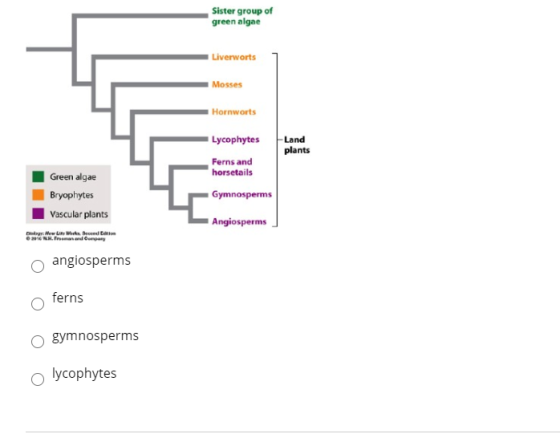
Other options include
|
angiosperms |
||
|
bryophytes |
||
|
ferns/horsetails and bryophytes |
||
|
ferns/horsetails |
||
|
gymnosperms |
Please select all of them
Homework Answers
Angiosperms, ferns/horsetails are monophyletic while gymnosperms, bryophytes and lycophytes are paraphyletic. Recently discovered acrogymnosperms are monophyletic.
Please do like and comment down if you have any query.
Add Answer to:
Which of the following are not a monophyletic group?
Other options include
angiosperms
bryophytes
ferns/horsetails and...
Which of the following are not a monophyletic group? angiosperms ferns gymnosperms lycophytes bryophytes ferns/horsetails and...
 Which of the following are not a monophyletic group?
angiosperms
ferns
gymnosperms
lycophytes
bryophytes
ferns/horsetails and bryophytes
ferns/horsetails
Sister group of green algae Liverworts Mosses Hornworts Lycophytes Land plants Ferns and horsetails Green algae Bryophytes Gymnosperms Vascular plants Angiosperms De How We Seed Cation HO
Which of the following are not a monophyletic group?
angiosperms
ferns
gymnosperms
lycophytes
bryophytes
ferns/horsetails and bryophytes
ferns/horsetails
Sister group of green algae Liverworts Mosses Hornworts Lycophytes Land plants Ferns and horsetails Green algae Bryophytes Gymnosperms Vascular plants Angiosperms De How We Seed Cation HO
Question 3 1 pts 3) The closest relatives of the familiar pine and spruce trees (Gymnosperms)...
 Question 3 1 pts 3) The closest relatives of the familiar pine and spruce trees (Gymnosperms) are A) ferns, horsetails, lycophytes, and other Seedless vascular plants B) hornworts, liverworts, mosses and other Bryophytes C) Chlorophyta and Charophyta D) elms, maples, and other Angiosperms OA
Draw a phylogeny of the plants that includes the following taxa: Green algae Liverworts Mosses Hornworts...
Draw a phylogeny of the plants that includes the following taxa: Green algae Liverworts Mosses Hornworts Lycophytes Ferns & horsetails Gymnosperm Angiosperm And the following adaptations: Sporophyte Cuticle Stem cells Xylem & phloem Lignin Seeds Flowers Lastly, indicate which of the taxa are classified as, non-vascular, vascular, bryophytes, seed, and flowering plants.
معطل Match the following plant groups with their proper phylum name Conifers Anthocerophyta Cycads Anthophyta Ferns...
 معطل Match the following plant groups with their proper phylum name Conifers Anthocerophyta Cycads Anthophyta Ferns Bryophyta Flowering plants Coniferophyta Ginko Cycadophyta Hornworts Ginkophyta Liverworts Hepatophyta Lycophytes (quillworts,etc.) Lycophyta Mosses Monilophyta 2. Place the following groups of plants, along with their outgroup, on the cladogram below. Gymnosperms Bryophytes Charophyceans Angiosperms Ferns Lycophytes Identify derived traits (most of these are adaptations for living on dry land) for 1-5 on the cladogram 2. 1. .
WURDU MUHIWUILS) Figure 9.1 depicts the phylogenetic tree that includes all land plants and their closest...
 WURDU MUHIWUILS) Figure 9.1 depicts the phylogenetic tree that includes all land plants and their closest protist relatives, a group of green algae called Charophytes. As seen in the phylogenetic tree, they all share a common ancestor. What would the Charophytes taxon be in this tree? Charophytes Bryophytes Lycophytes Monilophytes Gymnosperms Angiosperms megaphylls flowers microphylls seeds roots Liverworts Mosses Hornworts vasculature sporophyte dominance multicellular sporophyte Figure 9.1. Evolutionary relationship between Charophytes and plants.
Question 1 1 pts 1) Which of the following is not functionally important in the cells...
 Question 1 1 pts 1) Which of the following is not functionally important in the cells of the gametophytes of both angiosperms and gymnosperms? A) haploid nuclei B) mitochondria C) cell walls D) plastids ОА OB - OC Question 2 1 pts 2) In addition to seeds, which of the following characteristics is unique to the seed- producing plants? A) sporopollenin B) alternation of generations C) pollen D) megaphylls OD Question 3 1 pts 3) The closest relatives of the...
I need help. Please!!! Thanks in advance! riant seed J. Mon Vascular seed Vascular Seedless Nonvascular...
 I need help. Please!!! Thanks in advance!
riant seed J. Mon Vascular seed Vascular Seedless Nonvascular Plants Vascular Plants Plants- Gymnosperms PLANTS Angiosperms CHARACTERISTI Examples Bryophytes (mosses Pteridophytes Cycads, ginkgo Flowering plants and liverworts) club mosses, conifers (hibiscus, horsetails, ferns eucalyptus etc.) Gametophyte produce gametes sperm Female gametophyte Male gametophyte 10 Potente en
I need help. Please!!! Thanks in advance!
riant seed J. Mon Vascular seed Vascular Seedless Nonvascular Plants Vascular Plants Plants- Gymnosperms PLANTS Angiosperms CHARACTERISTI Examples Bryophytes (mosses Pteridophytes Cycads, ginkgo Flowering plants and liverworts) club mosses, conifers (hibiscus, horsetails, ferns eucalyptus etc.) Gametophyte produce gametes sperm Female gametophyte Male gametophyte 10 Potente en
Question 32 2 pts Which of the following is true of seedless vascular plants? They produce...
 Question 32 2 pts Which of the following is true of seedless vascular plants? They produce many spores, which are really the same as seeds. Sphagnum is an economically and ecologically important example, The gametophyte is the dominant generation Whole forests were dominated by large, seedless vascular plants during the Carboniferous period. O Extant seedless vascular plants are larger than the extinct varieties. If humans had been present to build log structures during the Carboniferous period (they weren't), which plant...
Bryophytes & Seedless vascular plants: Be able to define a true “plant” Know how plants differ...
Bryophytes & Seedless vascular plants: Be able to define a true “plant” Know how plants differ from other photosynthetic organisms (green algae, cyanobacteria) Understand that land plants share a common ancestor with green algae Be familiar with the four stages in land plant evolution, and know that both bryophytes and seedless vascular plants arose in the first stage seedless vascular plants diversified and dominated the Earth in the second stage, during the Carboniferous Period (~350-300 MYA), when coal deposits were...
The ancestors of plants were probably algae. True/False 2) What do plants and the green algae...
The ancestors of plants were probably algae. True/False 2) What do plants and the green algae charophytes have in common? 3) What advantages did life in land provide for plants? 4) What were the disadvantages for life on land for plants? 5) What are some differences between plants and algae? 6) How do land plants maintain moisture in their cells? 7) What structures do land plants use to obtain resources such as water, minerals, and CO2? 8) List the two...
 Which of the following are not a monophyletic group?
angiosperms
ferns
gymnosperms
lycophytes
bryophytes
ferns/horsetails and bryophytes
ferns/horsetails
Sister group of green algae Liverworts Mosses Hornworts Lycophytes Land plants Ferns and horsetails Green algae Bryophytes Gymnosperms Vascular plants Angiosperms De How We Seed Cation HO
Which of the following are not a monophyletic group?
angiosperms
ferns
gymnosperms
lycophytes
bryophytes
ferns/horsetails and bryophytes
ferns/horsetails
Sister group of green algae Liverworts Mosses Hornworts Lycophytes Land plants Ferns and horsetails Green algae Bryophytes Gymnosperms Vascular plants Angiosperms De How We Seed Cation HO
 Question 3 1 pts 3) The closest relatives of the familiar pine and spruce trees (Gymnosperms) are A) ferns, horsetails, lycophytes, and other Seedless vascular plants B) hornworts, liverworts, mosses and other Bryophytes C) Chlorophyta and Charophyta D) elms, maples, and other Angiosperms OA
 معطل Match the following plant groups with their proper phylum name Conifers Anthocerophyta Cycads Anthophyta Ferns Bryophyta Flowering plants Coniferophyta Ginko Cycadophyta Hornworts Ginkophyta Liverworts Hepatophyta Lycophytes (quillworts,etc.) Lycophyta Mosses Monilophyta 2. Place the following groups of plants, along with their outgroup, on the cladogram below. Gymnosperms Bryophytes Charophyceans Angiosperms Ferns Lycophytes Identify derived traits (most of these are adaptations for living on dry land) for 1-5 on the cladogram 2. 1. .
 WURDU MUHIWUILS) Figure 9.1 depicts the phylogenetic tree that includes all land plants and their closest protist relatives, a group of green algae called Charophytes. As seen in the phylogenetic tree, they all share a common ancestor. What would the Charophytes taxon be in this tree? Charophytes Bryophytes Lycophytes Monilophytes Gymnosperms Angiosperms megaphylls flowers microphylls seeds roots Liverworts Mosses Hornworts vasculature sporophyte dominance multicellular sporophyte Figure 9.1. Evolutionary relationship between Charophytes and plants.
 Question 1 1 pts 1) Which of the following is not functionally important in the cells of the gametophytes of both angiosperms and gymnosperms? A) haploid nuclei B) mitochondria C) cell walls D) plastids ОА OB - OC Question 2 1 pts 2) In addition to seeds, which of the following characteristics is unique to the seed- producing plants? A) sporopollenin B) alternation of generations C) pollen D) megaphylls OD Question 3 1 pts 3) The closest relatives of the...
 I need help. Please!!! Thanks in advance!
riant seed J. Mon Vascular seed Vascular Seedless Nonvascular Plants Vascular Plants Plants- Gymnosperms PLANTS Angiosperms CHARACTERISTI Examples Bryophytes (mosses Pteridophytes Cycads, ginkgo Flowering plants and liverworts) club mosses, conifers (hibiscus, horsetails, ferns eucalyptus etc.) Gametophyte produce gametes sperm Female gametophyte Male gametophyte 10 Potente en
I need help. Please!!! Thanks in advance!
riant seed J. Mon Vascular seed Vascular Seedless Nonvascular Plants Vascular Plants Plants- Gymnosperms PLANTS Angiosperms CHARACTERISTI Examples Bryophytes (mosses Pteridophytes Cycads, ginkgo Flowering plants and liverworts) club mosses, conifers (hibiscus, horsetails, ferns eucalyptus etc.) Gametophyte produce gametes sperm Female gametophyte Male gametophyte 10 Potente en
 Question 32 2 pts Which of the following is true of seedless vascular plants? They produce many spores, which are really the same as seeds. Sphagnum is an economically and ecologically important example, The gametophyte is the dominant generation Whole forests were dominated by large, seedless vascular plants during the Carboniferous period. O Extant seedless vascular plants are larger than the extinct varieties. If humans had been present to build log structures during the Carboniferous period (they weren't), which plant...
Most questions answered within 3 hours.
-
Where is the error in this code sequence?
String s1 = "Hello";
String s2 = "ello";...
asked 11 months ago -
Financial data for Joel de Paris, Inc., for last year
follow:
Joel de Paris, Inc.
Balance...
asked 11 months ago -
Consider this reaction:
Al2(SO4)3 (aq)+ BaCl3
(aq) Al2Cl6 (aq)- +
3BaSO4(s) . What is the...
asked 11 months ago -
Suppose that Savneet is considering increasing her
recent random sample from 20 car rentals to 40...
asked 11 months ago -
Trucks arrive at an unloading terminal at an average rate of 120
per hour.
Trucks arrive...
asked 11 months ago -
Why are methanol and ethanol completely soluble in water while
octanol is not very little soluble....
asked 11 months ago -
A facilities manager at a university reads in a research report
that the mean amount of...
asked 11 months ago -
When the CuSO4 is rehydrated by adding water to the anhydrous
compound, is this an endothermic...
asked 11 months ago -
A ray of sunlight is passing from diamond into crown glass; the
angle of incidence is...
asked 11 months ago -
A block of mass 0.249 kg is placed on top of a light, vertical
spring of...
asked 11 months ago -
how do the kidneys compensate in the presences of acidosis
a) trigger hyperventilate
b) reserve acid...
asked 11 months ago -
Question 501 pts
The rental rate of capital to the firm increases. Which of the
following...
asked 11 months ago