
Homework Answers
You have asked three questions here. As per Chegg Q&A Guidelines I am answering the first question since you haven't specified which question to answer.
We are given that:
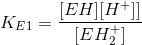
![[ESH][H+] Kesi = [ES]](http://img.homeworklib.com/questions/6f9d7da0-e45c-11eb-8ade-1bd8a7f9d46a.png?x-oss-process=image/resize,w_560)
![KE2 = E- H+] [ΕΗ]](http://img.homeworklib.com/questions/6ff94240-e45c-11eb-9e58-47934900321b.png?x-oss-process=image/resize,w_560)

Now, the reaction involves protonation and deprotonation steps. These reactions are very fast and hence all these acid-base reactions are considered to be in equilibrium.
The total enzyme concentration in the protonated/deprotonated state is given by:
![EHT = [EH,] + [EH] + [E-](http://img.homeworklib.com/questions/70a30c50-e45c-11eb-b421-b7772c11215a.png?x-oss-process=image/resize,w_560)
From the equilibrium constants mentioned above, we have,
![(EH)= [EH][Η]. 1 ΚΕΙ + (EH) +- ΚΕ2[ΕΗ) [H+]](http://img.homeworklib.com/questions/70ff6810-e45c-11eb-b6f8-110bbeaf8eb2.png?x-oss-process=image/resize,w_560)
![H+1 KE2 :: [EH]T = [EH] +1+ H+1](http://img.homeworklib.com/questions/71543e20-e45c-11eb-88c8-85a736e96899.png?x-oss-process=image/resize,w_560)

where, ![\alpha = (\frac{[H^+]}{K_{E1}} + 1 + \frac{K_{E2}}{[H^+]})](http://img.homeworklib.com/questions/7206d390-e45c-11eb-bc40-db509a2623b2.png?x-oss-process=image/resize,w_560)
Similarly, the total enzyme-substrate concentration in the protonated/deprotonated state is given by:
![ESHT = [ESH,1 + ESH] + ES-](http://img.homeworklib.com/questions/725b3da0-e45c-11eb-ba4d-015be842b5b7.png?x-oss-process=image/resize,w_560)
![[ESH][H+] KES2[ESH] :: [ESHT = + ESH+ KESI H+1](http://img.homeworklib.com/questions/72b2eba0-e45c-11eb-8340-6b261d1697a3.png?x-oss-process=image/resize,w_560)


where, ![\beta = (\frac{[H^+]}{K_{ES1}} + 1 + \frac{K_{ES2}}{[H^+]})](http://img.homeworklib.com/questions/73ba32b0-e45c-11eb-ae84-07a0fe93264c.png?x-oss-process=image/resize,w_560)
And the total enzyme concentration in any form is given by:

Now, assuming steadu-state condition, we have, the rate of change of [ESH] is 0.
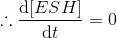
![DESH T = k1[EH][S] – (k-1 +km)[ESH] = 0 at](http://img.homeworklib.com/questions/74bd7530-e45c-11eb-b029-295ab840f9eb.png?x-oss-process=image/resize,w_560)
![.. ki[EH] S1 = (k_1 + k) [ESH](http://img.homeworklib.com/questions/7514ad90-e45c-11eb-9390-e5a6260adcb2.png?x-oss-process=image/resize,w_560)
![::EH - (k-1 + k2) ESH ki[S]](http://img.homeworklib.com/questions/756d9c70-e45c-11eb-abe0-e969cd3d4fd4.png?x-oss-process=image/resize,w_560)
Now, let

![KMESH :: EH] =-](http://img.homeworklib.com/questions/7609d420-e45c-11eb-ae5a-1bbd47ae1370.png?x-oss-process=image/resize,w_560)
Therefore, we have,
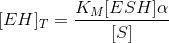
![KMα :. [E] = [ESH] - + β)](http://img.homeworklib.com/questions/76b33660-e45c-11eb-9f88-37e1e8dc5f20.png?x-oss-process=image/resize,w_560)
Now, the initial rate is given by

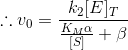
![k2 E ::00 = KM + [S]](http://img.homeworklib.com/questions/77ac5f40-e45c-11eb-9cfa-c52703424538.png?x-oss-process=image/resize,w_560)
Let

and

where, 
Thus, substituting back into the above equation gives the modified Michaelis-Menten equation as follows:
![Vma: [S] 00 KM + (S)](http://img.homeworklib.com/questions/78f2e7a0-e45c-11eb-9597-e9bc99a8d30e.png?x-oss-process=image/resize,w_560)
Add Answer to:
8. Enzymes often exhibit pH-dependent activity due to protonation/deprotonation of key amino acids. A general schematic...
Most questions answered within 3 hours.
-
Where is the error in this code sequence?
String s1 = "Hello";
String s2 = "ello";...
asked 10 months ago -
Financial data for Joel de Paris, Inc., for last year
follow:
Joel de Paris, Inc.
Balance...
asked 10 months ago -
Consider this reaction:
Al2(SO4)3 (aq)+ BaCl3
(aq) Al2Cl6 (aq)- +
3BaSO4(s) . What is the...
asked 10 months ago -
Suppose that Savneet is considering increasing her
recent random sample from 20 car rentals to 40...
asked 10 months ago -
Trucks arrive at an unloading terminal at an average rate of 120
per hour.
Trucks arrive...
asked 10 months ago -
Why are methanol and ethanol completely soluble in water while
octanol is not very little soluble....
asked 10 months ago -
A facilities manager at a university reads in a research report
that the mean amount of...
asked 10 months ago -
When the CuSO4 is rehydrated by adding water to the anhydrous
compound, is this an endothermic...
asked 10 months ago -
A ray of sunlight is passing from diamond into crown glass; the
angle of incidence is...
asked 10 months ago -
A block of mass 0.249 kg is placed on top of a light, vertical
spring of...
asked 10 months ago -
how do the kidneys compensate in the presences of acidosis
a) trigger hyperventilate
b) reserve acid...
asked 10 months ago -
Question 501 pts
The rental rate of capital to the firm increases. Which of the
following...
asked 10 months ago