
Homework Answers

Add Answer to:
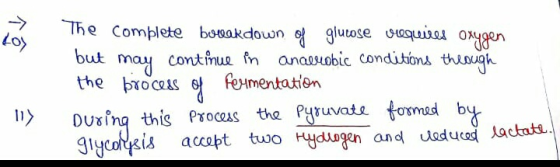
| ATP hydrogen lactate oxygen water anaerobic fermentation NAD+ aerobic pyruvate but may continue in 10....
The figures below show the two different types of anaerobic respiration: alcoholic fermentation (left) and lactate...
 The figures below show the two different types of anaerobic respiration: alcoholic fermentation (left) and lactate fermentation (right). Read the descriptions in the table that follows, and then select whether each statement describes alcoholic fermentation, lactate fermentation, or both. Check all that apply. COCO glucose 2 NAD GOGOGG glucose 2 NAD+ 2 NADH NADH OG @CC pyruvate COO Co pyruvate Glycolysis Glycolysis Alcoholic Fermentation 200, Lactate Fermentation 2 NADH Сс NAD аа acetaldehyde NADH lactate 2 NAD © ethanol Alcoholic...
- Attempt 1 ar Respiration and fermentation summary ③ 3 ott Part C - Fermentation -...
 - Attempt 1 ar Respiration and fermentation summary ③ 3 ott Part C - Fermentation - ATP production in the absence of oxygen Under anaerobic conditions (a lack of oxygen), glycolysis continues in most cells deste the fact that oxidative phosphorylation stops and its production of NAD (which is needed as an input to glycolysis) also stops. The diagram Vlustrates the process of fermentation which is used by many cols in the absence of oxygen In fermentation, the NADH produced...
What is the net yield of NADH when 26 moles of glucose are used to form...
What is the net yield of NADH when 26 moles of glucose are used to form pyruvate during glycolysis and the pyruvate is reduced during fermentation? If a bacterial cell capable of aerobic respiration and fermentation has no oxygen available, which metabolic process could be used to regenerate NAD+ so glycolysis can continue producing ATP? Aerobic Respiration Glyoxylate Pathway Pentose 5 Phosphate Pathwway Fermentation Anaerobic Respiration Which biochemical process puts electrons back on the same carbon source they came from?...
In skeletal muscle under anaerobic conditions, pyruvate is further reduced to lactate. What is the net...
In skeletal muscle under anaerobic conditions, pyruvate is further reduced to lactate. What is the net equation for the payoff phase of glycolysis? glyceraldehyde-3-phosphate + 2 ATP + Pi ---> lactone + NAD+ glucose+2ATP ---> 2Glyceraldehyde-3-Phosphate + 2ADP + 2H+ 2glyceraldehyde-3-phosphate + 4ADP + 2Pi >2Lactate + 4ATP None of the above
Categorize the following: Aerobic respiration, Anaerobic respiration, Fermentation, None of these .Assume in all cases that...
Categorize the following: Aerobic respiration, Anaerobic respiration, Fermentation, None of these .Assume in all cases that these processes follow breakdown of glucose by glycolysis. Results in complete oxidation of glucose to CO2 Involves regeneration of reduced co-factors (e.g. regenerating NAD+ from NADH) Generates energy by substrate level phosphorylation only Generates ATP by oxidative phosphorylation Utilizes an electron transport chain Uses molecules such as NO3 - , SO4 2- , or Fe3+ as terminal electron acceptors Products include organic acids, alcohols,...
11) (a) During fermentation, cells generate ATP via...circle all that apply Electron Transport Chain or Citric...
 11) (a) During fermentation, cells generate ATP via...circle all that apply Electron Transport Chain or Citric Acid Cycle or Glycolysis (b) If a cell ran out of NAD", then would that cell be able to continue performing glycolysis? If you say "no", then identify the specific step of glycolysis (draw it) that requires NAD. (c) During aerobic respiration, NAD* is regenerated when NADH donates its H atom to the electron transport chain. Explain how NAD is regenerated during fermentation. (d)...
Stage 2: Monosaccharide Degradation to Acetyl CoA (Glycolysis + Pyruvate Conversion) Pyruvate: Aerobic and Anaerobic Conversion...
 Stage 2: Monosaccharide Degradation to Acetyl CoA (Glycolysis + Pyruvate Conversion) Pyruvate: Aerobic and Anaerobic Conversion 1. Define what it means for a biochemical reaction to be aerobic vs. anaerobic. List what pyruvate will be converted to under each set of conditions. Conditions Definition Pyruvate Conversion Product aerobic anaerobic 2. In the space below, write the coupled reaction for the aerobic conversion of pyruvate, labeling the name of each reactant and product in the reaction. 3. Even though oxygen is...
3 20 The conversion pyruvate to either ethanol or lactate occurs A. when there is an abundance of pyruvate but a deficiency of onygen B. when there is an abundance of BOTH pyruvate and oxygen C....
 3 20 The conversion pyruvate to either ethanol or lactate occurs A. when there is an abundance of pyruvate but a deficiency of onygen B. when there is an abundance of BOTH pyruvate and oxygen C. when there is a deficiency of BOTH pyruvate and oxygen D. for the regeneration of NADH so that hydrolysis of ATP can continue to fuel the glycolysis pathway Explain how gluconeogenesis differs from gtycolysis 21 Gluconeogenesis is simply the reverse of all 10 steps...
gets reduced 20. glucose + ATP > glucose-6 phosphate +ADP In the above reaction, - A....
 gets reduced 20. glucose + ATP > glucose-6 phosphate +ADP In the above reaction, - A. ADPIATP B. ATP/glucose C. glucose/glucose-6 phosphate D. glucose6-phosphate/glucose E. glucose/ATP 21. Which of the following is a net product of glycolysis? A. ATP B. NAD+ C. pyruvate D. CO2 E. A&C 22. Substrate-level phosphorylation occurs in the process of A. Oxidative phosphorylation B. electron transport chain C. glycolysis D. ATP-synthase function E. C&D 23. What should your hypothesis be for "Do yeast produce ethanol...
Select ALL of the statements that correctly describe the Krebs cycle. A. Pyruvic acid must be...
Select ALL of the statements that correctly describe the Krebs cycle. A. Pyruvic acid must be converted to acetyl CoA prior to entering the cycle B. The molecule oxaloacetic acid picks up the acetyl group from acetylCoA, and in the last step of the cycle, oxaloacetic acid is regenerated. C. Electrons removed during oxidation steps are picked up by NAD or FAD. D. Each turn of the cycle generates one ATP molecule for a total of two per molecule of...
 The figures below show the two different types of anaerobic respiration: alcoholic fermentation (left) and lactate fermentation (right). Read the descriptions in the table that follows, and then select whether each statement describes alcoholic fermentation, lactate fermentation, or both. Check all that apply. COCO glucose 2 NAD GOGOGG glucose 2 NAD+ 2 NADH NADH OG @CC pyruvate COO Co pyruvate Glycolysis Glycolysis Alcoholic Fermentation 200, Lactate Fermentation 2 NADH Сс NAD аа acetaldehyde NADH lactate 2 NAD © ethanol Alcoholic...
 - Attempt 1 ar Respiration and fermentation summary ③ 3 ott Part C - Fermentation - ATP production in the absence of oxygen Under anaerobic conditions (a lack of oxygen), glycolysis continues in most cells deste the fact that oxidative phosphorylation stops and its production of NAD (which is needed as an input to glycolysis) also stops. The diagram Vlustrates the process of fermentation which is used by many cols in the absence of oxygen In fermentation, the NADH produced...
 11) (a) During fermentation, cells generate ATP via...circle all that apply Electron Transport Chain or Citric Acid Cycle or Glycolysis (b) If a cell ran out of NAD", then would that cell be able to continue performing glycolysis? If you say "no", then identify the specific step of glycolysis (draw it) that requires NAD. (c) During aerobic respiration, NAD* is regenerated when NADH donates its H atom to the electron transport chain. Explain how NAD is regenerated during fermentation. (d)...
 Stage 2: Monosaccharide Degradation to Acetyl CoA (Glycolysis + Pyruvate Conversion) Pyruvate: Aerobic and Anaerobic Conversion 1. Define what it means for a biochemical reaction to be aerobic vs. anaerobic. List what pyruvate will be converted to under each set of conditions. Conditions Definition Pyruvate Conversion Product aerobic anaerobic 2. In the space below, write the coupled reaction for the aerobic conversion of pyruvate, labeling the name of each reactant and product in the reaction. 3. Even though oxygen is...
 3 20 The conversion pyruvate to either ethanol or lactate occurs A. when there is an abundance of pyruvate but a deficiency of onygen B. when there is an abundance of BOTH pyruvate and oxygen C. when there is a deficiency of BOTH pyruvate and oxygen D. for the regeneration of NADH so that hydrolysis of ATP can continue to fuel the glycolysis pathway Explain how gluconeogenesis differs from gtycolysis 21 Gluconeogenesis is simply the reverse of all 10 steps...
 gets reduced 20. glucose + ATP > glucose-6 phosphate +ADP In the above reaction, - A. ADPIATP B. ATP/glucose C. glucose/glucose-6 phosphate D. glucose6-phosphate/glucose E. glucose/ATP 21. Which of the following is a net product of glycolysis? A. ATP B. NAD+ C. pyruvate D. CO2 E. A&C 22. Substrate-level phosphorylation occurs in the process of A. Oxidative phosphorylation B. electron transport chain C. glycolysis D. ATP-synthase function E. C&D 23. What should your hypothesis be for "Do yeast produce ethanol...
Most questions answered within 3 hours.
-
Where is the error in this code sequence?
String s1 = "Hello";
String s2 = "ello";...
asked 11 months ago -
Financial data for Joel de Paris, Inc., for last year
follow:
Joel de Paris, Inc.
Balance...
asked 11 months ago -
Consider this reaction:
Al2(SO4)3 (aq)+ BaCl3
(aq) Al2Cl6 (aq)- +
3BaSO4(s) . What is the...
asked 11 months ago -
Suppose that Savneet is considering increasing her
recent random sample from 20 car rentals to 40...
asked 11 months ago -
Trucks arrive at an unloading terminal at an average rate of 120
per hour.
Trucks arrive...
asked 11 months ago -
Why are methanol and ethanol completely soluble in water while
octanol is not very little soluble....
asked 11 months ago -
A facilities manager at a university reads in a research report
that the mean amount of...
asked 11 months ago -
When the CuSO4 is rehydrated by adding water to the anhydrous
compound, is this an endothermic...
asked 11 months ago -
A ray of sunlight is passing from diamond into crown glass; the
angle of incidence is...
asked 11 months ago -
A block of mass 0.249 kg is placed on top of a light, vertical
spring of...
asked 11 months ago -
how do the kidneys compensate in the presences of acidosis
a) trigger hyperventilate
b) reserve acid...
asked 11 months ago -
Question 501 pts
The rental rate of capital to the firm increases. Which of the
following...
asked 11 months ago