 1)
1)
2) If the total enzyme concentration was 9 nmol/Lnmol/L, how many molecules of substrate can a molecule of enzyme process in each minute?
Express your answer to three significant figures.
3) The kcat for neuraminidase at pH=6.15pH=6.15, 37 ∘C∘C is 26.8 s−1s−1. Calculate KMKM for the hydrolysis of sialic acid.
Express your answer with the appropriate units.
Homework Answers
Add Answer to:
1)
2) If the total enzyme concentration was 9 nmol/Lnmol/L, how
many molecules of substrate can...
Part A An enzyme that follows Michaelis-Menten kinetics has a KM value of 10.0 uM and...
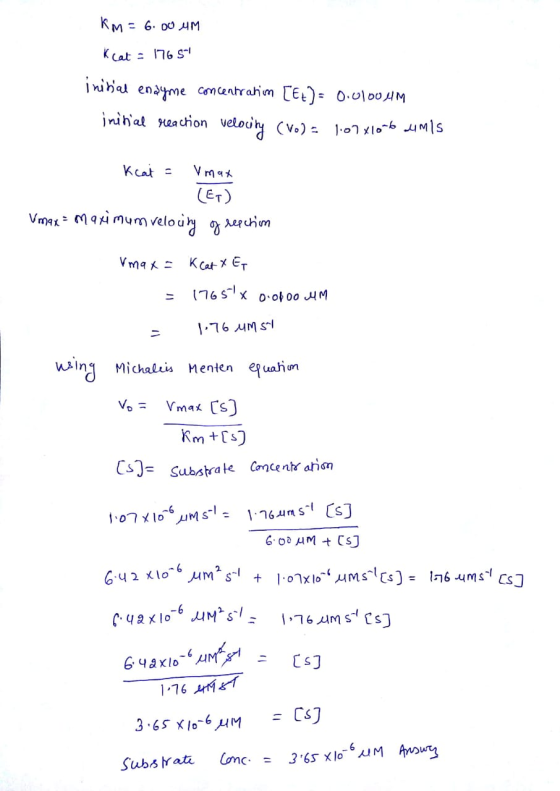
 Part A An enzyme that follows Michaelis-Menten kinetics has a KM value of 10.0 uM and a kcat value of 201 s-1. At an initial enzyme concentration of 0.0100 uM, the initial reaction velocity was found to be 1.07 x 10- uM/s. What was the initial concentration of the substrate, [S], used in the reaction ? Express your answer in micromolar to three significant figures. ► View Available Hint(s) PO ALO O O ? [S]; = MM UM
An enzyme that follows Michaelis-Menten kinetics has a KM value of 20.0 μM and a kcat...
An enzyme that follows Michaelis-Menten kinetics has a KM value of 20.0 μM and a kcat value of 211 s−1. At an initial enzyme concentration of 0.0100 μM, the initial reaction velocity was found to be 1.07×10⁻⁶ μM/s. What was the initial concentration of the substrate, [S], used in the reaction ? Express your answer in micromolar to three significant figures.
In kinetics experiments, the hydrolysis of the substrate sialic acid by neuraminidase appears to obey Michaelis–Menten...
In kinetics experiments, the hydrolysis of the substrate sialic acid by neuraminidase appears to obey Michaelis–Menten kinetics. Neuraminidase activity is critical for viral infectivity; thus, this enzyme is the target of much work by pharmaceutical companies to develop a drug to treat influenza virus infection. The drug “Tamiflu” is a competitive inhibitor of neuraminidase. Initial rate data collected at pH=6.15, 37 ∘C with 0.021 μM neuraminidase and 25.0 μM sialic acid gives a Lineweaver–Burk plot with a slope of 51.2...
To determine the kinetic characteristics of an enzyme you used 1 nmol/L of enzyme in a...
To determine the kinetic characteristics of an enzyme you used 1 nmol/L of enzyme in a series of assays where you measured the rate of reactions as you varied the concentration of substrate in each assay (Table A). Estimate from a Michaelis-Menten plot approximate values for Vmax, KM, Kcat, and the specificity constant for this enzyme and substrate. (The only information that is given is this paragraph and the table below). Table 1: [S] (μM) v (μmol/L/min) 0 0 5...
A single-substrate enzyme that obeys Michaelis-Menten kinetics displays the following parameters: Kd = 3.1 x 10^-5...
A single-substrate enzyme that obeys Michaelis-Menten kinetics displays the following parameters: Kd = 3.1 x 10^-5 M; k1 = 107 M-1 s-1, and kcat = 10^4 s-1. Given this information, what is the value of the Michaelis constant Km? Express your answer in terms of mM to four significant figures.
An enzyme that follows Michaelis-Menten kinetics has a initial velocity of 300 nM/s at a substrate...
 An enzyme that follows Michaelis-Menten kinetics has a initial velocity of 300 nM/s at a substrate concentration of 30 uM. The maximum velocity of 400 nM/sec. What is the Km for this enzyme in uM? (Give your answer as a number only. Type your response
Consider the enzyme-catalyzed reaction with Vmax=164 (μmol/L)min−1 and KM=32μmol/L. Part A If the total enzyme concentration...
Consider the enzyme-catalyzed reaction with Vmax=164 (μmol/L)min−1 and KM=32μmol/L. Part A If the total enzyme concentration was 6 nmol/L, how many molecules of substrate can a molecule of enzyme process in each minute? Express your answer to three significant figures. kcat kcat = 2.73×10⁴ min−1 Part B Calculate kcat/KM for the enzyme reaction.
For her undergraduate project, Jessica studied an enzyme that catalyzes the reaction A B. For substrate...
 For her undergraduate project, Jessica studied an enzyme that catalyzes the reaction A B. For substrate A, she determined 30 min that Km 3.0 HM and kcat Jessica graduated and her project has been passed on to you. Unfortunately, Jessica was so busy that she sometimes forgot to record all of the details of an assay in her lab notebook. Your mentor suggests that you try to back calculate some of the missing concentration values. Assume that the enzyme follows...
For her undergraduate project, Jessica studied an enzyme that catalyzes the reaction A↽−−⇀B. For substrate A,...
For her undergraduate project, Jessica studied an enzyme that catalyzes the reaction A↽−−⇀B. For substrate A, she determined that ?m=2.5 μM and ?cat=35 min−1. Jessica graduated and her project has been passed on to you. Unfortunately, Jessica was so busy that she sometimes forgot to record all of the details of an assay in her lab notebook. Your mentor suggests that you try to back calculate some of the missing concentration values. Assume that the enzyme follows Michaelis–Menten kinetics. 1)...
help with these please The turnover number is defined as the maximum number of substrate molecules...
 help with these please
The turnover number is defined as the maximum number of substrate molecules that can be converted into product molecules per unit time by an enzyme molecule. The concentration of enzyme active sites is not necessarily equal to the concentration of enzyme molecules, because some enzyme molecules have more than one active site. If the enzyme molecule has one active site, the turnover number is given by turnover number = - -=k2 (Rmax is often written as...
help with these please
The turnover number is defined as the maximum number of substrate molecules that can be converted into product molecules per unit time by an enzyme molecule. The concentration of enzyme active sites is not necessarily equal to the concentration of enzyme molecules, because some enzyme molecules have more than one active site. If the enzyme molecule has one active site, the turnover number is given by turnover number = - -=k2 (Rmax is often written as...
 Part A An enzyme that follows Michaelis-Menten kinetics has a KM value of 10.0 uM and a kcat value of 201 s-1. At an initial enzyme concentration of 0.0100 uM, the initial reaction velocity was found to be 1.07 x 10- uM/s. What was the initial concentration of the substrate, [S], used in the reaction ? Express your answer in micromolar to three significant figures. ► View Available Hint(s) PO ALO O O ? [S]; = MM UM
 An enzyme that follows Michaelis-Menten kinetics has a initial velocity of 300 nM/s at a substrate concentration of 30 uM. The maximum velocity of 400 nM/sec. What is the Km for this enzyme in uM? (Give your answer as a number only. Type your response
 For her undergraduate project, Jessica studied an enzyme that catalyzes the reaction A B. For substrate A, she determined 30 min that Km 3.0 HM and kcat Jessica graduated and her project has been passed on to you. Unfortunately, Jessica was so busy that she sometimes forgot to record all of the details of an assay in her lab notebook. Your mentor suggests that you try to back calculate some of the missing concentration values. Assume that the enzyme follows...
 help with these please
The turnover number is defined as the maximum number of substrate molecules that can be converted into product molecules per unit time by an enzyme molecule. The concentration of enzyme active sites is not necessarily equal to the concentration of enzyme molecules, because some enzyme molecules have more than one active site. If the enzyme molecule has one active site, the turnover number is given by turnover number = - -=k2 (Rmax is often written as...
help with these please
The turnover number is defined as the maximum number of substrate molecules that can be converted into product molecules per unit time by an enzyme molecule. The concentration of enzyme active sites is not necessarily equal to the concentration of enzyme molecules, because some enzyme molecules have more than one active site. If the enzyme molecule has one active site, the turnover number is given by turnover number = - -=k2 (Rmax is often written as...
Most questions answered within 3 hours.
-
Where is the error in this code sequence?
String s1 = "Hello";
String s2 = "ello";...
asked 10 months ago -
Financial data for Joel de Paris, Inc., for last year
follow:
Joel de Paris, Inc.
Balance...
asked 10 months ago -
Consider this reaction:
Al2(SO4)3 (aq)+ BaCl3
(aq) Al2Cl6 (aq)- +
3BaSO4(s) . What is the...
asked 10 months ago -
Suppose that Savneet is considering increasing her
recent random sample from 20 car rentals to 40...
asked 10 months ago -
Trucks arrive at an unloading terminal at an average rate of 120
per hour.
Trucks arrive...
asked 10 months ago -
Why are methanol and ethanol completely soluble in water while
octanol is not very little soluble....
asked 10 months ago -
A facilities manager at a university reads in a research report
that the mean amount of...
asked 10 months ago -
When the CuSO4 is rehydrated by adding water to the anhydrous
compound, is this an endothermic...
asked 10 months ago -
A ray of sunlight is passing from diamond into crown glass; the
angle of incidence is...
asked 10 months ago -
A block of mass 0.249 kg is placed on top of a light, vertical
spring of...
asked 10 months ago -
how do the kidneys compensate in the presences of acidosis
a) trigger hyperventilate
b) reserve acid...
asked 10 months ago -
Question 501 pts
The rental rate of capital to the firm increases. Which of the
following...
asked 10 months ago