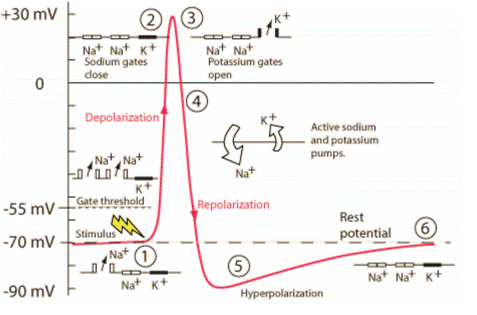
Question 2: Explain what is occurring in this graph:
Homework Answers
The picture is representing the action potential in the membrane:
First of all, the membrane is at resting stage or we can say that it is polarised having -70mV.
* Depolarisation: The voltage gated sodium channel opens. This leads to change the potential of membrane from -70 to +30 mV.
* Repolarisation: The sodium channel is closedclosed and potassium gate open. This leads to change the potential from +30 to 0.
After that the potassium channel is activated. It transports potassium ion outside the membrane.This reduces the membrane potential to the -70 mV
* Hyper polarising: The more potassiuk ion moves outside and reduces the membrane potential to the -90 mV in hyper polarising pahse.
Then again the resting potential is achieved.
Add Answer to:
Question 2: Explain what is occurring in this graph:
+30 mv Nat Nat K+ Sodium gates...
Question 1: Draw, label, and explain the anatomical and physiological differences between a multipolar, bipolar and...
 Question 1: Draw, label, and explain the anatomical and physiological differences between a multipolar, bipolar and unipolar neuron. Be sure to include soma, axon, and dendrite(s) in your explanation image. Question 2: Explain what is occurring in this graph: +30 mV E mv 23 K Nat Nat kt Sodium gates dose Nat Nat Potassium gates open Depolarization Active sodium and potassium pumps Nyt 10 -55 mySeteteshold Repolarization Rest potential -70 myStimulus NS (1 Not Na+ K+ -90 mV Hyperpolarization Question...
Question 4 2 pts During and action potential, sodium (Na+) rushes into the cell causing of...
 Question 4 2 pts During and action potential, sodium (Na+) rushes into the cell causing of the cell. Then sodium channels close and potassium (K+) rushes out of the cell, causing of the cell. However, the potassium overshoots and causes Question 5 2 pts During the refractory period, the pumps Na+ ions out of the cell and K+ions into the cell, re-establishing the resting membrane potential and concentration gradient. Serotonin Acetylcholine Glutamate Endorphins Barbiturates GABA Dopamine Cocaine Sodium Potassium Calcium...
2. Neuron during an action potential: a. What triggers the first action potential (which ion)? b....
 2. Neuron during an action potential: a. What triggers the first action potential (which ion)? b. What is the typical threshold potential of a neuron? c. The calculated equilibrium potential of Na+ (EN) is approx. +60mV (calculated). Explain how this is related to the rising phase of an action potential (depolarization). d. The calculated equilibrium potential of K+ (EK) is approx. -90mV. Explain how this is related to the falling phase (repolarization). e. Direction of Nation movement (influx/efflux). f. Direction...
change pas channels in the volta t ive protein to change shape. This A of the...
 change pas channels in the volta t ive protein to change shape. This A of the S l e terminal siste oplasmic reticum calcio p r eneule warcoplasm reticulum sodium ions m o nster transverse tubules sarcolemma: calcium ions Saroplasmic reticum: triadsarcolemma: calcium ions sons bind to This causes a change in shape and exposing C D E Calcium vesicle tylcholine action potential Sodium sarcolemma calcium on myosin heads Sodium sacoplasmic reticulum calcium ions actin 15. An attaches to exposed...
1. According to the paper, what does lactate dehydrogenase (LDH) do and what does it allow...
 1. According to the paper, what does lactate dehydrogenase
(LDH) do and what does it allow to happen within the myofiber? (5
points)
2. According to the paper, what is the major disadvantage of
relying on glycolysis during high-intensity exercise? (5
points)
3. Using Figure 1 in the paper, briefly describe the different
sources of ATP production at 50% versus 90% AND explain whether you
believe this depiction of ATP production applies to a Type IIX
myofiber in a human....
1. According to the paper, what does lactate dehydrogenase
(LDH) do and what does it allow to happen within the myofiber? (5
points)
2. According to the paper, what is the major disadvantage of
relying on glycolysis during high-intensity exercise? (5
points)
3. Using Figure 1 in the paper, briefly describe the different
sources of ATP production at 50% versus 90% AND explain whether you
believe this depiction of ATP production applies to a Type IIX
myofiber in a human....
1. Oral acetaminophen has been ordered for a young child who has a fever. A liquid...
 1. Oral acetaminophen has been ordered for a young child who has a fever. A liquid form has been obtained by the nurse to increase the chance of problem free administration. Prior to administration, the nurse is going through the rights of medication administration. When confirming the right dose, what term is the most appropriate? a. "160 mg" b. "one teaspoon" c. "one third of a tablespoon d. "SmL 2. A pregnant woman asks why she needs to take a...
10. Write a one-page summary of the attached paper? INTRODUCTION Many problems can develop in activated...
10. Write a one-page summary of the attached paper? INTRODUCTION Many problems can develop in activated sludge operation that adversely affect effluent quality with origins in the engineering, hydraulic and microbiological components of the process. The real "heart" of the activated sludge system is the development and maintenance of a mixed microbial culture (activated sludge) that treats wastewater and which can be managed. One definition of a wastewater treatment plant operator is a "bug farmer", one who controls the aeration...
 Question 1: Draw, label, and explain the anatomical and physiological differences between a multipolar, bipolar and unipolar neuron. Be sure to include soma, axon, and dendrite(s) in your explanation image. Question 2: Explain what is occurring in this graph: +30 mV E mv 23 K Nat Nat kt Sodium gates dose Nat Nat Potassium gates open Depolarization Active sodium and potassium pumps Nyt 10 -55 mySeteteshold Repolarization Rest potential -70 myStimulus NS (1 Not Na+ K+ -90 mV Hyperpolarization Question...
 Question 4 2 pts During and action potential, sodium (Na+) rushes into the cell causing of the cell. Then sodium channels close and potassium (K+) rushes out of the cell, causing of the cell. However, the potassium overshoots and causes Question 5 2 pts During the refractory period, the pumps Na+ ions out of the cell and K+ions into the cell, re-establishing the resting membrane potential and concentration gradient. Serotonin Acetylcholine Glutamate Endorphins Barbiturates GABA Dopamine Cocaine Sodium Potassium Calcium...
 2. Neuron during an action potential: a. What triggers the first action potential (which ion)? b. What is the typical threshold potential of a neuron? c. The calculated equilibrium potential of Na+ (EN) is approx. +60mV (calculated). Explain how this is related to the rising phase of an action potential (depolarization). d. The calculated equilibrium potential of K+ (EK) is approx. -90mV. Explain how this is related to the falling phase (repolarization). e. Direction of Nation movement (influx/efflux). f. Direction...
 change pas channels in the volta t ive protein to change shape. This A of the S l e terminal siste oplasmic reticum calcio p r eneule warcoplasm reticulum sodium ions m o nster transverse tubules sarcolemma: calcium ions Saroplasmic reticum: triadsarcolemma: calcium ions sons bind to This causes a change in shape and exposing C D E Calcium vesicle tylcholine action potential Sodium sarcolemma calcium on myosin heads Sodium sacoplasmic reticulum calcium ions actin 15. An attaches to exposed...
 1. According to the paper, what does lactate dehydrogenase
(LDH) do and what does it allow to happen within the myofiber? (5
points)
2. According to the paper, what is the major disadvantage of
relying on glycolysis during high-intensity exercise? (5
points)
3. Using Figure 1 in the paper, briefly describe the different
sources of ATP production at 50% versus 90% AND explain whether you
believe this depiction of ATP production applies to a Type IIX
myofiber in a human....
1. According to the paper, what does lactate dehydrogenase
(LDH) do and what does it allow to happen within the myofiber? (5
points)
2. According to the paper, what is the major disadvantage of
relying on glycolysis during high-intensity exercise? (5
points)
3. Using Figure 1 in the paper, briefly describe the different
sources of ATP production at 50% versus 90% AND explain whether you
believe this depiction of ATP production applies to a Type IIX
myofiber in a human....
 1. Oral acetaminophen has been ordered for a young child who has a fever. A liquid form has been obtained by the nurse to increase the chance of problem free administration. Prior to administration, the nurse is going through the rights of medication administration. When confirming the right dose, what term is the most appropriate? a. "160 mg" b. "one teaspoon" c. "one third of a tablespoon d. "SmL 2. A pregnant woman asks why she needs to take a...
Most questions answered within 3 hours.
-
Where is the error in this code sequence?
String s1 = "Hello";
String s2 = "ello";...
asked 10 months ago -
Financial data for Joel de Paris, Inc., for last year
follow:
Joel de Paris, Inc.
Balance...
asked 10 months ago -
Consider this reaction:
Al2(SO4)3 (aq)+ BaCl3
(aq) Al2Cl6 (aq)- +
3BaSO4(s) . What is the...
asked 10 months ago -
Suppose that Savneet is considering increasing her
recent random sample from 20 car rentals to 40...
asked 10 months ago -
Trucks arrive at an unloading terminal at an average rate of 120
per hour.
Trucks arrive...
asked 10 months ago -
Why are methanol and ethanol completely soluble in water while
octanol is not very little soluble....
asked 10 months ago -
A facilities manager at a university reads in a research report
that the mean amount of...
asked 10 months ago -
When the CuSO4 is rehydrated by adding water to the anhydrous
compound, is this an endothermic...
asked 10 months ago -
A ray of sunlight is passing from diamond into crown glass; the
angle of incidence is...
asked 10 months ago -
A block of mass 0.249 kg is placed on top of a light, vertical
spring of...
asked 10 months ago -
how do the kidneys compensate in the presences of acidosis
a) trigger hyperventilate
b) reserve acid...
asked 10 months ago -
Question 501 pts
The rental rate of capital to the firm increases. Which of the
following...
asked 10 months ago