why is the total ATP generated from cellular respiration different for prokaryotes compared to eukaryotes?
Homework Answers
Question
The prokaryotes generate around 38 ATP during the cellular respiration whereas eukaryotes produce 36 ATP. So, there is only the difference of 2 ATP between prokaryotes and eukaryotes. The difference is because prokaryotes are without cellular organelle. In prokaryotes, all sub-process of cellular respiration take place in cytoplasm and plasma membrane whereas in eukaryotes cellular respiration take place in cytoplasm, mitochondria and mitochondrial membrane.
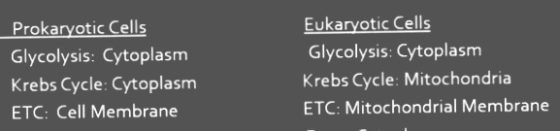
Figure: Comparison of the cellular location of three process include in cellular respiration.
So, in eukaryotes, NADH molecules produce during glycolysis go to mitochondria for Kreb's cycle that consume 2 ATP and therefore yields only 36 ATP whereaa prokaryotes produce 38 ATP.
Add Answer to:
why
is the total ATP generated from cellular respiration different for
prokaryotes compared to eukaryotes?
Cellular respiration in eukaryotes has the same purpose as fermentation in prokaryotes True False
Cellular respiration in eukaryotes has the same purpose as fermentation in prokaryotes True False
Why is respiration in prokaryotes more efficient than in eukaryotes?
Why is respiration in prokaryotes more efficient than in eukaryotes?
From the following which is true about cellular respiration (select all that apply) 1. In prokaryotes,...
From the following which is true about cellular respiration (select all that apply) 1. In prokaryotes, the electrons transport is in the plasma membrane 2. Prokaryotic fermentation net yield is 4 ATP and oxidative respiration has 32 ATP 3. The major regulatory enzyme of glycolysis is Hexokinase 4. Substrate-level phosphorylation is catalyzed by kinase and transfers the phosphate group from an intermediate in a metabolic pathway directly to a molecule of ADP
Which of the following is different between prokaryotes and eukaryotes? a Prokaryotes are polycistronic and eukaryotes...
Which of the following is different between prokaryotes and eukaryotes? a Prokaryotes are polycistronic and eukaryotes are monocistronic b Prokaryotes have more complex controls over gene expression than eukaryotes c mRNA only exists in eukaryotes. d DNA does exist in prokaryotes. 2. Do humans contain an 80s ribosome? True or False?
From the following which is true about cellular respiration (select all that apply) 1. In prokaryotes,...
From the following which is true about cellular respiration (select all that apply) 1. In prokaryotes, the electrons transport is in the plasma membrane 2. Prokaryotic fermentation net yield is 4 ATP and oxidative respiration has 32 ATP 3. The major regulatory enzyme of glycolysis is Hexokinase 4. Substrate-level phosphorylation is catalyzed by kinase and transfers the phosphate group from an intermediate in a metabolic pathway directly to a molecule of ADP B) Which statement is false about phosphate esters...
Chapter 5 (Cellular Respiration) With the aid of your notes and/or textbook, write the terms that...
 Chapter 5 (Cellular Respiration) With the aid of your notes and/or textbook, write the terms that correspond to the following definitions and descriptions Oxygen-requiring process that produces CO., H,0 and ATP. A series of enzyme catalyzed reactions that form pyruvate molecules from splitting glucose. Second stage of aerobic cellular respiration that produces CO, and electron camer molecules, and takes place in the mitochondrion. Type of cellular respiration that does not use oxygen in the production of ATP. Produces lactic acid...
What is the theoretical TOTAL yield of ATP per glucose molecule in the entire Cellular Respiration...
What is the theoretical TOTAL yield of ATP per glucose molecule in the entire Cellular Respiration process?
How many ATP are formed via cellular aerobic respiration? ATP from glycolysis and the citric cycle?...
How many ATP are formed via cellular aerobic respiration? ATP from glycolysis and the citric cycle? ATP from the electron transport chain?
True or False? Only eukaryotes need ATP to power their cells. True False Important: For this...
True or False? Only eukaryotes need ATP to power their cells. True False Important: For this question, there may be more than one answer, so check ALL that apply. Which statements are incorrect? In eukaryotic cells, photosynthesis occurs in chloroplasts. In eukaryotic cells, cellular respiration occurs in mitochondria. Cellular respiration and photosynthesis both produce ATP to power cellular work. Only heterotrophs perform cellular respiration. Photosynthesis produces sugars (glucose), which can then be used in cellular respiration to produce ATP.
What is the overall purpose of cellular respiration? to produce ATP by using the electrons from...
 What is the overall purpose of cellular respiration? to produce ATP by using the electrons from glucose to build the ATP molecule to produce ATP by using oxygen to build the ATP molecule to break down glucose and convert it into ATP to produce ATP using the energy from the oxidation of a glucose molecule
 Chapter 5 (Cellular Respiration) With the aid of your notes and/or textbook, write the terms that correspond to the following definitions and descriptions Oxygen-requiring process that produces CO., H,0 and ATP. A series of enzyme catalyzed reactions that form pyruvate molecules from splitting glucose. Second stage of aerobic cellular respiration that produces CO, and electron camer molecules, and takes place in the mitochondrion. Type of cellular respiration that does not use oxygen in the production of ATP. Produces lactic acid...
 What is the overall purpose of cellular respiration? to produce ATP by using the electrons from glucose to build the ATP molecule to produce ATP by using oxygen to build the ATP molecule to break down glucose and convert it into ATP to produce ATP using the energy from the oxidation of a glucose molecule
Most questions answered within 3 hours.
-
Where is the error in this code sequence?
String s1 = "Hello";
String s2 = "ello";...
asked 1 year ago -
Financial data for Joel de Paris, Inc., for last year
follow:
Joel de Paris, Inc.
Balance...
asked 1 year ago -
Consider this reaction:
Al2(SO4)3 (aq)+ BaCl3
(aq) Al2Cl6 (aq)- +
3BaSO4(s) . What is the...
asked 1 year ago -
Suppose that Savneet is considering increasing her
recent random sample from 20 car rentals to 40...
asked 1 year ago -
Trucks arrive at an unloading terminal at an average rate of 120
per hour.
Trucks arrive...
asked 1 year ago -
Why are methanol and ethanol completely soluble in water while
octanol is not very little soluble....
asked 1 year ago -
A facilities manager at a university reads in a research report
that the mean amount of...
asked 1 year ago -
When the CuSO4 is rehydrated by adding water to the anhydrous
compound, is this an endothermic...
asked 1 year ago -
A ray of sunlight is passing from diamond into crown glass; the
angle of incidence is...
asked 1 year ago -
A block of mass 0.249 kg is placed on top of a light, vertical
spring of...
asked 1 year ago -
how do the kidneys compensate in the presences of acidosis
a) trigger hyperventilate
b) reserve acid...
asked 1 year ago -
Question 501 pts
The rental rate of capital to the firm increases. Which of the
following...
asked 1 year ago