
Homework Answers
Answer 4) there are two parts of the plants that help in the circulation of nutrients across them, the two parts of the vascular system of the plants include the following :
1) xylem : The xylem mainly transports all the nutrients which are soluble in the water while
2) phloem : transports mainly protiens and sugars.
Answer5) Sinks are those areas or those parts of the plant that require food or some kind of nutrition. for eg the food or organic compounds of the plants like sugars are mainly stored in the stem part of the plant therefore when there is a shortage of these reserves in the plants ', those areas act like sinks and the areas from where these materials come via the phloem are known as the sources.
Answer 6) Adhesion and Cohesion of water is a common phenomenon that occurs in the plant.'
adhesion : happens when there is an attraction between the water molecule and the xylem, therefore whenever adhesion happens in a plants it actually aids in the the upward movement of water in the xylem
cohesion on the other hand means when the water molecules stick to one another.. this makes the water molecules (many of it ) act as a single unit/ single chain which also helps the xylem in the smooth pull of water,
Answer 7) root pressure is the process which actually acts as the main mechanism in the plant which makes the upward pull of water into the xylem.'
this root pressure gets build up in the plant near to the root due to the osmotic changes that happen there,
the root pressures could be built up in many other ways like whenever the environment is very hot (usually during the day time ) when the stomatas of the plants open, there is a deficiency of water above and greater concentration of water below in the roots which helps in the building up of the pressure that leads to the water uptake by the xylem'.
evaporation aids in the building up of the root pressures,'
i hope i was able to help you with the answers:)
Add Answer to:
4, 5, 6, and 7.
4. What sort of nutrients and minerals are transported through the...
Transpiration What is transported? In xylem or phloem? Direction of flow Cells involved (note alive or...
Transpiration What is transported? In xylem or phloem? Direction of flow Cells involved (note alive or dead, which plant groups have them, function) Tracheids: Vessel elements: Does this process require the plant to expend energy? Explain how movement is achieved (how does this work?)
7. Which of the following is seen in plants with self-fertilization? a. Each individual plant only...
7. Which of the following is seen in plants with self-fertilization? a. Each individual plant only produces either male or female flowers b. Male and female flowers are produced in different parts of the plant c. Male and female flowers are produced at different points in time d. Pollen tube is incompatible with stigma from the same plant e. Flower bud never opens, pollen flows directly to the stigma 8. Select one outcome that is NOT the result of the...
Please help with 1, 2, 3, 4 & 5 (Organisms to Ecosystems) 1. 2. 3. 4....
 Please help with 1, 2, 3, 4 & 5 (Organisms to
Ecosystems)
1.
2.
3.
4.
5.
What defines transpiration in plants? Water is absorbed into the roots through root hair. Carbon dioxide is absorbed through stomata Water is absorbed into the leaves through stomata Water is lost into the environment through stomata are removed, roots will no longer respond to gravity If cells in the root hairs secondary meristem Ozone of elongation root cap Ring-barking is a procedure that...
Please help with 1, 2, 3, 4 & 5 (Organisms to
Ecosystems)
1.
2.
3.
4.
5.
What defines transpiration in plants? Water is absorbed into the roots through root hair. Carbon dioxide is absorbed through stomata Water is absorbed into the leaves through stomata Water is lost into the environment through stomata are removed, roots will no longer respond to gravity If cells in the root hairs secondary meristem Ozone of elongation root cap Ring-barking is a procedure that...
QUESTION 1 Which of these statements is NOT correct? A. Endodermis requires energy to move nutrients...
 QUESTION 1
Which of these statements is NOT correct?
A.
Endodermis requires energy to move nutrients into vascular
cylinder of roots.
B.
Energy is required to make soil nutrients available to
roots.
C.
Plants spend energy to maintain their symbiotic relationship
with soil microorganisms.
D.
Root cells do not spend energy to transfer nutrients from soil
because their movement is powered by transpiration when water
enters the roots.
E.
All of the above statements are correct.
1 points
QUESTION...
QUESTION 1
Which of these statements is NOT correct?
A.
Endodermis requires energy to move nutrients into vascular
cylinder of roots.
B.
Energy is required to make soil nutrients available to
roots.
C.
Plants spend energy to maintain their symbiotic relationship
with soil microorganisms.
D.
Root cells do not spend energy to transfer nutrients from soil
because their movement is powered by transpiration when water
enters the roots.
E.
All of the above statements are correct.
1 points
QUESTION...
Please answer all Sugar is conducted in solution through specialized cells known as: A. fibers. B....
 Please answer all
Sugar is conducted in solution through specialized cells known as: A. fibers. B. companion cells. C. sieve tube dements. D. tracheids. E. vessels. Q.22. High squareroot pressure can cause water to be lost by leaves through the process of A) respiration B) regurgitation C) transpiration D) guttation E) translocation Q.23. Which of the following terms would be used to explain how trees can lift water to heights often more? A) air pressure B)adhesion C) cohesion D) tensile...
Please answer all
Sugar is conducted in solution through specialized cells known as: A. fibers. B. companion cells. C. sieve tube dements. D. tracheids. E. vessels. Q.22. High squareroot pressure can cause water to be lost by leaves through the process of A) respiration B) regurgitation C) transpiration D) guttation E) translocation Q.23. Which of the following terms would be used to explain how trees can lift water to heights often more? A) air pressure B)adhesion C) cohesion D) tensile...
3. Explain how phloem loading occurs (both mechanisms), what results, and how this causes the movement...
 3. Explain how phloem loading occurs (both mechanisms), what results, and how this causes the movement of water and sucrose through the phloem 4. Describe long-distance transport in phloem through the Munch pressure-flow model 5. Describe the process of phloem unloading. 6. Predict "source" vs. "sink" relationships in plant parts, given a description of environmental influences and metabolic status.
Using an insertion sort, sort the array 5, 7, 4, 9, 8, 6, 3 into ascending...
Using an insertion sort, sort the array 5, 7, 4, 9, 8, 6, 3 into ascending order. After the first swap, what will the array look like?
Bowen's Reaction Series Composition (2) Temperature (1) Minerals (7) (3) Tenperature (5) plagioclase (Ca-rich) ругохепe (4)...
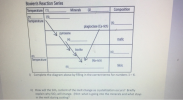 Bowen's Reaction Series Composition (2) Temperature (1) Minerals (7) (3) Tenperature (5) plagioclase (Ca-rich) ругохепe (4) mafic biotite (6) (8) Temperature (Na-rich) felsic (9) i) Complete the diagram above by filling in the correct terms for numbers 1-6 ii) How will the SiO2 content of the melt change as crystallization occurs? Briefly explain why SiO, will change. (Hint: what is going into the minerals and what stays in the melt during cooling?
Bowen's Reaction Series Composition (2) Temperature (1) Minerals...
Bowen's Reaction Series Composition (2) Temperature (1) Minerals (7) (3) Tenperature (5) plagioclase (Ca-rich) ругохепe (4) mafic biotite (6) (8) Temperature (Na-rich) felsic (9) i) Complete the diagram above by filling in the correct terms for numbers 1-6 ii) How will the SiO2 content of the melt change as crystallization occurs? Briefly explain why SiO, will change. (Hint: what is going into the minerals and what stays in the melt during cooling?
Bowen's Reaction Series Composition (2) Temperature (1) Minerals...
Sort the sequence of integers { 2 ,5 ,4 , 6 , 3, 7, 8, 1}...
Sort the sequence of integers { 2 ,5 ,4 , 6 , 3, 7, 8, 1} (show steps, do not write code) (20 points) Using Insertion Sort
2.1 Searching and Sorting- 5 points each 1. Run Heapsort on the following array: A (7,3, 9, 4, 2,5, 6, 1,8) 2. Run merge sort on the same array. 3. What is the worst case for quick sort? What is...
 2.1 Searching and Sorting- 5 points each 1. Run Heapsort on the following array: A (7,3, 9, 4, 2,5, 6, 1,8) 2. Run merge sort on the same array. 3. What is the worst case for quick sort? What is the worst case time com- plexity for quick sort and why? Explain what modifications we can make to quick sort to make it run faster, and why this helps. 4. Gi pseudocode for an algorithm that will solve the following...
 Please help with 1, 2, 3, 4 & 5 (Organisms to
Ecosystems)
1.
2.
3.
4.
5.
What defines transpiration in plants? Water is absorbed into the roots through root hair. Carbon dioxide is absorbed through stomata Water is absorbed into the leaves through stomata Water is lost into the environment through stomata are removed, roots will no longer respond to gravity If cells in the root hairs secondary meristem Ozone of elongation root cap Ring-barking is a procedure that...
Please help with 1, 2, 3, 4 & 5 (Organisms to
Ecosystems)
1.
2.
3.
4.
5.
What defines transpiration in plants? Water is absorbed into the roots through root hair. Carbon dioxide is absorbed through stomata Water is absorbed into the leaves through stomata Water is lost into the environment through stomata are removed, roots will no longer respond to gravity If cells in the root hairs secondary meristem Ozone of elongation root cap Ring-barking is a procedure that...
 QUESTION 1
Which of these statements is NOT correct?
A.
Endodermis requires energy to move nutrients into vascular
cylinder of roots.
B.
Energy is required to make soil nutrients available to
roots.
C.
Plants spend energy to maintain their symbiotic relationship
with soil microorganisms.
D.
Root cells do not spend energy to transfer nutrients from soil
because their movement is powered by transpiration when water
enters the roots.
E.
All of the above statements are correct.
1 points
QUESTION...
QUESTION 1
Which of these statements is NOT correct?
A.
Endodermis requires energy to move nutrients into vascular
cylinder of roots.
B.
Energy is required to make soil nutrients available to
roots.
C.
Plants spend energy to maintain their symbiotic relationship
with soil microorganisms.
D.
Root cells do not spend energy to transfer nutrients from soil
because their movement is powered by transpiration when water
enters the roots.
E.
All of the above statements are correct.
1 points
QUESTION...
 Please answer all
Sugar is conducted in solution through specialized cells known as: A. fibers. B. companion cells. C. sieve tube dements. D. tracheids. E. vessels. Q.22. High squareroot pressure can cause water to be lost by leaves through the process of A) respiration B) regurgitation C) transpiration D) guttation E) translocation Q.23. Which of the following terms would be used to explain how trees can lift water to heights often more? A) air pressure B)adhesion C) cohesion D) tensile...
Please answer all
Sugar is conducted in solution through specialized cells known as: A. fibers. B. companion cells. C. sieve tube dements. D. tracheids. E. vessels. Q.22. High squareroot pressure can cause water to be lost by leaves through the process of A) respiration B) regurgitation C) transpiration D) guttation E) translocation Q.23. Which of the following terms would be used to explain how trees can lift water to heights often more? A) air pressure B)adhesion C) cohesion D) tensile...
 3. Explain how phloem loading occurs (both mechanisms), what results, and how this causes the movement of water and sucrose through the phloem 4. Describe long-distance transport in phloem through the Munch pressure-flow model 5. Describe the process of phloem unloading. 6. Predict "source" vs. "sink" relationships in plant parts, given a description of environmental influences and metabolic status.
 Bowen's Reaction Series Composition (2) Temperature (1) Minerals (7) (3) Tenperature (5) plagioclase (Ca-rich) ругохепe (4) mafic biotite (6) (8) Temperature (Na-rich) felsic (9) i) Complete the diagram above by filling in the correct terms for numbers 1-6 ii) How will the SiO2 content of the melt change as crystallization occurs? Briefly explain why SiO, will change. (Hint: what is going into the minerals and what stays in the melt during cooling?
Bowen's Reaction Series Composition (2) Temperature (1) Minerals...
Bowen's Reaction Series Composition (2) Temperature (1) Minerals (7) (3) Tenperature (5) plagioclase (Ca-rich) ругохепe (4) mafic biotite (6) (8) Temperature (Na-rich) felsic (9) i) Complete the diagram above by filling in the correct terms for numbers 1-6 ii) How will the SiO2 content of the melt change as crystallization occurs? Briefly explain why SiO, will change. (Hint: what is going into the minerals and what stays in the melt during cooling?
Bowen's Reaction Series Composition (2) Temperature (1) Minerals...
 2.1 Searching and Sorting- 5 points each 1. Run Heapsort on the following array: A (7,3, 9, 4, 2,5, 6, 1,8) 2. Run merge sort on the same array. 3. What is the worst case for quick sort? What is the worst case time com- plexity for quick sort and why? Explain what modifications we can make to quick sort to make it run faster, and why this helps. 4. Gi pseudocode for an algorithm that will solve the following...
Most questions answered within 3 hours.
-
Where is the error in this code sequence?
String s1 = "Hello";
String s2 = "ello";...
asked 11 months ago -
Financial data for Joel de Paris, Inc., for last year
follow:
Joel de Paris, Inc.
Balance...
asked 11 months ago -
Consider this reaction:
Al2(SO4)3 (aq)+ BaCl3
(aq) Al2Cl6 (aq)- +
3BaSO4(s) . What is the...
asked 11 months ago -
Suppose that Savneet is considering increasing her
recent random sample from 20 car rentals to 40...
asked 11 months ago -
Trucks arrive at an unloading terminal at an average rate of 120
per hour.
Trucks arrive...
asked 11 months ago -
Why are methanol and ethanol completely soluble in water while
octanol is not very little soluble....
asked 11 months ago -
A facilities manager at a university reads in a research report
that the mean amount of...
asked 11 months ago -
When the CuSO4 is rehydrated by adding water to the anhydrous
compound, is this an endothermic...
asked 11 months ago -
A ray of sunlight is passing from diamond into crown glass; the
angle of incidence is...
asked 11 months ago -
A block of mass 0.249 kg is placed on top of a light, vertical
spring of...
asked 11 months ago -
how do the kidneys compensate in the presences of acidosis
a) trigger hyperventilate
b) reserve acid...
asked 11 months ago -
Question 501 pts
The rental rate of capital to the firm increases. Which of the
following...
asked 11 months ago