


Homework Answers
1.
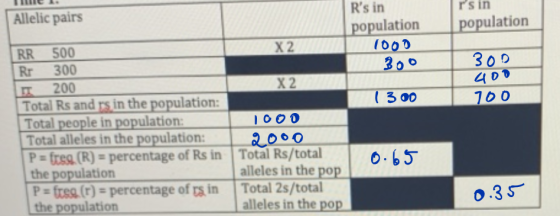
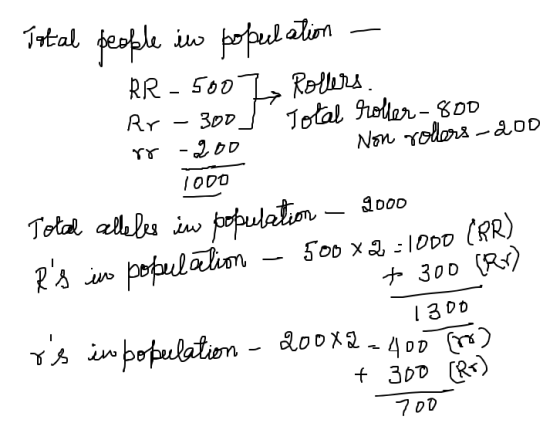
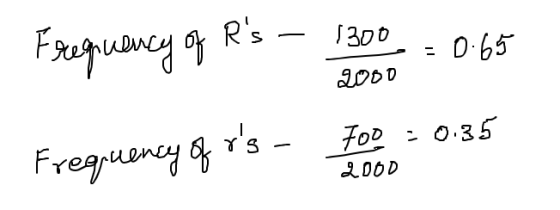
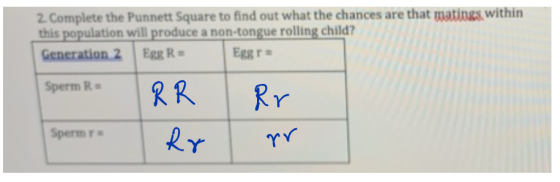
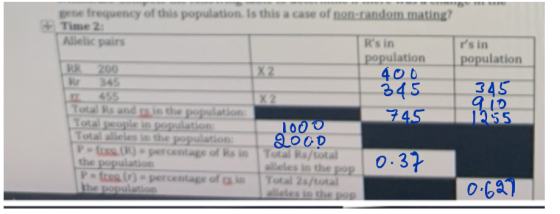
This is a case non-random mating because of selective mating of non-rollers must have resulted in inrease in the frequency of non-rollers.
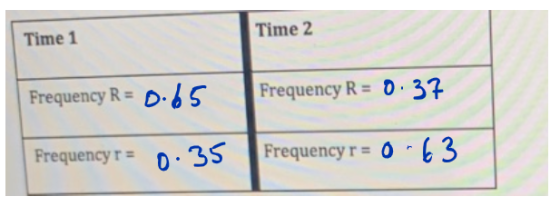
The genetic trend is way from tongue rolling. This is because the frequency of non-rollers is increases after 100 generations.
Add Answer to:
r's in population Genotype Frequency 1. Determine the number of tongue rollers in this population. Time...
I did 1-5 but confused on the rest LAB EXERCISE 4.1 continued Name 6 Remember that...
 I did 1-5 but confused on the rest
LAB EXERCISE 4.1 continued Name 6 Remember that the ability to taste PTC is dominant to the inability. Two normally pigmented taster parents have an albino, taster son and a non-taster daughter with normal pigmentation. Using A and Tand a and t for the dominant and recessive alleles, respectively, create a Punnett square for two traits, as shown on pages 71-73 in the section "Transmission of Autosomal Traits: Two at a Time."...
I did 1-5 but confused on the rest
LAB EXERCISE 4.1 continued Name 6 Remember that the ability to taste PTC is dominant to the inability. Two normally pigmented taster parents have an albino, taster son and a non-taster daughter with normal pigmentation. Using A and Tand a and t for the dominant and recessive alleles, respectively, create a Punnett square for two traits, as shown on pages 71-73 in the section "Transmission of Autosomal Traits: Two at a Time."...
i need some help with this lab ASAP please! HUMAN GENETICS It to study because of...
 i need some help with this lab ASAP please!
HUMAN GENETICS It to study because of the relatively long life span and the limited number In addition, the number of chromosome pairs (23) increases the possible number of genetic combinations. It is possible, however, to take a sample from human frequency of a trait and the possible ways a given trait is inherited. populations to estimate the Objectives .Investigate the inheritance of some human traits. Estimate the frequency of selected...
i need some help with this lab ASAP please!
HUMAN GENETICS It to study because of the relatively long life span and the limited number In addition, the number of chromosome pairs (23) increases the possible number of genetic combinations. It is possible, however, to take a sample from human frequency of a trait and the possible ways a given trait is inherited. populations to estimate the Objectives .Investigate the inheritance of some human traits. Estimate the frequency of selected...
explaim the mechanisms amd toxological effects if type 1 diabetes in this article Exposure to arsenic...
 explaim the mechanisms amd toxological effects if type 1
diabetes in this article
Exposure to arsenic in drinking water is associated with increased prevalence of diabetes. We previously reported an association of diabetes and urinary concentration of dimethylarsinite (DMAS"), a toxic product of arsenic methylation by arsenic (+ 3 oxidation state) methyltransferase (AS3MT). Here we examine associations between AS3MT polymorphism, arsenic metabolism and diabetes. Fasting blood glucose, oral glucose tolerance and self-reported diagnoses were used to identify diabetic individuals. Inorganic...
explaim the mechanisms amd toxological effects if type 1
diabetes in this article
Exposure to arsenic in drinking water is associated with increased prevalence of diabetes. We previously reported an association of diabetes and urinary concentration of dimethylarsinite (DMAS"), a toxic product of arsenic methylation by arsenic (+ 3 oxidation state) methyltransferase (AS3MT). Here we examine associations between AS3MT polymorphism, arsenic metabolism and diabetes. Fasting blood glucose, oral glucose tolerance and self-reported diagnoses were used to identify diabetic individuals. Inorganic...
 I did 1-5 but confused on the rest
LAB EXERCISE 4.1 continued Name 6 Remember that the ability to taste PTC is dominant to the inability. Two normally pigmented taster parents have an albino, taster son and a non-taster daughter with normal pigmentation. Using A and Tand a and t for the dominant and recessive alleles, respectively, create a Punnett square for two traits, as shown on pages 71-73 in the section "Transmission of Autosomal Traits: Two at a Time."...
I did 1-5 but confused on the rest
LAB EXERCISE 4.1 continued Name 6 Remember that the ability to taste PTC is dominant to the inability. Two normally pigmented taster parents have an albino, taster son and a non-taster daughter with normal pigmentation. Using A and Tand a and t for the dominant and recessive alleles, respectively, create a Punnett square for two traits, as shown on pages 71-73 in the section "Transmission of Autosomal Traits: Two at a Time."...
 i need some help with this lab ASAP please!
HUMAN GENETICS It to study because of the relatively long life span and the limited number In addition, the number of chromosome pairs (23) increases the possible number of genetic combinations. It is possible, however, to take a sample from human frequency of a trait and the possible ways a given trait is inherited. populations to estimate the Objectives .Investigate the inheritance of some human traits. Estimate the frequency of selected...
i need some help with this lab ASAP please!
HUMAN GENETICS It to study because of the relatively long life span and the limited number In addition, the number of chromosome pairs (23) increases the possible number of genetic combinations. It is possible, however, to take a sample from human frequency of a trait and the possible ways a given trait is inherited. populations to estimate the Objectives .Investigate the inheritance of some human traits. Estimate the frequency of selected...
 explaim the mechanisms amd toxological effects if type 1
diabetes in this article
Exposure to arsenic in drinking water is associated with increased prevalence of diabetes. We previously reported an association of diabetes and urinary concentration of dimethylarsinite (DMAS"), a toxic product of arsenic methylation by arsenic (+ 3 oxidation state) methyltransferase (AS3MT). Here we examine associations between AS3MT polymorphism, arsenic metabolism and diabetes. Fasting blood glucose, oral glucose tolerance and self-reported diagnoses were used to identify diabetic individuals. Inorganic...
explaim the mechanisms amd toxological effects if type 1
diabetes in this article
Exposure to arsenic in drinking water is associated with increased prevalence of diabetes. We previously reported an association of diabetes and urinary concentration of dimethylarsinite (DMAS"), a toxic product of arsenic methylation by arsenic (+ 3 oxidation state) methyltransferase (AS3MT). Here we examine associations between AS3MT polymorphism, arsenic metabolism and diabetes. Fasting blood glucose, oral glucose tolerance and self-reported diagnoses were used to identify diabetic individuals. Inorganic...
Most questions answered within 3 hours.
-
Where is the error in this code sequence?
String s1 = "Hello";
String s2 = "ello";...
asked 10 months ago -
Financial data for Joel de Paris, Inc., for last year
follow:
Joel de Paris, Inc.
Balance...
asked 10 months ago -
Consider this reaction:
Al2(SO4)3 (aq)+ BaCl3
(aq) Al2Cl6 (aq)- +
3BaSO4(s) . What is the...
asked 10 months ago -
Suppose that Savneet is considering increasing her
recent random sample from 20 car rentals to 40...
asked 10 months ago -
Trucks arrive at an unloading terminal at an average rate of 120
per hour.
Trucks arrive...
asked 10 months ago -
Why are methanol and ethanol completely soluble in water while
octanol is not very little soluble....
asked 10 months ago -
A facilities manager at a university reads in a research report
that the mean amount of...
asked 10 months ago -
When the CuSO4 is rehydrated by adding water to the anhydrous
compound, is this an endothermic...
asked 10 months ago -
A ray of sunlight is passing from diamond into crown glass; the
angle of incidence is...
asked 10 months ago -
A block of mass 0.249 kg is placed on top of a light, vertical
spring of...
asked 10 months ago -
how do the kidneys compensate in the presences of acidosis
a) trigger hyperventilate
b) reserve acid...
asked 10 months ago -
Question 501 pts
The rental rate of capital to the firm increases. Which of the
following...
asked 10 months ago