

Homework Answers
The open wound and the exposed skin due to burn are opportunities for the bacteria to colonise and cause infection. These bacteria can either be from contact with the contaminated surrounding or due to the opportunistic bacteria in our normal flora. The possible bacteria that can cause infections in burn are.,
Gram positive- Staphylococcus aureus, Methicillin-resistant S. aureus, Coagulase-negative Staphylococci ,Enterococcus spp., Vancomycin-resistant Enterococci and
Gram negative- Pseudomonas aeruginosa, E scherichia coli, Klebsiella pneumoniae, Serratia marcescens, Enterobacter spp., Proteus spp., Acinetobacter spp., Bacteroides spp.(Burn Wound Infections, Church et al)
- The swab collected from the burn sites can be inoculated by swabbing in suitable media, incuabted and then isolated into a single pure colony by streak plate for identification. Other than this biochemical tests are also performed to identify the bacteria according to the metabolism
- Selective and differential media are used for identifying the bacteria into two broad classifications- Gram positive (Blood, Chocolate agar, etc ) and Gram negative bacteria (EMB, MacConkey, etc)
- Bacteria that grows in MCK and EMB are Gram negative bacteria because they inhibit the growth of Gram positive bacteria.
Based on plate results,
1, It is a Gram negative bacteria
2, Pale reddish colour will be shown after the Gram staining.
3, No, the isolated bacteria do not ferment lactose. Because lactose fermenting colonies look reddish or pinkish colony in Macconkey agar. Since the organsim shows pale colour- it do not ferment lactose
Based on biochemical,
1, Simmon s citrate- the change of green colour Simmon citrate media to prussian blue after incubation of the bacteria shows positive citrate test which means that the bacteria has used citrate as sole source of carbon.
2, TSI- complete red with no bubbles indicates negative result i.e., the organism do not ferment sugars. (acidic fermentation is not seen)
3, MRVP- No colour change indicates negative result for MR which means that the bacteria do not ferment glucose
4, SIM- Growth on the surface of the agar indicates that the bacteria is aerobic. No other colour change or preciptate formation shows that the bacteria do not ferment sugars or produce hydrogen sulphide gas.
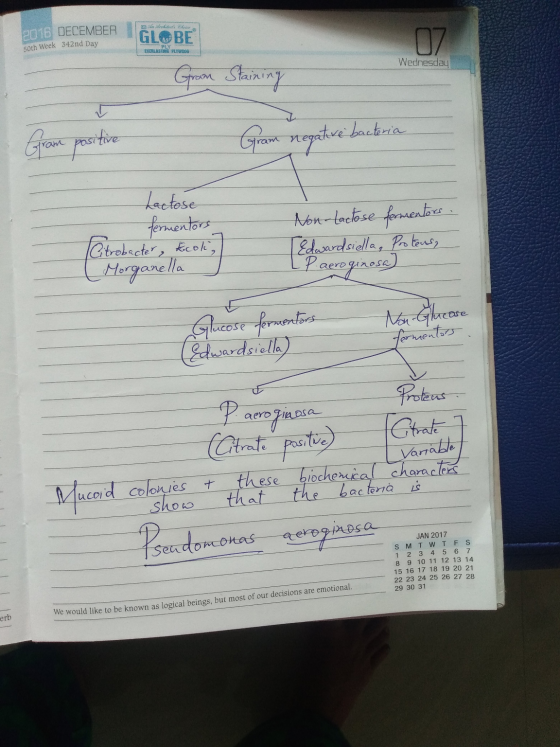
the identified organism is found to be Pseudomonas aeroginosa. It is the most common infection seen in burns and wound. The results of cultural charcteristics and biochemical tests shows that it is Pseudomonas aeroginosa
Add Answer to:
I. Solve the next problem You are asked to identify the cause of infection from a...
You are given a mixed culture of two organisms in a small tube of TSB.
 You are given a mixed culture of two organisms in a small tube of TSB. These two organisms include a Gram-negative strain (your bacterial strain to identify) and a Gram-positive strain (a contaminant). Your first task is to isolate these organisms which will help you identify which Gram-negative strain you are working with. 1) You inoculate two streak plates on TSA media and MacConkey Agar using aseptic technique. For each medium, state whether the medium is selective, differential, or neither and...
You have obtained samples from a patient who is in the ICU at your hospital. You...
 You have obtained samples from a patient who is in the ICU at your hospital. You perform the Gram-Stain and IMVIC tests, and see the following results: Gram-Stain Upon examination under the microscope you view pink colored rods. IMVIC Indole: After the addition of Kovac's Reagent, you see no color change at the top of the media. Methyl Red: After the addition of methyl red, your broth immediately turns a red color. Voges Proskauer: After the addition of VP reagents...
Lab Report-Carbohydrates 1. Purpose 2. Special Media for Isolating Bacteria (Lab #12) a. Why are dyes...
 Lab Report-Carbohydrates 1. Purpose 2. Special Media for Isolating Bacteria (Lab #12) a. Why are dyes such as phenol red, eosin or methylene blue added to the media? b. How does the bacterium change the media (i.e color of agar or colonies) after incubation? C. In this experiment, which media are selective, and which are differential? d. How did the results observe on the mannitol salt agar and EMB agar correlate to the Gram reaction of the bacteria? e. What...
D e eest. Results are determined by one of two ways: Ord O Directly observe First...
 D e eest. Results are determined by one of two ways: Ord O Directly observe First perform a chemical test using media for results OR reagents. THEN observe media for results For example read through Physical Factors: Atmospheric Oxygen Requirements. (you do not do this test for your unknown). Pene 04. 1 pt. What is it you are testing for with this test? This should be a general answer, not a list of the five types of metabolic pathways. Omnou...
I need help answering this graph. And these questions Thank you. Your Results and Observations with...
 I need help answering this graph.
And these questions
Thank you.
Your Results and Observations with a digital camera or mobile device. Organism or sample Result (appearance of the growth) Inerpretation (what the results indicate) Escherichia coli Р.aeruginosa s epdermicro S. 2. If the staining of the respiratory secretions in the case file had been negative for bacteria and positive for fungi, what would be the likely organism 3. Both EMB and MacConkey agars are differential and selective for gram-negative...
I need help answering this graph.
And these questions
Thank you.
Your Results and Observations with a digital camera or mobile device. Organism or sample Result (appearance of the growth) Inerpretation (what the results indicate) Escherichia coli Р.aeruginosa s epdermicro S. 2. If the staining of the respiratory secretions in the case file had been negative for bacteria and positive for fungi, what would be the likely organism 3. Both EMB and MacConkey agars are differential and selective for gram-negative...
78 Exercise 7: Selective and Differential Growth Medium and Tests 1 have been identified. These arms...
 78 Exercise 7: Selective and Differential Growth Medium and Tests 1 have been identified. These arms are ganima prutenbacteria. Trods and oxidase negative There are also gram+ onanisms among our unknowns. The blochemical changes we aim to assess are most often mediated by bacterial enzymes and others are fermentations. Color and/or texture changes in the media will aid in the identification of the unknown. The bacterium can be different lated on the basis of their metabolic capacity to manifest biochemical...
I need help answering these question. So think about it? The table may help you, and...
 I need help answering these
question. So think about it? The table may help you, and think about stuff we did in lab before the break 5. Below are your Gram stain results. What does this result tell you (consider gram reaction, shape, morphology)? Can you narrow down your unknown a little with this result? Explain your answer, and list your evidence. 6. MSA results Using what you have learned about this media, list everything this result tells you about...
I need help answering these
question. So think about it? The table may help you, and think about stuff we did in lab before the break 5. Below are your Gram stain results. What does this result tell you (consider gram reaction, shape, morphology)? Can you narrow down your unknown a little with this result? Explain your answer, and list your evidence. 6. MSA results Using what you have learned about this media, list everything this result tells you about...
Citrate Utilization Test OBSERVATIONS AND INTERPRETATIONS 1 Using Table 5-10, page 340, as a guide, enter...
 Citrate Utilization Test OBSERVATIONS AND INTERPRETATIONS 1 Using Table 5-10, page 340, as a guide, enter your results in the table below. Organism Color Result (+ or -) Interpretation Control QUESTIONS 1 Consider the uninoculated tube. a. Is it a positive or a negative control? b. What information is provided by the uninoculated control? Rus. ay Manry bacteria that are able to metabolize citrate (as seen in the citric acid cycle) produce negative e this test. Why? Be specific. ative...
we were given an unknown bacteria to work with at lab. the results came and its...
 we were given an unknown bacteria to work with at lab. the
results came and its written in the second observation. based on
that observation i got to know that my unknown bacteria was
Enterobacter aerogenes. so based on my second observation ive
written, im to answer the last two columns( conclusion and
comments)
Gram Negative Conclusion What does be your test result Comments List all possible organisms that match your Biochemical test and gram staining Theoretical Positive Second Observation...
we were given an unknown bacteria to work with at lab. the
results came and its written in the second observation. based on
that observation i got to know that my unknown bacteria was
Enterobacter aerogenes. so based on my second observation ive
written, im to answer the last two columns( conclusion and
comments)
Gram Negative Conclusion What does be your test result Comments List all possible organisms that match your Biochemical test and gram staining Theoretical Positive Second Observation...
microbiology help TOT Zoo Add Page Insert Table Chart Text Shape Media Comment These questions will...
 microbiology help
TOT Zoo Add Page Insert Table Chart Text Shape Media Comment These questions will serve in lieu of a lab report for Exercise 15, 16, and 17 You will find the answer to these questions in the background, procedure, results and interpretation sections of manual Exercise 15, 16, and 17, videos, Actions of Selective and Differential Media Chart, and the Principle/Theory article in homework section.) General Questions 1. What is the purpose (function) of selective media? (How does...
microbiology help
TOT Zoo Add Page Insert Table Chart Text Shape Media Comment These questions will serve in lieu of a lab report for Exercise 15, 16, and 17 You will find the answer to these questions in the background, procedure, results and interpretation sections of manual Exercise 15, 16, and 17, videos, Actions of Selective and Differential Media Chart, and the Principle/Theory article in homework section.) General Questions 1. What is the purpose (function) of selective media? (How does...
 You have obtained samples from a patient who is in the ICU at your hospital. You perform the Gram-Stain and IMVIC tests, and see the following results: Gram-Stain Upon examination under the microscope you view pink colored rods. IMVIC Indole: After the addition of Kovac's Reagent, you see no color change at the top of the media. Methyl Red: After the addition of methyl red, your broth immediately turns a red color. Voges Proskauer: After the addition of VP reagents...
 Lab Report-Carbohydrates 1. Purpose 2. Special Media for Isolating Bacteria (Lab #12) a. Why are dyes such as phenol red, eosin or methylene blue added to the media? b. How does the bacterium change the media (i.e color of agar or colonies) after incubation? C. In this experiment, which media are selective, and which are differential? d. How did the results observe on the mannitol salt agar and EMB agar correlate to the Gram reaction of the bacteria? e. What...
 D e eest. Results are determined by one of two ways: Ord O Directly observe First perform a chemical test using media for results OR reagents. THEN observe media for results For example read through Physical Factors: Atmospheric Oxygen Requirements. (you do not do this test for your unknown). Pene 04. 1 pt. What is it you are testing for with this test? This should be a general answer, not a list of the five types of metabolic pathways. Omnou...
 I need help answering this graph.
And these questions
Thank you.
Your Results and Observations with a digital camera or mobile device. Organism or sample Result (appearance of the growth) Inerpretation (what the results indicate) Escherichia coli Р.aeruginosa s epdermicro S. 2. If the staining of the respiratory secretions in the case file had been negative for bacteria and positive for fungi, what would be the likely organism 3. Both EMB and MacConkey agars are differential and selective for gram-negative...
I need help answering this graph.
And these questions
Thank you.
Your Results and Observations with a digital camera or mobile device. Organism or sample Result (appearance of the growth) Inerpretation (what the results indicate) Escherichia coli Р.aeruginosa s epdermicro S. 2. If the staining of the respiratory secretions in the case file had been negative for bacteria and positive for fungi, what would be the likely organism 3. Both EMB and MacConkey agars are differential and selective for gram-negative...
 78 Exercise 7: Selective and Differential Growth Medium and Tests 1 have been identified. These arms are ganima prutenbacteria. Trods and oxidase negative There are also gram+ onanisms among our unknowns. The blochemical changes we aim to assess are most often mediated by bacterial enzymes and others are fermentations. Color and/or texture changes in the media will aid in the identification of the unknown. The bacterium can be different lated on the basis of their metabolic capacity to manifest biochemical...
 I need help answering these
question. So think about it? The table may help you, and think about stuff we did in lab before the break 5. Below are your Gram stain results. What does this result tell you (consider gram reaction, shape, morphology)? Can you narrow down your unknown a little with this result? Explain your answer, and list your evidence. 6. MSA results Using what you have learned about this media, list everything this result tells you about...
I need help answering these
question. So think about it? The table may help you, and think about stuff we did in lab before the break 5. Below are your Gram stain results. What does this result tell you (consider gram reaction, shape, morphology)? Can you narrow down your unknown a little with this result? Explain your answer, and list your evidence. 6. MSA results Using what you have learned about this media, list everything this result tells you about...
 Citrate Utilization Test OBSERVATIONS AND INTERPRETATIONS 1 Using Table 5-10, page 340, as a guide, enter your results in the table below. Organism Color Result (+ or -) Interpretation Control QUESTIONS 1 Consider the uninoculated tube. a. Is it a positive or a negative control? b. What information is provided by the uninoculated control? Rus. ay Manry bacteria that are able to metabolize citrate (as seen in the citric acid cycle) produce negative e this test. Why? Be specific. ative...
 we were given an unknown bacteria to work with at lab. the
results came and its written in the second observation. based on
that observation i got to know that my unknown bacteria was
Enterobacter aerogenes. so based on my second observation ive
written, im to answer the last two columns( conclusion and
comments)
Gram Negative Conclusion What does be your test result Comments List all possible organisms that match your Biochemical test and gram staining Theoretical Positive Second Observation...
we were given an unknown bacteria to work with at lab. the
results came and its written in the second observation. based on
that observation i got to know that my unknown bacteria was
Enterobacter aerogenes. so based on my second observation ive
written, im to answer the last two columns( conclusion and
comments)
Gram Negative Conclusion What does be your test result Comments List all possible organisms that match your Biochemical test and gram staining Theoretical Positive Second Observation...
 microbiology help
TOT Zoo Add Page Insert Table Chart Text Shape Media Comment These questions will serve in lieu of a lab report for Exercise 15, 16, and 17 You will find the answer to these questions in the background, procedure, results and interpretation sections of manual Exercise 15, 16, and 17, videos, Actions of Selective and Differential Media Chart, and the Principle/Theory article in homework section.) General Questions 1. What is the purpose (function) of selective media? (How does...
microbiology help
TOT Zoo Add Page Insert Table Chart Text Shape Media Comment These questions will serve in lieu of a lab report for Exercise 15, 16, and 17 You will find the answer to these questions in the background, procedure, results and interpretation sections of manual Exercise 15, 16, and 17, videos, Actions of Selective and Differential Media Chart, and the Principle/Theory article in homework section.) General Questions 1. What is the purpose (function) of selective media? (How does...
Most questions answered within 3 hours.
-
Where is the error in this code sequence?
String s1 = "Hello";
String s2 = "ello";...
asked 10 months ago -
Financial data for Joel de Paris, Inc., for last year
follow:
Joel de Paris, Inc.
Balance...
asked 10 months ago -
Consider this reaction:
Al2(SO4)3 (aq)+ BaCl3
(aq) Al2Cl6 (aq)- +
3BaSO4(s) . What is the...
asked 10 months ago -
Suppose that Savneet is considering increasing her
recent random sample from 20 car rentals to 40...
asked 10 months ago -
Trucks arrive at an unloading terminal at an average rate of 120
per hour.
Trucks arrive...
asked 10 months ago -
Why are methanol and ethanol completely soluble in water while
octanol is not very little soluble....
asked 10 months ago -
A facilities manager at a university reads in a research report
that the mean amount of...
asked 10 months ago -
When the CuSO4 is rehydrated by adding water to the anhydrous
compound, is this an endothermic...
asked 10 months ago -
A ray of sunlight is passing from diamond into crown glass; the
angle of incidence is...
asked 10 months ago -
A block of mass 0.249 kg is placed on top of a light, vertical
spring of...
asked 10 months ago -
how do the kidneys compensate in the presences of acidosis
a) trigger hyperventilate
b) reserve acid...
asked 10 months ago -
Question 501 pts
The rental rate of capital to the firm increases. Which of the
following...
asked 10 months ago