
Homework Answers
Answer:
7)
d. oxidative phosphorylation refers to the electron transport chain coupled with ATP synthesis.
8)
a. The subunit c10 binds protons from inner membrane space.
9)
b) Beta ATP subunit catalyzes ADP to ATP conversion.
Add Answer to:
Oxidative phosphorylation refers to O the electron transport chain coupled to glycolysis O the citric acid...
Inhibitors of Oxidative Phosphorylation The following chemicals inhibit oxidative phosphorylation: Cyanide: Cyanide is a naturally occurring...
 Inhibitors of Oxidative Phosphorylation The following chemicals inhibit oxidative phosphorylation: Cyanide: Cyanide is a naturally occurring compound that binds to protein complex IV of the mitochondrial electron transport chain and prevents transfer of electrons from the protein. Metformin: At the cellular level, chemically synthesized metformin, a drug commonly prescribed for Type 2 diabetes, inhibits mitochondrial respiration by blocking complex I. Dinitrophenol: Dinitrophenol is a metabolic poison that can be sold legally as a pesticide. Although it is lethal to humans,...
Which two processes make up oxidative phosphorylation? A. Chemiosmosis and ATP synthesis B. Electron transport chain...
Which two processes make up oxidative phosphorylation? A. Chemiosmosis and ATP synthesis B. Electron transport chain and chemiosmosis C. Pyruvate oxidation and electron transport chain D. Proton motive force and chemiosmosis What is the final electron acceptor in the electron transport chain? A. FADH2 B. Water C. Oxygen D. NADH
Fill in the blanks regarding the electron transport chain and oxidative phosphorylation. Complex1 accepts electrons from...
 Fill in the blanks regarding the electron transport
chain and oxidative phosphorylation.
Complex1 accepts electrons from NADH and uses coenzyme Q
to transport them to complex 3.
Complex 2 accepts electrons from FADH2 and uses coenzyme
q to transport them from complex 3 to complex 4.
The ATP synthase will transport 3H+ ions for every 2 ATP
produces.
This entire process occurs across the inner
mitochondrial membrane.
Fill in the blanks regarding the electron transport chain and oxidative phosphorylation
Fill in the blanks regarding the electron transport
chain and oxidative phosphorylation.
Complex1 accepts electrons from NADH and uses coenzyme Q
to transport them to complex 3.
Complex 2 accepts electrons from FADH2 and uses coenzyme
q to transport them from complex 3 to complex 4.
The ATP synthase will transport 3H+ ions for every 2 ATP
produces.
This entire process occurs across the inner
mitochondrial membrane.
Fill in the blanks regarding the electron transport chain and oxidative phosphorylation
Which complex in the electron transport chain does not contribute to the proton gradient across the...
Which complex in the electron transport chain does not contribute to the proton gradient across the mitochondrial membrane? A. Complex I B. Complex IV C. Complex II D. Complex III Which statement regarding the mitochondrial electron transport chain and oxidative phosphorylation is true? A. Ubiquinone and the F zero subunit of ATP synthase are peripheral membrane proteins. B. Complexes I, II, III, and IV all are proton pumps. C. The final electron acceptor is water. D. Complex II is considered...
1 (a) What is the difference between the electron transport chain and chemiosmosis in oxidative phosphorylation?...
1 (a) What is the difference between the electron transport chain and chemiosmosis in oxidative phosphorylation? Explain how each process contributes towards ATP synthesis.
What process uses ATP to create glucose? O ATP synthase electron transport chain O gluconeogenesis O...
 What process uses ATP to create glucose? O ATP synthase electron transport chain O gluconeogenesis O citric acid cycle Question 11 (2 points) What would expect to happen in mitochondria that have fewer cristae Increased proton motive force Decreased oxygen usage increased ATP to ADP conversion O No change in mitocondrial funciton Question 12 (2 points) What is one example of when energy molecules/electron carriers are produced during the citric acid cycle? O conversion of succinate to fumarate O addition...
Oxidative phosphorylation refers to the addition of a phosphate group to ADP by the energy released...
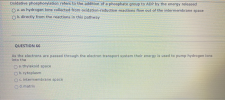 Oxidative phosphorylation refers to the addition of a phosphate group to ADP by the energy released a. as hydrogen ions collected from oxidation-reduction reactions flow out of the intermembrane space b. directly from the reactions in this pathway QUESTION 66 As the electrons are passed through the electron transport system their energy is used to pump hydrogen ions into the a thylakoid space b. cytoplasm c. intermembrane space d. matrix
Inhibitors of Oxidative Phosphorylation The following chemicals inhibit oxidative phosphorylation: Cyanide: Cyanide is a naturally occurring...
 Inhibitors of Oxidative Phosphorylation The following chemicals inhibit oxidative phosphorylation: Cyanide: Cyanide is a naturally occurring compound that binds to protein complex IV of the mitochondrial electron transport chain and prevents transfer of electrons from the protein. Metformin: At the cellular level, chemically synthesized metformin, a drug commonly prescribed for Type 2 diabetes, inhibits mitochondrial respiration by blocking complex I. Dinitrophenol: Dinitrophenol is a metabolic poison that can be sold legally as a pesticide. Although it is lethal to humans,...
Which of the following statements about oxidative phosphorylation is true? a. Oxidative phosphorylation involves the activities...
Which of the following statements about oxidative phosphorylation is true? a. Oxidative phosphorylation involves the activities of the electron transport chain and the ATP synthesizing machinery. b. The oxidation of NADH is the only way to form ATP. c. ATP is synthesized using the energy that is released when electrons and hydrogen are excreted outside of the cell. d. ATP synthesis occurs during oxidative phosphorylation directly by the reduction of electron carrier proteins in the cytoplasmic membrane.
27) Which one of the following best describes the electron transport chain? A) Electrons are passed...
 27) Which one of the following best describes the electron transport chain? A) Electrons are passed from one carrier to another releasing a little energy at each B) Hydrogen atoms are added to CO2 to make an energy-rich compound. C) Electrons are pumped across a membrane by active transport. D) Glucose is broken down to a three-carbon compound 28) After completion of the citric acid cycle, most of the usable energy from the one molecule is in the form of...
 Inhibitors of Oxidative Phosphorylation The following chemicals inhibit oxidative phosphorylation: Cyanide: Cyanide is a naturally occurring compound that binds to protein complex IV of the mitochondrial electron transport chain and prevents transfer of electrons from the protein. Metformin: At the cellular level, chemically synthesized metformin, a drug commonly prescribed for Type 2 diabetes, inhibits mitochondrial respiration by blocking complex I. Dinitrophenol: Dinitrophenol is a metabolic poison that can be sold legally as a pesticide. Although it is lethal to humans,...
 Fill in the blanks regarding the electron transport
chain and oxidative phosphorylation.
Complex1 accepts electrons from NADH and uses coenzyme Q
to transport them to complex 3.
Complex 2 accepts electrons from FADH2 and uses coenzyme
q to transport them from complex 3 to complex 4.
The ATP synthase will transport 3H+ ions for every 2 ATP
produces.
This entire process occurs across the inner
mitochondrial membrane.
Fill in the blanks regarding the electron transport chain and oxidative phosphorylation
Fill in the blanks regarding the electron transport
chain and oxidative phosphorylation.
Complex1 accepts electrons from NADH and uses coenzyme Q
to transport them to complex 3.
Complex 2 accepts electrons from FADH2 and uses coenzyme
q to transport them from complex 3 to complex 4.
The ATP synthase will transport 3H+ ions for every 2 ATP
produces.
This entire process occurs across the inner
mitochondrial membrane.
Fill in the blanks regarding the electron transport chain and oxidative phosphorylation
 What process uses ATP to create glucose? O ATP synthase electron transport chain O gluconeogenesis O citric acid cycle Question 11 (2 points) What would expect to happen in mitochondria that have fewer cristae Increased proton motive force Decreased oxygen usage increased ATP to ADP conversion O No change in mitocondrial funciton Question 12 (2 points) What is one example of when energy molecules/electron carriers are produced during the citric acid cycle? O conversion of succinate to fumarate O addition...
 Oxidative phosphorylation refers to the addition of a phosphate group to ADP by the energy released a. as hydrogen ions collected from oxidation-reduction reactions flow out of the intermembrane space b. directly from the reactions in this pathway QUESTION 66 As the electrons are passed through the electron transport system their energy is used to pump hydrogen ions into the a thylakoid space b. cytoplasm c. intermembrane space d. matrix
 Inhibitors of Oxidative Phosphorylation The following chemicals inhibit oxidative phosphorylation: Cyanide: Cyanide is a naturally occurring compound that binds to protein complex IV of the mitochondrial electron transport chain and prevents transfer of electrons from the protein. Metformin: At the cellular level, chemically synthesized metformin, a drug commonly prescribed for Type 2 diabetes, inhibits mitochondrial respiration by blocking complex I. Dinitrophenol: Dinitrophenol is a metabolic poison that can be sold legally as a pesticide. Although it is lethal to humans,...
 27) Which one of the following best describes the electron transport chain? A) Electrons are passed from one carrier to another releasing a little energy at each B) Hydrogen atoms are added to CO2 to make an energy-rich compound. C) Electrons are pumped across a membrane by active transport. D) Glucose is broken down to a three-carbon compound 28) After completion of the citric acid cycle, most of the usable energy from the one molecule is in the form of...
Most questions answered within 3 hours.
-
Where is the error in this code sequence?
String s1 = "Hello";
String s2 = "ello";...
asked 10 months ago -
Financial data for Joel de Paris, Inc., for last year
follow:
Joel de Paris, Inc.
Balance...
asked 10 months ago -
Consider this reaction:
Al2(SO4)3 (aq)+ BaCl3
(aq) Al2Cl6 (aq)- +
3BaSO4(s) . What is the...
asked 10 months ago -
Suppose that Savneet is considering increasing her
recent random sample from 20 car rentals to 40...
asked 10 months ago -
Trucks arrive at an unloading terminal at an average rate of 120
per hour.
Trucks arrive...
asked 10 months ago -
Why are methanol and ethanol completely soluble in water while
octanol is not very little soluble....
asked 10 months ago -
A facilities manager at a university reads in a research report
that the mean amount of...
asked 10 months ago -
When the CuSO4 is rehydrated by adding water to the anhydrous
compound, is this an endothermic...
asked 10 months ago -
A ray of sunlight is passing from diamond into crown glass; the
angle of incidence is...
asked 10 months ago -
A block of mass 0.249 kg is placed on top of a light, vertical
spring of...
asked 10 months ago -
how do the kidneys compensate in the presences of acidosis
a) trigger hyperventilate
b) reserve acid...
asked 10 months ago -
Question 501 pts
The rental rate of capital to the firm increases. Which of the
following...
asked 10 months ago