What supports the contention that proton gradient drives ATP formation in mitochondria? Explain the process of...
What supports the contention that proton gradient drives ATP formation in mitochondria? Explain the process of ATP synthesis?
Homework Answers
In the aerobic respiration process the last process known as Electron Transport Chain (ETC) takes place in the mitochondria of the cell. The ETC is nothing but the creation of proton gradient through the proton pumping due to which ATP are synthesized in huge amount in the mitochondria. The ATP synthase present in the inner membrane of the mitochondria generates ATP when the proton moves in to the matrix of the mitochondria by proton pumping to create proton gradient and also spins the ATP synthase. This spin like movement of the ATP synthase converts the ADP in to ATP and produces ATP in the mitochondria.
Process of ATP synthesis :
Before knowing the process of ATP synthesis in the mitochondria, let us discuss the structure of the mitochondria first. The mitochondria are cell organelles which are present in each cell. Its number may vary from cell to cell as per the physiological function of the cell. As the cells of heart contains more number of mitochondria as compare to the cells of the skin. The mitochondria is double membrane bound organelle. The outer membrane allows the movement of the small molecules along with the ions. But the inner membrane is highly folded (crista) which don't allow the free flow movement of the small molecules and even of the ions. The molecules responsible for the movement of electron of the respiratory chain and the molecules responsible for synthesis of ATP which is ATP synthase or ATP synthatase are present in the inner membrane of the mitochondria. Also the inner membrane bound space of the mitochondria called matrix contains enzymes responsible for the Kreb's Cycle and hence resluts in the production of NADH and FADH2 which are used as substrate for the synthesis of ATP in mitochondria. Also the movement or exchange of charged metabolites are mediated by the carrier presents in the inner membrane of the mitochondria and are done on one-one exchange principle.
When the Hydrogen ion from FADH2 or NADH is transferred to Oxygen, the protons (Hydrogen ion) pumped across the crista/inner membrane of mitochondria hence converting the chemical energy of the previously synthesised substrate molecules in to electrical energy and also generates an electric potential across the membranes of the mitochondria. The electric pitential ranges fron 200 to 300 milivolt. The crista contains ATP synthase in them which can facilitates the binding of ADP, ATP and Pi to it. The ATP synthase has a special structure of polypeptides which forms a proton pore on the inner membrane of the mitochondria. When the ADP and Pi are attached to the ATP synthetase, the extra hydrogen ions formed outside the mitochondrial matrix flows back to the mitochondrial matrix resulting in the spinning of the ATP synthase and the production of ATP from the ADP and Pi. In this process again the electrical energy is converted in to chemical energy and are stored in the form of ATP. The rate of ATP synthesis depends upon the amount of ADP which can be supplied.
( I may have written ATP Synthatase instead of ATP Synthetase, please have a eye on this spelling mistake)
Add Answer to:
What supports the contention that proton gradient drives ATP
formation in mitochondria? Explain the process of...
What evidence supports the contention that the proton gradient drives ATP formation in mitochondria? Give at...
What evidence supports the contention that the proton gradient drives ATP formation in mitochondria? Give at least 2 lines of evidence.
Both mitochondria and chloroplasts use electron transport to pump protons, creating an electrochemical proton gradient, which...
Both mitochondria and chloroplasts use electron transport to pump protons, creating an electrochemical proton gradient, which drives ATP synthesis. Are protons pumped across the same (analogous) membranes in the two oraganelles? Directionality of the pump? Is ATP synthesized in analogous compartments? Fully explain your answers.
In mitochondria, a proton gradient is established by the movement of electrons through the electron transport...
In mitochondria, a proton gradient is established by the movement of electrons through the electron transport chain. Protons are moved to the intermembrane space against the concentration gradient and the flow back to the matrix via facilitated diffusion using the ATP synthase. Describe how this proton flow contributes to ATP synthesis and the role played by aspartic acid in this process.
Question 4 1 pts Which of the following compound can uncouple the process of proton gradient...
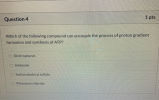 Question 4 1 pts Which of the following compound can uncouple the process of proton gradient formation and synthesis of ATP? Dinitrophenol Imidazole Sodium dodecyl sulfate Potassium chloride
Beta barrels are present in mitochondria.The formation of a concentration gradient in the mitochondria is necessary...
Beta barrels are present in mitochondria.The formation of a concentration gradient in the mitochondria is necessary for the efficient creation of ATP, such as hydrogen channels, but is this what these β-barrels are involved in, or do they have some other function?
why the proton gradient is both a chemical gradient and an electrical radiant and state which...
why the proton gradient is both a chemical gradient and an electrical radiant and state which radiant is the major contributor to the proton motive force driving the ATP synthesis RX? please explain it in a short sentance
7. What would happen to the ATP yield of cellular respiration if (a) the transporter that...
7. What would happen to the ATP yield of cellular respiration if (a) the transporter that imports pyruvate into the mitochondria stopped working? Explain. (b) the transporter that imports pyruvate into the mitochondria worked only at 10% of its normal capacity? Explain. (c) The inner membrane of the mitochondria became affected by an antibiotic that prevented the buildup of a proton gradient. Explain. (d) ATP synthase started to make one ATP per proton. Explain.
1. Which one of the following shows the correct sequence of energy transitions during chemiosmosis? A. NADH → electron acceptors → proton gradient → ATP synthase → ATP B. NADH → NAD+ → FADH2 → electro...
1. Which one of the following shows the correct sequence of energy transitions during chemiosmosis? A. NADH → electron acceptors → proton gradient → ATP synthase → ATP B. NADH → NAD+ → FADH2 → electron acceptors → ATP C. carbohydrates → acetyl CoA → CO2 → proton gradient → ATP D. NAD+ → NADH → protons → ADP → ATP E. glucose → pyruvate → acetyl CoA → NADH → ATP 2. Facultative anaerobes: A. prefer carbon dioxide. B....
6. Electron movement results in the establishment of a proton gradient across the inner mitochondrial membrane....
6. Electron movement results in the establishment of a proton gradient across the inner mitochondrial membrane. The proton motive force then provides the energy for ATP formation. a. How are protons shifted from the matrix to the intramembrane space? b. How is the proton gradient harnessed for ATP formation? c. How does ATP reach the cellular compartment/s where biosynthesis is occurring?
why was it necessary to isolate mitochondria to study and also use engineered vesicles that either...
 why was it necessary to
isolate mitochondria to study and also use engineered vesicles that
either did or did not contain atp synthetase?
by the first ATP s r aasing the enzyme to function as an ATPase and result in ATP ATP synthase would likely drive the ATP synh reverse direction, s Original Paper The oniginal experiments on pli and ATP formation were donc on chloroplasts The chemiosmotic generation of ATP is simila to mitochondria, but occurs across tihe thylašoid...
why was it necessary to
isolate mitochondria to study and also use engineered vesicles that
either did or did not contain atp synthetase?
by the first ATP s r aasing the enzyme to function as an ATPase and result in ATP ATP synthase would likely drive the ATP synh reverse direction, s Original Paper The oniginal experiments on pli and ATP formation were donc on chloroplasts The chemiosmotic generation of ATP is simila to mitochondria, but occurs across tihe thylašoid...
 Question 4 1 pts Which of the following compound can uncouple the process of proton gradient formation and synthesis of ATP? Dinitrophenol Imidazole Sodium dodecyl sulfate Potassium chloride
 why was it necessary to
isolate mitochondria to study and also use engineered vesicles that
either did or did not contain atp synthetase?
by the first ATP s r aasing the enzyme to function as an ATPase and result in ATP ATP synthase would likely drive the ATP synh reverse direction, s Original Paper The oniginal experiments on pli and ATP formation were donc on chloroplasts The chemiosmotic generation of ATP is simila to mitochondria, but occurs across tihe thylašoid...
why was it necessary to
isolate mitochondria to study and also use engineered vesicles that
either did or did not contain atp synthetase?
by the first ATP s r aasing the enzyme to function as an ATPase and result in ATP ATP synthase would likely drive the ATP synh reverse direction, s Original Paper The oniginal experiments on pli and ATP formation were donc on chloroplasts The chemiosmotic generation of ATP is simila to mitochondria, but occurs across tihe thylašoid...
Most questions answered within 3 hours.
-
Where is the error in this code sequence?
String s1 = "Hello";
String s2 = "ello";...
asked 10 months ago -
Financial data for Joel de Paris, Inc., for last year
follow:
Joel de Paris, Inc.
Balance...
asked 10 months ago -
Consider this reaction:
Al2(SO4)3 (aq)+ BaCl3
(aq) Al2Cl6 (aq)- +
3BaSO4(s) . What is the...
asked 10 months ago -
Suppose that Savneet is considering increasing her
recent random sample from 20 car rentals to 40...
asked 10 months ago -
Trucks arrive at an unloading terminal at an average rate of 120
per hour.
Trucks arrive...
asked 10 months ago -
Why are methanol and ethanol completely soluble in water while
octanol is not very little soluble....
asked 10 months ago -
A facilities manager at a university reads in a research report
that the mean amount of...
asked 10 months ago -
When the CuSO4 is rehydrated by adding water to the anhydrous
compound, is this an endothermic...
asked 10 months ago -
A ray of sunlight is passing from diamond into crown glass; the
angle of incidence is...
asked 10 months ago -
A block of mass 0.249 kg is placed on top of a light, vertical
spring of...
asked 10 months ago -
how do the kidneys compensate in the presences of acidosis
a) trigger hyperventilate
b) reserve acid...
asked 10 months ago -
Question 501 pts
The rental rate of capital to the firm increases. Which of the
following...
asked 10 months ago