
Homework Answers
Lysozyme kills the bacteria by attacking the links in the cell wall. Lysozyme is more effective against gram-positive bacteria than gram-negative bacteria because gram-positive bacteria contain far more peptidoglycans in their cell wall.
If the lysozyme is added to Gram-Negative bacteria, there will be no change. However, the reading should decrease, indicating a less light absorbed, when the lysozyme is added to Gram-Positive bacteria.
Absorbance is a measure of the quantity of light absorbed by a sample. It is also known as optical density, extinction, or decadic absorbance. If all light passes through a sample, none was absorbed, so the absorbance would be zero and the transmission would be 100%.
Add Answer to:
A spectrophotometer can measure the amount of light absorbed by a solution. A cloudy solution absorbs...
A spectrophotometer can measure the amount of light absorbed by a solution. A cloudy solution absorbs...
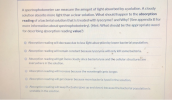 A spectrophotometer can measure the amount of light absorbed by a solution. A cloudy solution absorbs more light than a clear solution. What should happen to the absorption reading of a bacterial solution that is treated with lysozyme? and Why? (See appendix B for more information about spectrophotometry). (Hint: What should be the appropriate word for describing absorption reading value?) Absorption reading will decrease due to less light absorption by lower bacterial population. Absorption reading will remain constant because lysozyme...
 A spectrophotometer can measure the amount of light absorbed by a solution. A cloudy solution absorbs more light than a clear solution. What should happen to the absorption reading of a bacterial solution that is treated with lysozyme? and Why? (See appendix B for more information about spectrophotometry). (Hint: What should be the appropriate word for describing absorption reading value?) Absorption reading will decrease due to less light absorption by lower bacterial population. Absorption reading will remain constant because lysozyme...
Most questions answered within 3 hours.
-
Where is the error in this code sequence?
String s1 = "Hello";
String s2 = "ello";...
asked 10 months ago -
Financial data for Joel de Paris, Inc., for last year
follow:
Joel de Paris, Inc.
Balance...
asked 10 months ago -
Consider this reaction:
Al2(SO4)3 (aq)+ BaCl3
(aq) Al2Cl6 (aq)- +
3BaSO4(s) . What is the...
asked 10 months ago -
Suppose that Savneet is considering increasing her
recent random sample from 20 car rentals to 40...
asked 10 months ago -
Trucks arrive at an unloading terminal at an average rate of 120
per hour.
Trucks arrive...
asked 10 months ago -
Why are methanol and ethanol completely soluble in water while
octanol is not very little soluble....
asked 10 months ago -
A facilities manager at a university reads in a research report
that the mean amount of...
asked 10 months ago -
When the CuSO4 is rehydrated by adding water to the anhydrous
compound, is this an endothermic...
asked 10 months ago -
A ray of sunlight is passing from diamond into crown glass; the
angle of incidence is...
asked 10 months ago -
A block of mass 0.249 kg is placed on top of a light, vertical
spring of...
asked 10 months ago -
how do the kidneys compensate in the presences of acidosis
a) trigger hyperventilate
b) reserve acid...
asked 10 months ago -
Question 501 pts
The rental rate of capital to the firm increases. Which of the
following...
asked 10 months ago