![failose QUESTION 9 Which sugar was poorly fermented (ie, which had the slowest rate)? [2 pt] O glucose O maltose fructose O m](http://img.homeworklib.com/questions/c2704e40-e776-11eb-ab5c-3dcab6895e46.png?x-oss-process=image/resize,w_560)
Homework Answers
The answer is maltotriose.
Explaination:
The maltotriose is a trisachharide sugar which contains three glucose units.
According to many research articles: When glucose, fructose, maltose and maltotriose sugars were subjected to the fermentation, the sugars showed a sequential pattern of fermentation.
Glucose was completely fermented first followed by fructose and maltose. When maltose was completely depleted or fermented, maltotriose started to ferment but at very little extent.
Thus, the maltotriose sugar has the lowest rate of fermentation and so it is said to be poorly fermented sugar.
The rate of fermentation of glucose is highest because its rate of carbon dioxide production is highest followed by sucrose, fructose and maltose as all the sugars transported easily to the cells by facilitated diffusion.
Whereas, the transport of maltotriose across the plasma membrane of yeast cells is supposed to be the important limiting step for its slowest rate of fermentation.
Add Answer to:
failose QUESTION 9 Which sugar was poorly fermented (ie, which had the slowest rate)? [2 pt]...
Which sugar is not a reducing sugar?
 1 Which sugar is not a reducing sugar? sucrose glucose maltose galactose fructose 2 Which federal OSHA agency is responsible for researching best practices in safety?
uestion Completion Status: QUESTION 7 Which of the sugars produced the most carbon dioxide in the...
 uestion Completion Status: QUESTION 7 Which of the sugars produced the most carbon dioxide in the 1 minute allotted? [2 pt] glucose maltose fructose maltotriose QUESTION 8 wnet ranidly ferment
Sucrose, a sugar, decomposes in acidic solution to produce glucose and fructose. The reaction is first...
 Sucrose, a sugar, decomposes in acidic solution to produce glucose and fructose. The reaction is first order in sucrose, and at 25 °C the rate constant is k = 3.60 x 10⁻³-1. If the initial concentration of sucrose is 0.050 M, what is the concentration after 2 days? O 0.042M 4.3 x 10⁻³M O 0.028 M 0.013 M
I tried option 3 and it wasnt correct. QUESTION 2 Which dienophile reacts slowest in a...
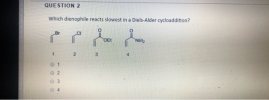 I tried option 3 and it wasnt correct.
QUESTION 2 Which dienophile reacts slowest in a Diels-Alder cycloaddition? 1 2 3 o o o AN o
I tried option 3 and it wasnt correct.
QUESTION 2 Which dienophile reacts slowest in a Diels-Alder cycloaddition? 1 2 3 o o o AN o
Question 9 10 pts Multiple Choice: Which of the following is NOT true concerning fats and...
 Question 9 10 pts Multiple Choice: Which of the following is NOT true concerning fats and lipids? Some fat is necessary in our diet Polyunsaturated fatty acids cause the greatest increase in LDL levels To lower blood cholesterol levels choose foods made with unsaturated fats O A relationship has been found between a diet high in fat and cardiovascular disease D Question 10 10 pts 5. Ancample is galactose Choose Question 6 10 pts Multiple Choice: Which of the following...
I.-(3 pts) What is the structural difference between an aldose and a ketose 2. (2 pts) Which two ...
 I.-(3 pts) What is the structural difference between an aldose and a ketose 2. (2 pts) Which two functional groups are present in all monosaccharides? 3. (4 pts) Wha is the name of the molecule below? Which enantiomer is represented? C-H но-с-н CH2OH 4. (2 pts) Wha property of a pair of molecules results in the formation of enantiomers? 5. (3 pts) How are the symbols D- or L- assigned in naming a sugar? 6. (3 pts The following disaccharides...
Question 9 2 pt In a Poisson probability problem, the rate of defects is 2 every...
 Question 9 2 pt In a Poisson probability problem, the rate of defects is 2 every 3 hours. Find the probability of 5 defects in 6 hours. use poisspdf or poisscdf function Wk5Hw_Pois2
Which of the diagrams illustrates the way in which the rate of an enzyme-controlled reaction depends...
 Which of the diagrams illustrates the way in which the rate of an enzyme-controlled reaction depends on substrate concentration? * А B Rate of reaction MÚN Substrate concentration A B D When starch and amylase are mixed in the presence of iodine solution, the blue-black colour rapidly disappears. This is due to the formation of which molecule? * glucose O glycogen sucrose O maltose Which of the following enzyme groups can catalyse oxidation reactions? * O phosphorylases isomerases hydrolases dehydrogenases...
Question 9 (2 pt.) Explain which of the equations Eq, = la, and bodies, which is...
 Question 9 (2 pt.) Explain which of the equations Eq, = la, and bodies, which is valid for both rigid and non-rigid bodies? ž = dī /dt is valid only for rigid
Remaining Time: 19 minutes, 42 seconds. Question Completion Status: Which of the following compounds is a...
 Remaining Time: 19 minutes, 42 seconds. Question Completion Status: Which of the following compounds is a disaccharide? glucose maltose galactose fructose 2 poi QUESTION 50 The six characteristics of a nutritious diet include: adequacy, B vitamins, carbohydrates, meat, variety, and portion control. abundance, balance, carbohydrates, moderation, vegetables, and variety. adequacy, balance, kealorie control, moderation, variety, and nutrient density abundance, B vitamins, kcalorie control, milk, vegetables, and nutrient density.
 uestion Completion Status: QUESTION 7 Which of the sugars produced the most carbon dioxide in the 1 minute allotted? [2 pt] glucose maltose fructose maltotriose QUESTION 8 wnet ranidly ferment
 Sucrose, a sugar, decomposes in acidic solution to produce glucose and fructose. The reaction is first order in sucrose, and at 25 °C the rate constant is k = 3.60 x 10⁻³-1. If the initial concentration of sucrose is 0.050 M, what is the concentration after 2 days? O 0.042M 4.3 x 10⁻³M O 0.028 M 0.013 M
 I tried option 3 and it wasnt correct.
QUESTION 2 Which dienophile reacts slowest in a Diels-Alder cycloaddition? 1 2 3 o o o AN o
I tried option 3 and it wasnt correct.
QUESTION 2 Which dienophile reacts slowest in a Diels-Alder cycloaddition? 1 2 3 o o o AN o
 Question 9 10 pts Multiple Choice: Which of the following is NOT true concerning fats and lipids? Some fat is necessary in our diet Polyunsaturated fatty acids cause the greatest increase in LDL levels To lower blood cholesterol levels choose foods made with unsaturated fats O A relationship has been found between a diet high in fat and cardiovascular disease D Question 10 10 pts 5. Ancample is galactose Choose Question 6 10 pts Multiple Choice: Which of the following...
 I.-(3 pts) What is the structural difference between an aldose and a ketose 2. (2 pts) Which two functional groups are present in all monosaccharides? 3. (4 pts) Wha is the name of the molecule below? Which enantiomer is represented? C-H но-с-н CH2OH 4. (2 pts) Wha property of a pair of molecules results in the formation of enantiomers? 5. (3 pts) How are the symbols D- or L- assigned in naming a sugar? 6. (3 pts The following disaccharides...
 Question 9 2 pt In a Poisson probability problem, the rate of defects is 2 every 3 hours. Find the probability of 5 defects in 6 hours. use poisspdf or poisscdf function Wk5Hw_Pois2
 Which of the diagrams illustrates the way in which the rate of an enzyme-controlled reaction depends on substrate concentration? * А B Rate of reaction MÚN Substrate concentration A B D When starch and amylase are mixed in the presence of iodine solution, the blue-black colour rapidly disappears. This is due to the formation of which molecule? * glucose O glycogen sucrose O maltose Which of the following enzyme groups can catalyse oxidation reactions? * O phosphorylases isomerases hydrolases dehydrogenases...
 Question 9 (2 pt.) Explain which of the equations Eq, = la, and bodies, which is valid for both rigid and non-rigid bodies? ž = dī /dt is valid only for rigid
 Remaining Time: 19 minutes, 42 seconds. Question Completion Status: Which of the following compounds is a disaccharide? glucose maltose galactose fructose 2 poi QUESTION 50 The six characteristics of a nutritious diet include: adequacy, B vitamins, carbohydrates, meat, variety, and portion control. abundance, balance, carbohydrates, moderation, vegetables, and variety. adequacy, balance, kealorie control, moderation, variety, and nutrient density abundance, B vitamins, kcalorie control, milk, vegetables, and nutrient density.
Most questions answered within 3 hours.
-
Where is the error in this code sequence?
String s1 = "Hello";
String s2 = "ello";...
asked 10 months ago -
Financial data for Joel de Paris, Inc., for last year
follow:
Joel de Paris, Inc.
Balance...
asked 10 months ago -
Consider this reaction:
Al2(SO4)3 (aq)+ BaCl3
(aq) Al2Cl6 (aq)- +
3BaSO4(s) . What is the...
asked 10 months ago -
Suppose that Savneet is considering increasing her
recent random sample from 20 car rentals to 40...
asked 10 months ago -
Trucks arrive at an unloading terminal at an average rate of 120
per hour.
Trucks arrive...
asked 10 months ago -
Why are methanol and ethanol completely soluble in water while
octanol is not very little soluble....
asked 10 months ago -
A facilities manager at a university reads in a research report
that the mean amount of...
asked 10 months ago -
When the CuSO4 is rehydrated by adding water to the anhydrous
compound, is this an endothermic...
asked 10 months ago -
A ray of sunlight is passing from diamond into crown glass; the
angle of incidence is...
asked 10 months ago -
A block of mass 0.249 kg is placed on top of a light, vertical
spring of...
asked 10 months ago -
how do the kidneys compensate in the presences of acidosis
a) trigger hyperventilate
b) reserve acid...
asked 10 months ago -
Question 501 pts
The rental rate of capital to the firm increases. Which of the
following...
asked 10 months ago