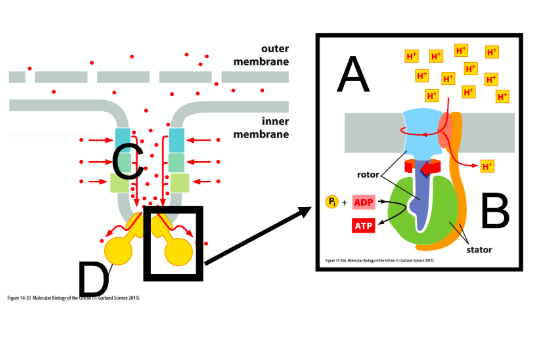
Matching options: Cytosol, Electron transport chain, mitochondrial matrix, ATP synthetase
Homework Answers
Answer:
A - Electron Transport Chain.
B - ATP synthase.
C - Cytosol.
D - Mitochondrial matrix.
Explanation:
The given figure shows an electron transport chain. The A part is in the inner membrane space and it has the electron transport chain. The B part represent the ATP synthase is an enzyme which forms the energy storage molecules adenosine triphosphate (ATP). The C part is cytosol (although please verify the options as cytosol is generally labelled outside outer membrane). And the D part is the inner mitochondrial matrix.
Add Answer to:
Matching options: Cytosol, Electron transport chain,
mitochondrial matrix, ATP synthetase
... outer membrane inner membrane rotor...
Question 5 (0.5 points) Where is the electron transport chain located? In the mitochondrial matrix In...
 Question 5 (0.5 points) Where is the electron transport chain located? In the mitochondrial matrix In the mitochondrial outer membrane In the mitochondrial intermembrane space In the mitochondrial intermembrane Question 6 (0.5 points) What molecules release electrons into the electron transport chain? Acids Glucose and its metabolites NADH and FADH2 ADP
1. where is the location of the electron transport chain? a. mitochondrial matrix b. mitochondrial inner...
1. where is the location of the electron transport chain? a. mitochondrial matrix b. mitochondrial inner membrane c cytoplasm 2. photophosphorylation involves the transfer of phosphateto ADP via a. glycolysis b krebs cycle c. sunlight energy d. oxidation-reduction reaction 3. photosynthesis involves absorption of light in the a. microwave region of the electromagnetic spectrum b. infrared region of the electromagnetic spectrum c. visible region of the electromagnetic spectrum d. ultraviolet region of the electromagnetic spectrum e. x-ray region of the...
Where does the elctron transport chain reside? o the cytoplasm O across the outer mitochondrial membrane...
 Where does the elctron transport chain reside? o the cytoplasm O across the outer mitochondrial membrane the cristae o the matrix QUESTION 14 is reduced is oxidized and oxygen ADP In glycolysis, O a. glucose b. ATP OC. NAD+ od glucose glucose NAD+
Which of the following is TRUE about mitochondrion? ATP Synthase is located in the outer mitochondrial...
Which of the following is TRUE about mitochondrion? ATP Synthase is located in the outer mitochondrial membrane. ATP synthase pumps Na+ and K+ across the mitochondrial membrane to power the electron transport chain. The electrochemical gradient of Na+ across the mitochondrial membrane drives the generation of ATP. The pH in mitochondrial matrix is higher than that in cytoplasm.
The electron transport chain consists of protein complexes embedded in the inner mitochondrial membrane, where it...
 The electron transport chain consists of protein complexes embedded in the inner mitochondrial membrane, where it generat a proton gradient by a series of oxidation-reduction, or redox, reactions. Although all of the stages of cellular respiration (glycolysis, the citric acid cycle, and the electron transport chain) are necessary for life, the electron transport chain is sometimes called the most important stage. First complete the sentence, then answer the question. The electron transport chain uses the transfer of protons between protein...
QUESTION 40 Where are the proteins of the electron transport chain located in prokaryotic cells that...
 QUESTION 40 Where are the proteins of the electron transport chain located in prokaryotic cells that respire A Mitochondrial inner membrane B. Plasma membrane OC. Cytosol D. Mitochondrial intermembrane space E Mitochondrial matrix
QUESTION 40 Where are the proteins of the electron transport chain located in prokaryotic cells that...
 QUESTION 40 Where are the proteins of the electron transport chain located in prokaryotic cells that respire A. Mitochondrial inner membrane B. Plasma membrane C. Cytosol D. Mitochondrial intermembrane space E. Mitochondrial matrix
The electron transport chain(ETC), or respiratory chain, is linked to proton movement and ATPsynthesis....
The electron transport chain (ETC), or respiratory chain, is linked to proton movement and ATP synthesis. Select the statements that accurately describe the electron transport chain. Choose all that apply.Prosthetic groups, such as iron-sulfur centers, are directly involved with electron transfer. The reactions of the ETC take place in the outer membrane of mitochondria. Electron carriers in the mitochondrial matrix include ubiquinone (coenzyme Q), FMN, and cytochrome c. The outer membrane of mitochondria is readily permeable to small molecules and hydrogen ions. Electrons generated...
Complete the sentences to explain why long chain fatty acids cannot pass the mitochondrial membrane via...
 Complete the sentences to explain why long chain fatty
acids cannot pass the mitochondrial membrane via diffusion, and the
mechanism by which the cells transport them.
duction of Energy via Fatty Acid Oxidation CPT II mitochondrial matrix large CPT I inner mitochondrial Long-chain fatty acids have an alkyl chain of more than 10 carbon atoms. Fatty acids with alkyl chains of this length are characterized as size. This length decreases their ability to cross the lipid bilayer of the mitochondrial...
Complete the sentences to explain why long chain fatty
acids cannot pass the mitochondrial membrane via diffusion, and the
mechanism by which the cells transport them.
duction of Energy via Fatty Acid Oxidation CPT II mitochondrial matrix large CPT I inner mitochondrial Long-chain fatty acids have an alkyl chain of more than 10 carbon atoms. Fatty acids with alkyl chains of this length are characterized as size. This length decreases their ability to cross the lipid bilayer of the mitochondrial...
Part A Complete the sentences to explain why long-chain fatty acids cannot pass the mitochondrial membrane...
 Part A Complete the sentences to explain why long-chain fatty acids cannot pass the mitochondrial membrane via diffusion, and the mechanism by which the cells transport them. Match the words in the left column to the appropriate blanks in the sentences on the right. View Available Hint(s) Reset Help translocase polar acyl-CoA synthetase Long-chain fatty acids have an alkyl chain of more than 10 carbon atoms. Fatty acids with alkyl chains of this length are characterized as in terms of...
 Question 5 (0.5 points) Where is the electron transport chain located? In the mitochondrial matrix In the mitochondrial outer membrane In the mitochondrial intermembrane space In the mitochondrial intermembrane Question 6 (0.5 points) What molecules release electrons into the electron transport chain? Acids Glucose and its metabolites NADH and FADH2 ADP
 Where does the elctron transport chain reside? o the cytoplasm O across the outer mitochondrial membrane the cristae o the matrix QUESTION 14 is reduced is oxidized and oxygen ADP In glycolysis, O a. glucose b. ATP OC. NAD+ od glucose glucose NAD+
 The electron transport chain consists of protein complexes embedded in the inner mitochondrial membrane, where it generat a proton gradient by a series of oxidation-reduction, or redox, reactions. Although all of the stages of cellular respiration (glycolysis, the citric acid cycle, and the electron transport chain) are necessary for life, the electron transport chain is sometimes called the most important stage. First complete the sentence, then answer the question. The electron transport chain uses the transfer of protons between protein...
 QUESTION 40 Where are the proteins of the electron transport chain located in prokaryotic cells that respire A Mitochondrial inner membrane B. Plasma membrane OC. Cytosol D. Mitochondrial intermembrane space E Mitochondrial matrix
 QUESTION 40 Where are the proteins of the electron transport chain located in prokaryotic cells that respire A. Mitochondrial inner membrane B. Plasma membrane C. Cytosol D. Mitochondrial intermembrane space E. Mitochondrial matrix
 Complete the sentences to explain why long chain fatty
acids cannot pass the mitochondrial membrane via diffusion, and the
mechanism by which the cells transport them.
duction of Energy via Fatty Acid Oxidation CPT II mitochondrial matrix large CPT I inner mitochondrial Long-chain fatty acids have an alkyl chain of more than 10 carbon atoms. Fatty acids with alkyl chains of this length are characterized as size. This length decreases their ability to cross the lipid bilayer of the mitochondrial...
Complete the sentences to explain why long chain fatty
acids cannot pass the mitochondrial membrane via diffusion, and the
mechanism by which the cells transport them.
duction of Energy via Fatty Acid Oxidation CPT II mitochondrial matrix large CPT I inner mitochondrial Long-chain fatty acids have an alkyl chain of more than 10 carbon atoms. Fatty acids with alkyl chains of this length are characterized as size. This length decreases their ability to cross the lipid bilayer of the mitochondrial...
 Part A Complete the sentences to explain why long-chain fatty acids cannot pass the mitochondrial membrane via diffusion, and the mechanism by which the cells transport them. Match the words in the left column to the appropriate blanks in the sentences on the right. View Available Hint(s) Reset Help translocase polar acyl-CoA synthetase Long-chain fatty acids have an alkyl chain of more than 10 carbon atoms. Fatty acids with alkyl chains of this length are characterized as in terms of...
Most questions answered within 3 hours.
-
Where is the error in this code sequence?
String s1 = "Hello";
String s2 = "ello";...
asked 10 months ago -
Financial data for Joel de Paris, Inc., for last year
follow:
Joel de Paris, Inc.
Balance...
asked 10 months ago -
Consider this reaction:
Al2(SO4)3 (aq)+ BaCl3
(aq) Al2Cl6 (aq)- +
3BaSO4(s) . What is the...
asked 10 months ago -
Suppose that Savneet is considering increasing her
recent random sample from 20 car rentals to 40...
asked 10 months ago -
Trucks arrive at an unloading terminal at an average rate of 120
per hour.
Trucks arrive...
asked 10 months ago -
Why are methanol and ethanol completely soluble in water while
octanol is not very little soluble....
asked 10 months ago -
A facilities manager at a university reads in a research report
that the mean amount of...
asked 10 months ago -
When the CuSO4 is rehydrated by adding water to the anhydrous
compound, is this an endothermic...
asked 10 months ago -
A ray of sunlight is passing from diamond into crown glass; the
angle of incidence is...
asked 10 months ago -
A block of mass 0.249 kg is placed on top of a light, vertical
spring of...
asked 10 months ago -
how do the kidneys compensate in the presences of acidosis
a) trigger hyperventilate
b) reserve acid...
asked 10 months ago -
Question 501 pts
The rental rate of capital to the firm increases. Which of the
following...
asked 10 months ago