
Homework Answers
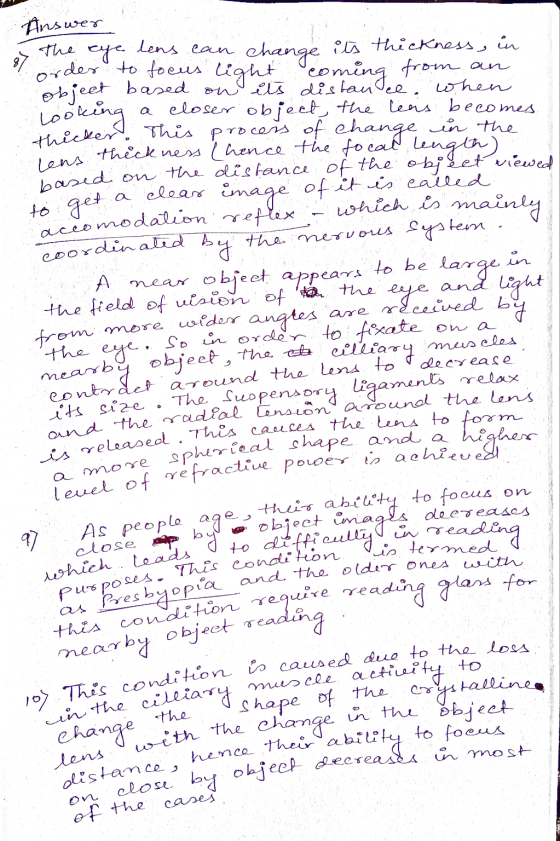
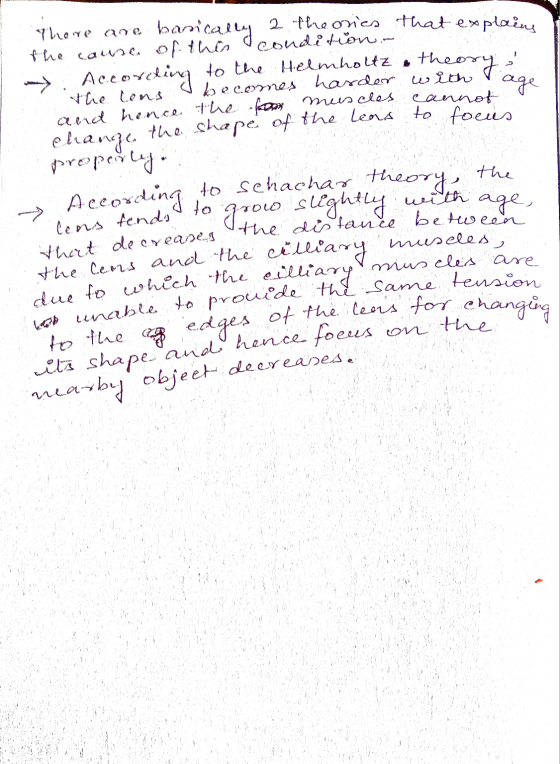
The eye is a very sensitive organ and is very much controlled by the nervous system because it is a specialized extension of the brain. So,with the help of the nervous coordination it makes appropriate responses for light intensity and object distance to get a distinct and clear image of the object viewed ,to form on the retina.
Add Answer to:
ACCOMMODATION • Obtain a card with a thin letter on it and bring it towards the...
3. Consider the compound optical system shown in the diagram, where two thin lenses of focal...
 3. Consider the compound optical system shown
in the diagram, where two thin lenses of focal lengths 7.5
cm (left lens) and 8.5 cm (right lens) are separated by a
distance 32 cm.
a) If an object is placed a distance do =
15.3 cm to the left of the first lens (the left one) as
shown in the figure, how far to the right of that lens, in
centimeters, is the image formed?
b) What is the magnification of...
3. Consider the compound optical system shown
in the diagram, where two thin lenses of focal lengths 7.5
cm (left lens) and 8.5 cm (right lens) are separated by a
distance 32 cm.
a) If an object is placed a distance do =
15.3 cm to the left of the first lens (the left one) as
shown in the figure, how far to the right of that lens, in
centimeters, is the image formed?
b) What is the magnification of...
Help with part a, please! Problem 4 In problem set 9, we briefly looked at how the intensity of light reaching the retina is strongly influenced by the pupil. In front of the pupil is the cornea and...
 Help with part a, please!
Problem 4 In problem set 9, we briefly looked at how the intensity of light reaching the retina is strongly influenced by the pupil. In front of the pupil is the cornea and just behind is the lens, both of which work together to direct and focus light in the eye. Light first enters the eye through the cornea, is bent through the pupil, and then moves through the lens which is controlled by muscles...
Help with part a, please!
Problem 4 In problem set 9, we briefly looked at how the intensity of light reaching the retina is strongly influenced by the pupil. In front of the pupil is the cornea and just behind is the lens, both of which work together to direct and focus light in the eye. Light first enters the eye through the cornea, is bent through the pupil, and then moves through the lens which is controlled by muscles...
Goal Apply geometric optics to correct nearsightedness. Problem A particular nearsighted patient can't see objects clearly...
 Goal Apply geometric optics to correct nearsightedness. Problem A particular nearsighted patient can't see objects clearly when they are beyond 24 cm (the far point of the eye). (a) What focal length should the prescribed contact lens have to correct this problem? (b) Find the power of the lens, in diopters. Neglect the distance between the eye and the corrective lens. Strategy The purpose of the lens in this instance is to take objects at infinity and create an image...
In the figure, a sand grain is 3.5 cm from thin lens 1, on the central...
 In the figure, a sand grain is 3.5 cm from thin lens 1, on the central axis through the two symmetric lenses. The distance between focal point and lens is 4.6 cm for both lenses; the lenses are separated by 9.2 cm. (a) What is the distance between lens 2 and the image it produces of the sand grain? Is that image (b) to the left or right of lens 2, (c) real or virtual, and (d) inverted relative to...
C Exercise 25.18 5 of 10 Review 1 Constants l Periodic Table Part A Bifocal glasses are used to c...
 C Exercise 25.18 5 of 10 Review 1 Constants l Periodic Table Part A Bifocal glasses are used to correct both nearsightedness and farsightedness at the same time. (Figure 1) If the near points in the right and left eyes are 34.0 cm and 48.0 cm, respectively, and the far point is 230 cm for both eyes, what are the powers of the lens prescribed for the right eye? (Assume that the glasses are worn 3.00 cm from the eyes.)...
An octopus has eyes that are very similar to yours. If an octopus leaves the water,...
An octopus has eyes that are very similar to yours. If an octopus leaves the water, will it be nearsighted or farsighted? Explain. If you are nearsighted, your vision is sharper outside in bright light than it is indoors in dimmer light. But if you have perfect vision, it is possible that, in very bright light, your vision could be slightly less sharp. Explain what is happening in each of these cases. I have a combination of myopia and presbyopia—overall,...
Please help with part C and E Review IC Part A A 30-year-old optometry patient focuses...
 Please help with part C and E
Review IC Part A A 30-year-old optometry patient focuses on a 6.50 cm-tall photograph at his near point. (See the table below.) We can model his eye as a sphere 2.50 cm in diameter, with a thin lens at the front and the retina at the rear. Receding of near point with age: Age (years) Near point (cm) 10 7 10 What is the effective focal length of his eye when he focuses...
Please help with part C and E
Review IC Part A A 30-year-old optometry patient focuses on a 6.50 cm-tall photograph at his near point. (See the table below.) We can model his eye as a sphere 2.50 cm in diameter, with a thin lens at the front and the retina at the rear. Receding of near point with age: Age (years) Near point (cm) 10 7 10 What is the effective focal length of his eye when he focuses...
90 cm, an eyepiece lens with a fosal length of 6.20 m and a barrel A custom-made compound microcp...
 90 cm, an eyepiece lens with a fosal length of 6.20 m and a barrel A custom-made compound microcpe (see the figure below) wih an objective lens with a focal length of 3 ength of 29.5 cm is used to view a D.100 cm specimen mounted on a microscope slide. Since the miaroscope is custom-made, varies slightly from a standard production rn croscope in that the object distance for the ubjectve ฯ Bo much larger than the otel length of...
1. The distance from the center of a lens to the location where parallel rays converge...
 1. The distance from the center of a lens to the location where parallel rays converge or appear to converge is called the length. convergence O meeting O focal O None of the above 2. When incoming rays are the focal point and the image point are the same. O parallel O from a nearby object O passing through the near side focal point O None of the above 3. A(n) image will not appear on a screen placed at...
Problem 25.25 - Enhanced - with Solution 19 of 21 A Review Constants Submit Previous Answers...
 Problem 25.25 - Enhanced - with Solution 19 of 21 A Review Constants Submit Previous Answers A thin lens with a focal length of 6.15 cm is used as a simple magnifier. For related problem-solving tips and strategies, you may want to view a Video Tutor Solution of A simple magnifier. Correct Set Up: When the object is at the focal point the image is at infinity and M= 25.0 cm Solve: M 25.0 cm 6.15cm 4.07x Part B When...
 3. Consider the compound optical system shown
in the diagram, where two thin lenses of focal lengths 7.5
cm (left lens) and 8.5 cm (right lens) are separated by a
distance 32 cm.
a) If an object is placed a distance do =
15.3 cm to the left of the first lens (the left one) as
shown in the figure, how far to the right of that lens, in
centimeters, is the image formed?
b) What is the magnification of...
3. Consider the compound optical system shown
in the diagram, where two thin lenses of focal lengths 7.5
cm (left lens) and 8.5 cm (right lens) are separated by a
distance 32 cm.
a) If an object is placed a distance do =
15.3 cm to the left of the first lens (the left one) as
shown in the figure, how far to the right of that lens, in
centimeters, is the image formed?
b) What is the magnification of...
 Help with part a, please!
Problem 4 In problem set 9, we briefly looked at how the intensity of light reaching the retina is strongly influenced by the pupil. In front of the pupil is the cornea and just behind is the lens, both of which work together to direct and focus light in the eye. Light first enters the eye through the cornea, is bent through the pupil, and then moves through the lens which is controlled by muscles...
Help with part a, please!
Problem 4 In problem set 9, we briefly looked at how the intensity of light reaching the retina is strongly influenced by the pupil. In front of the pupil is the cornea and just behind is the lens, both of which work together to direct and focus light in the eye. Light first enters the eye through the cornea, is bent through the pupil, and then moves through the lens which is controlled by muscles...
 Goal Apply geometric optics to correct nearsightedness. Problem A particular nearsighted patient can't see objects clearly when they are beyond 24 cm (the far point of the eye). (a) What focal length should the prescribed contact lens have to correct this problem? (b) Find the power of the lens, in diopters. Neglect the distance between the eye and the corrective lens. Strategy The purpose of the lens in this instance is to take objects at infinity and create an image...
 In the figure, a sand grain is 3.5 cm from thin lens 1, on the central axis through the two symmetric lenses. The distance between focal point and lens is 4.6 cm for both lenses; the lenses are separated by 9.2 cm. (a) What is the distance between lens 2 and the image it produces of the sand grain? Is that image (b) to the left or right of lens 2, (c) real or virtual, and (d) inverted relative to...
 C Exercise 25.18 5 of 10 Review 1 Constants l Periodic Table Part A Bifocal glasses are used to correct both nearsightedness and farsightedness at the same time. (Figure 1) If the near points in the right and left eyes are 34.0 cm and 48.0 cm, respectively, and the far point is 230 cm for both eyes, what are the powers of the lens prescribed for the right eye? (Assume that the glasses are worn 3.00 cm from the eyes.)...
 Please help with part C and E
Review IC Part A A 30-year-old optometry patient focuses on a 6.50 cm-tall photograph at his near point. (See the table below.) We can model his eye as a sphere 2.50 cm in diameter, with a thin lens at the front and the retina at the rear. Receding of near point with age: Age (years) Near point (cm) 10 7 10 What is the effective focal length of his eye when he focuses...
Please help with part C and E
Review IC Part A A 30-year-old optometry patient focuses on a 6.50 cm-tall photograph at his near point. (See the table below.) We can model his eye as a sphere 2.50 cm in diameter, with a thin lens at the front and the retina at the rear. Receding of near point with age: Age (years) Near point (cm) 10 7 10 What is the effective focal length of his eye when he focuses...
 90 cm, an eyepiece lens with a fosal length of 6.20 m and a barrel A custom-made compound microcpe (see the figure below) wih an objective lens with a focal length of 3 ength of 29.5 cm is used to view a D.100 cm specimen mounted on a microscope slide. Since the miaroscope is custom-made, varies slightly from a standard production rn croscope in that the object distance for the ubjectve ฯ Bo much larger than the otel length of...
 1. The distance from the center of a lens to the location where parallel rays converge or appear to converge is called the length. convergence O meeting O focal O None of the above 2. When incoming rays are the focal point and the image point are the same. O parallel O from a nearby object O passing through the near side focal point O None of the above 3. A(n) image will not appear on a screen placed at...
 Problem 25.25 - Enhanced - with Solution 19 of 21 A Review Constants Submit Previous Answers A thin lens with a focal length of 6.15 cm is used as a simple magnifier. For related problem-solving tips and strategies, you may want to view a Video Tutor Solution of A simple magnifier. Correct Set Up: When the object is at the focal point the image is at infinity and M= 25.0 cm Solve: M 25.0 cm 6.15cm 4.07x Part B When...
Most questions answered within 3 hours.
-
Where is the error in this code sequence?
String s1 = "Hello";
String s2 = "ello";...
asked 10 months ago -
Financial data for Joel de Paris, Inc., for last year
follow:
Joel de Paris, Inc.
Balance...
asked 10 months ago -
Consider this reaction:
Al2(SO4)3 (aq)+ BaCl3
(aq) Al2Cl6 (aq)- +
3BaSO4(s) . What is the...
asked 10 months ago -
Suppose that Savneet is considering increasing her
recent random sample from 20 car rentals to 40...
asked 10 months ago -
Trucks arrive at an unloading terminal at an average rate of 120
per hour.
Trucks arrive...
asked 10 months ago -
Why are methanol and ethanol completely soluble in water while
octanol is not very little soluble....
asked 10 months ago -
A facilities manager at a university reads in a research report
that the mean amount of...
asked 10 months ago -
When the CuSO4 is rehydrated by adding water to the anhydrous
compound, is this an endothermic...
asked 10 months ago -
A ray of sunlight is passing from diamond into crown glass; the
angle of incidence is...
asked 10 months ago -
A block of mass 0.249 kg is placed on top of a light, vertical
spring of...
asked 10 months ago -
how do the kidneys compensate in the presences of acidosis
a) trigger hyperventilate
b) reserve acid...
asked 10 months ago -
Question 501 pts
The rental rate of capital to the firm increases. Which of the
following...
asked 10 months ago