
Homework Answers
Ans:
Similarities between Protein kinase A, B and C
1) All the protein kinases A, B and C are involved in phosphorylation and are made of Serine/ Thereonine amino acid residues.
2) All three protein kinases are involved in the function of transcription.
Differences
1) Function
Protein kinase A has several functions in the cell, including regulation of glycogen, sugar, and lipid metabolism.
Protein kinase B plays a key role in multiple cellular processes such as glucose metabolism, apoptosis, cell proliferation and cell migration.
Protein kinase C is involved in receptor desensitization, in modulating membrane structure events, in regulating transcription, in mediating immune responses, in regulating cell growth and in learning and memory.
2) Activation:
Protein kinase A gets activated by high levels of cAMP.
Protein kinase B gets activated by high levels of growth factors and hormones.
Protein kinase responds to levels of Ca+2 ions and diacylglycerol levels.
Add Answer to:
Quick question. thanks!
Protein kinase A, B, C, What do these proteins have in common? How...
44. Diacylglycerol and calcium activate a. protein kinase A. b. protein kinase C. c. PI 3-kinase....
44. Diacylglycerol and calcium activate a. protein kinase A. b. protein kinase C. c. PI 3-kinase. d. Ca2+/calmodulin-dependent kinase.
Proteins have different parts, or domains, that have different functions. What is the function of an...
 Proteins have different parts, or domains, that have different functions. What is the function of an SH2 domain? A. Binds to a phosphorylated tyrosine on itself B. Binds to a phosphorylated tyrosine on a different protein C. binds to a proline rich sequence in another protein D. Binds to a kinase
Proteins have different parts, or domains, that have different functions. What is the function of an...
Proteins have different parts, or domains, that have different functions. What is the function of an SH2 domain? a. binds to a proline-rich sequence in another protein b. binds to a phosphorylated tyrosine on itself c. binds to a kinase d. binds to a phosphorylated tyrosine on a different protein
Choose all of the following that are differences between kinase receptors and G- protein linked receptors....
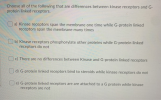 Choose all of the following that are differences between kinase receptors and G- protein linked receptors. a) Kinase receptors span the membrane one time while G-protein linked receptors span the membrane many times b) Kinase receptors phosphorylate other proteins while G-protein linked receptors do not c) There are no differences between Kinase and G-protein linked receptors d) G-protein linked receptors bind to steroids while kinase receptors do not e) G-protein linked receptors are are attached to a G protein while...
Describe how protein kinases and phosphates change the activity of downstream proteins and explain what is...
Describe how protein kinases and phosphates change the activity of downstream proteins and explain what is meant by "kinase cascade" by using the mitogen activated protein kinase pathways as an example.
What do all β-barrel transmembrane proteins have in common? A. The number of β strands. B....
What do all β-barrel transmembrane proteins have in common? A. The number of β strands. B. The diameter of the barrel. C. The number of negative peaks in their hydropathy plots. D. The general function, i.e. membrane transport. E. The structural rigidity compared to α-helical transmembrane proteins.
-Describe how trimeric G proteins get activated and inactivated - Name the two common second messengers In what signaling pathways do these messengers get activated (Yes, you do need to know the...
 -Describe how trimeric G proteins get activated and inactivated - Name the two common second messengers In what signaling pathways do these messengers get activated (Yes, you do need to know the names of the key players in the pathway!)? What can the second messenger then do? What two criteria are needed for activation of a receptor tyrosine kinase? -Describe how monomeric Ras is activated and what does Ras do upon activation. (Again, you must know the signaling pathway)
-Describe...
-Describe how trimeric G proteins get activated and inactivated - Name the two common second messengers In what signaling pathways do these messengers get activated (Yes, you do need to know the names of the key players in the pathway!)? What can the second messenger then do? What two criteria are needed for activation of a receptor tyrosine kinase? -Describe how monomeric Ras is activated and what does Ras do upon activation. (Again, you must know the signaling pathway)
-Describe...
Lab #14 Protein Synthesis Introduction Proteins are vital for the survival of an organism. Proteins make...
 Lab #14 Protein Synthesis Introduction Proteins are vital for the survival of an organism. Proteins make enzymes and hormones which control reactions that must take place in the cell to survive.Proteins are made of basic units called amino acids. There are a total of 20 amino acids. Different proteins have different number and/or combination of amino acids. The kind of amino acid that is used when producing the protein depends on the 3-base code (codon) read from the RNA molecule...
QUESTION 1 To study how proteins fold, scientists must be able to purify the protein of...
QUESTION 1 To study how proteins fold, scientists must be able to purify the protein of interest, use solvents like urea to denature the folded protein, and observe the process of refolding at successive time points. What is the effect of the solvents used in the denaturation process? a. The solvents break all noncovalent interactions. b. The solvents break all covalent interactions. c. The solvents create a new folded conformation. d. The solvents break some of the noncovalent interactions, resulting...
9. In the mixture of proteins you have protein A: 35 kDa, protein B: 15 kDa,...
 9. In the mixture of proteins you have protein A: 35 kDa, protein B: 15 kDa, protein C: 58 kDa, protein D: 150 kDa. Propose the chromatographical method to separate them. Write in which order they would elute from the column. 10. What is the best chromatographical method to separate fluorescein and amide black? They are organic dyes.
 Proteins have different parts, or domains, that have different functions. What is the function of an SH2 domain? A. Binds to a phosphorylated tyrosine on itself B. Binds to a phosphorylated tyrosine on a different protein C. binds to a proline rich sequence in another protein D. Binds to a kinase
 Choose all of the following that are differences between kinase receptors and G- protein linked receptors. a) Kinase receptors span the membrane one time while G-protein linked receptors span the membrane many times b) Kinase receptors phosphorylate other proteins while G-protein linked receptors do not c) There are no differences between Kinase and G-protein linked receptors d) G-protein linked receptors bind to steroids while kinase receptors do not e) G-protein linked receptors are are attached to a G protein while...
 -Describe how trimeric G proteins get activated and inactivated - Name the two common second messengers In what signaling pathways do these messengers get activated (Yes, you do need to know the names of the key players in the pathway!)? What can the second messenger then do? What two criteria are needed for activation of a receptor tyrosine kinase? -Describe how monomeric Ras is activated and what does Ras do upon activation. (Again, you must know the signaling pathway)
-Describe...
-Describe how trimeric G proteins get activated and inactivated - Name the two common second messengers In what signaling pathways do these messengers get activated (Yes, you do need to know the names of the key players in the pathway!)? What can the second messenger then do? What two criteria are needed for activation of a receptor tyrosine kinase? -Describe how monomeric Ras is activated and what does Ras do upon activation. (Again, you must know the signaling pathway)
-Describe...
 Lab #14 Protein Synthesis Introduction Proteins are vital for the survival of an organism. Proteins make enzymes and hormones which control reactions that must take place in the cell to survive.Proteins are made of basic units called amino acids. There are a total of 20 amino acids. Different proteins have different number and/or combination of amino acids. The kind of amino acid that is used when producing the protein depends on the 3-base code (codon) read from the RNA molecule...
 9. In the mixture of proteins you have protein A: 35 kDa, protein B: 15 kDa, protein C: 58 kDa, protein D: 150 kDa. Propose the chromatographical method to separate them. Write in which order they would elute from the column. 10. What is the best chromatographical method to separate fluorescein and amide black? They are organic dyes.
Most questions answered within 3 hours.
-
Where is the error in this code sequence?
String s1 = "Hello";
String s2 = "ello";...
asked 10 months ago -
Financial data for Joel de Paris, Inc., for last year
follow:
Joel de Paris, Inc.
Balance...
asked 10 months ago -
Consider this reaction:
Al2(SO4)3 (aq)+ BaCl3
(aq) Al2Cl6 (aq)- +
3BaSO4(s) . What is the...
asked 10 months ago -
Suppose that Savneet is considering increasing her
recent random sample from 20 car rentals to 40...
asked 10 months ago -
Trucks arrive at an unloading terminal at an average rate of 120
per hour.
Trucks arrive...
asked 10 months ago -
Why are methanol and ethanol completely soluble in water while
octanol is not very little soluble....
asked 10 months ago -
A facilities manager at a university reads in a research report
that the mean amount of...
asked 10 months ago -
When the CuSO4 is rehydrated by adding water to the anhydrous
compound, is this an endothermic...
asked 10 months ago -
A ray of sunlight is passing from diamond into crown glass; the
angle of incidence is...
asked 10 months ago -
A block of mass 0.249 kg is placed on top of a light, vertical
spring of...
asked 10 months ago -
how do the kidneys compensate in the presences of acidosis
a) trigger hyperventilate
b) reserve acid...
asked 10 months ago -
Question 501 pts
The rental rate of capital to the firm increases. Which of the
following...
asked 10 months ago