Many drugs are very large NON-POLAR molecules that show some bit of motility. And are
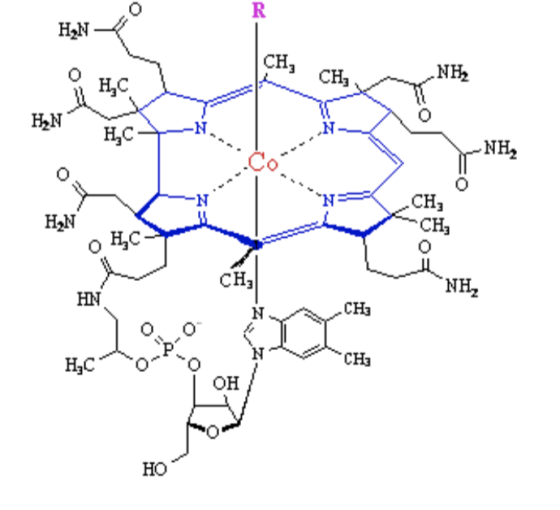
difficult for the body to transport from body location to another. Discuss using the drug below
(vitamin B12), how you would go about modifying the drug further to accommodate a more
flexible motility.
Homework Answers
Cobalamin (Cbl) is an essential nutrient for mammals, because two of its derivatives, methyl-Cbl and 5′-deoxyadenosyl-Cbl (Ado-Cbl), act as coenzymes for methionine synthase and methyl-malonyl-CoA mutase, respectively (1, 2). Only microorganisms are capable of synthesizing Cbl. Consequently, animals have developed a complex pathway for gastrointestinal absorption, blood transport, and cellular uptake of dietary Cbl or vitamin B12 (cyano-Cbl). Cbl delivery from food to tissues involves three successive transport proteins and their cell-surface receptors (3, 4). Protein-free Cbl is first bound to haptocorrin (HC) in saliva. After proteolysis of HC–Cbl and other protein complexes of dietary Cbl in the duodenum, Cbl binds to intrinsic factor (IF) in the proximal ileum. The IF–Cbl complex enters mucosal cells in the distal ileum by receptor-mediated endocytosis, and Cbl is transferred to transcobalamin II (TC) (5), whose suggested source is the vascular endothelium (5), and which is the only nonglycosylated protein among the transporters. TC–Cbl is released to the plasma and enters cells by endocytosis via a receptor of as-yet-controversial identity (4). After dissociation of the TC–Cbl complex in lysosomes, Cbl is transformed to the coenzymes methyl- and Ado-Cbl in the cytoplasm and in mitochondria, respectively. Approximately one-quarter of Cbl in plasma is bound to TC, whereas the rest circulates bound to plasmatic HC that can enter only hepatocytes. All three proteins carry a single Cbl molecule and show high affinity to the ligand (6) but differ in specificity for Cbl and its analogues produced by microorganisms (7).
Add Answer to:
Many drugs are very large NON-POLAR molecules that show
some bit of motility. And are
difficult...
Most questions answered within 3 hours.
-
Where is the error in this code sequence?
String s1 = "Hello";
String s2 = "ello";...
asked 11 months ago -
Financial data for Joel de Paris, Inc., for last year
follow:
Joel de Paris, Inc.
Balance...
asked 11 months ago -
Consider this reaction:
Al2(SO4)3 (aq)+ BaCl3
(aq) Al2Cl6 (aq)- +
3BaSO4(s) . What is the...
asked 11 months ago -
Suppose that Savneet is considering increasing her
recent random sample from 20 car rentals to 40...
asked 11 months ago -
Trucks arrive at an unloading terminal at an average rate of 120
per hour.
Trucks arrive...
asked 11 months ago -
Why are methanol and ethanol completely soluble in water while
octanol is not very little soluble....
asked 11 months ago -
A facilities manager at a university reads in a research report
that the mean amount of...
asked 11 months ago -
When the CuSO4 is rehydrated by adding water to the anhydrous
compound, is this an endothermic...
asked 11 months ago -
A ray of sunlight is passing from diamond into crown glass; the
angle of incidence is...
asked 11 months ago -
A block of mass 0.249 kg is placed on top of a light, vertical
spring of...
asked 11 months ago -
how do the kidneys compensate in the presences of acidosis
a) trigger hyperventilate
b) reserve acid...
asked 11 months ago -
Question 501 pts
The rental rate of capital to the firm increases. Which of the
following...
asked 11 months ago