In the Ireland, 10% of the population is red haired. Assuming mating is random, what is...
In the Ireland, 10% of the population is red
haired. Assuming mating is random, what is the frequency of
heterozygotes in Ireland?
Homework Answers
It is given that 10% of the individual in a population have red hair. The frequency of red hair individual is 0.10
The allelic frequency for red (r) allele is √0.10= 0.316227766
The allelic frequency of R is 1- r= 1-0.31622776=-l 0.683772234
The heterozygous frequency is 2× R×r = 2×0.316227766× 0.683772234= 0.432455532
On round off upt9 two decimal place, the answer is 0.43
Add Answer to:
In the Ireland, 10% of the population is red
haired. Assuming mating is random, what is...
In a hypothetical population which is in Hardy Weinberg equilibrium, the frequency for a recessive allele...
In a hypothetical population which is in Hardy Weinberg equilibrium, the frequency for a recessive allele is 30%. What percentage of the population would be expected to show the dominant trait in the next generation? Humans who are born homozygous for the recessive sickle cell allele die of sickle cell anemia, while those who are heterozygous are resistant to malaria (see chapter 4 for more information on this balanced polymorphism). 4% of the population of the Congo are homozygous recessive for...
Humans who are born homozygous for the recessive sickle cell allele die of sickle cell anemia,...
Humans who are born homozygous for the recessive sickle cell allele die of sickle cell anemia, while those who are heterozygous are resistant to malaria (see chapter 4 for more information on this balanced polymorphism). 4% of the population of the Congo are homozygous recessive for the sickle cell allele. What percentage of the population is resistant to malaria? Red hair is a result of a recessive mutation at the melanocortin 1 receptor (MC1R). As you learned, about 13% of the...
In a population of flowers, red is dominant to white. Assuming the population is in HWE,...
In a population of flowers, red is dominant to white. Assuming the population is in HWE, if the red allele frequency is 0.46, what is the red phenotype frequency? answer to two decimals
in a study, 8 long-haired rats and 7 short haired rats were selected at random the...
in a study, 8 long-haired rats and 7 short haired rats were selected at random the heights of these rats were then measured. let μ1 and μ2 be the population mean height of both the long-haired and short-haired rats (respectively). Assume that the length measurements for both populations are normally distributed. long-haired rats: n1=8, x̄1=185, s1=8 short-haired rats: n1=7, x̄2=198, s2=10 i) what is the evidence (very strong / strong / moderate / little or no) we have against the...
In an infinitely large, diploid, random-mating population, we observe the frequency of nonsense mutations is equal...
In an infinitely large, diploid, random-mating population, we observe the frequency of nonsense mutations is equal to 10^-4 in a gene. A) If we assume the nonsense mutations cause complete infertility and are completely dominant, what is the nonsense mutation rate per gene per generation? (2 points) B) If we assume the nonsense mutations cause complete infertility but are complete recessive, what is the nonsense mutation rate? (2 points)
mutation rate Question 1: In an infinitely large, diploid, random-mating population, we observe the frequency of...
 mutation rate
Question 1: In an infinitely large, diploid, random-mating population, we observe the frequency of nonsense mutations is equal to 10 in a gene. A) If we assume the nonsense mutations cause complete infertility and are completely dominant, what is the nonsense mutation rate per gene per generation? (2 points) B) If we assume the nonsense mutations cause complete infertility but are complete recessive, what is the nonsense mutation rate? (2 points)
mutation rate
Question 1: In an infinitely large, diploid, random-mating population, we observe the frequency of nonsense mutations is equal to 10 in a gene. A) If we assume the nonsense mutations cause complete infertility and are completely dominant, what is the nonsense mutation rate per gene per generation? (2 points) B) If we assume the nonsense mutations cause complete infertility but are complete recessive, what is the nonsense mutation rate? (2 points)
A population of birds has 24 animals with red tail feathers and 52 animals with blue...
A population of birds has 24 animals with red tail feathers and 52 animals with blue tail feathers. Blue feathers are the dominant trait. a. What is the frequency of the red allele? b. What is the frequency of the blue allele? c. What is the frequency of the heterozygotes? d. What is the frequency of birds homozygous for the blue allele? e. What is the frequency of birds homozygous for the red allele?
2. Which of the following correctly describes how inbreeding will affect genotype and allele frequencies in...
 2. Which of the following correctly describes how inbreeding will affect genotype and allele frequencies in Hardy-Weinberg populations? Genotype and allele frequencies will be unaffected. The frequency of heterozygotes will decrease, but allele frequencies will be unaffected. The frequency of homozygotes will increase, and deleterious alleles will decrease. Beneficial alleles will increase in frequency, as well as the genotypes containing those alleles. Genotype frequencies will return to H-W expectations after 1 generation of random mating. 3. Consider a population with...
What is the probability that a lady has a red-haired gene? The probability of her mother...
What is the probability that a lady has a red-haired gene? The probability of her mother having the gene is 2/3 and the probability of her father having the gene is 1/4.
QUESTION 48 What would be the long-term outcome in this population (AA: 400, red dermis: Aa:...
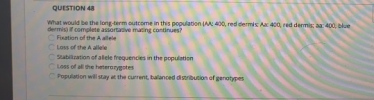 QUESTION 48 What would be the long-term outcome in this population (AA: 400, red dermis: Aa: 400, red dermis:aa: 400, blue dermis) if complete assortative mating continues? Fixation of the A allele CLoss of the A allele Stabilization of allele frequencies in the population Loss of all the heterozygotes Population will stay at the current, balanced distribution of genotypes 2 points The diagram below represents an alignment of a randomly cut portion for alcohol dehydrogenase (ALDH), a conserved homologous gene,...
 mutation rate
Question 1: In an infinitely large, diploid, random-mating population, we observe the frequency of nonsense mutations is equal to 10 in a gene. A) If we assume the nonsense mutations cause complete infertility and are completely dominant, what is the nonsense mutation rate per gene per generation? (2 points) B) If we assume the nonsense mutations cause complete infertility but are complete recessive, what is the nonsense mutation rate? (2 points)
mutation rate
Question 1: In an infinitely large, diploid, random-mating population, we observe the frequency of nonsense mutations is equal to 10 in a gene. A) If we assume the nonsense mutations cause complete infertility and are completely dominant, what is the nonsense mutation rate per gene per generation? (2 points) B) If we assume the nonsense mutations cause complete infertility but are complete recessive, what is the nonsense mutation rate? (2 points)
 2. Which of the following correctly describes how inbreeding will affect genotype and allele frequencies in Hardy-Weinberg populations? Genotype and allele frequencies will be unaffected. The frequency of heterozygotes will decrease, but allele frequencies will be unaffected. The frequency of homozygotes will increase, and deleterious alleles will decrease. Beneficial alleles will increase in frequency, as well as the genotypes containing those alleles. Genotype frequencies will return to H-W expectations after 1 generation of random mating. 3. Consider a population with...
 QUESTION 48 What would be the long-term outcome in this population (AA: 400, red dermis: Aa: 400, red dermis:aa: 400, blue dermis) if complete assortative mating continues? Fixation of the A allele CLoss of the A allele Stabilization of allele frequencies in the population Loss of all the heterozygotes Population will stay at the current, balanced distribution of genotypes 2 points The diagram below represents an alignment of a randomly cut portion for alcohol dehydrogenase (ALDH), a conserved homologous gene,...
Most questions answered within 3 hours.
-
Where is the error in this code sequence?
String s1 = "Hello";
String s2 = "ello";...
asked 11 months ago -
Financial data for Joel de Paris, Inc., for last year
follow:
Joel de Paris, Inc.
Balance...
asked 11 months ago -
Consider this reaction:
Al2(SO4)3 (aq)+ BaCl3
(aq) Al2Cl6 (aq)- +
3BaSO4(s) . What is the...
asked 11 months ago -
Suppose that Savneet is considering increasing her
recent random sample from 20 car rentals to 40...
asked 11 months ago -
Trucks arrive at an unloading terminal at an average rate of 120
per hour.
Trucks arrive...
asked 11 months ago -
Why are methanol and ethanol completely soluble in water while
octanol is not very little soluble....
asked 11 months ago -
A facilities manager at a university reads in a research report
that the mean amount of...
asked 11 months ago -
When the CuSO4 is rehydrated by adding water to the anhydrous
compound, is this an endothermic...
asked 11 months ago -
A ray of sunlight is passing from diamond into crown glass; the
angle of incidence is...
asked 11 months ago -
A block of mass 0.249 kg is placed on top of a light, vertical
spring of...
asked 11 months ago -
how do the kidneys compensate in the presences of acidosis
a) trigger hyperventilate
b) reserve acid...
asked 11 months ago -
Question 501 pts
The rental rate of capital to the firm increases. Which of the
following...
asked 11 months ago