
Homework Answers
Ans- first generation does not produce any hairless mouse. when first-generation heterozygous crossed with each other produce hairless mouse in the second generation but not all mice are hairless in the second generation. the second generation also produces normal homozygous, heterozygous, and homozygous knockout (hairless mouse) mouse.
so option first generation are crossed with each other
is the correct option.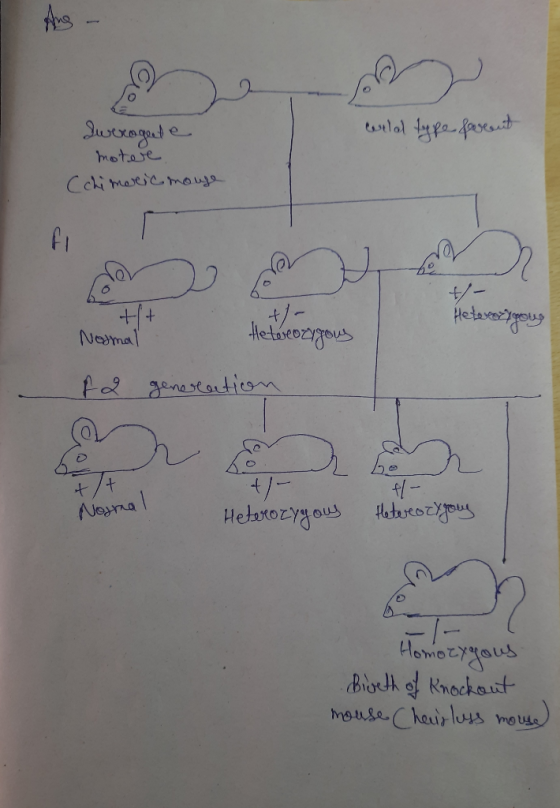
Add Answer to:
You wish to create a transgenic mouse that is completely hairless. You introduce the appropriate mutation...
You wish to create a transgenic mouse that is completely hairless. You introduce the appropriate mutation...
You wish to create a transgenic mouse that is completely hairless. You introduce the appropriate mutation into embryonic stem cells and implant those cells into early embryos. Those embryos are placed in a surrogate mouse who then gives birth to the first generation of mice. These mice are further bred. Which of the following is(are) true? A) First generation is completely hairless B) Second generation is completely hairless C) Third generation is completely hairless D) Second generation is heterozygous E)...
Order the steps to generate a transgenic mouse from when male and female mice are first...
 Order the steps to generate a transgenic mouse from when male and female mice are first mated to breeding heterozygous offspring together to generate a homozygote. mate male and female mice breed heterozygous offspring together to generate a homozygote Answer Bank harvest fertilized eggs from mated females implant the embryos into a surrogate female inject the transgene into a pronucleus identify integrants by DNA analysis
Order the steps to generate a transgenic mouse from when male and female mice are first...
Order the steps to generate a transgenic mouse from when male and female mice are first mated to breeding heterozygous offspring together to generate a homozygote. mate male and female mice breed heterozygous offspring together to generate a homozygote Answer Bank Harvest Fertilized egg from mate females Injected the transgene into pronucleus Id integrants by DNA Analysis Implant the embryos into a surrogate female
6a) You want to use homologous recombination to generate a mouse that does not express a functional XPC gene (‘Knock-out...
6a) You want to use homologous recombination to generate a mouse that does not express a functional XPC gene (‘Knock-out’ or KO). To do this, you want to delete exon 10 and replace it with a gene that confers resistance to the drug Neomycin (NEO. The usual second selection with tk we discussed in class is not shown here). Using the diagram as a guide: illustrate on the diagram where you expect crossing over to occur and (below the diagram)...
2. A dominant allele H reduces the number of body bristles that Drosophila flies have, giving...
2. A dominant allele H reduces the number of body bristles that Drosophila flies have, giving rise to a “hairless” phenotype. In the homozygous condition, H is lethal. An independently assorting dominant allele S has no effect on bristle number except in the presence of H, in which case a single dose of S suppresses the hairless phenotype, thus restoring the "hairy" phenotype. However, S also is lethal in the homozygous (S/S) condition. What ratio of hairy to hairless flies...
1 Overview and Background Many of the assignments in this course will introduce you to topics in ...
 1 Overview and Background Many of the assignments in this course will introduce you to topics in computational biology. You do not need to know anything about biology to do these assignments other than what is contained in the description itself. The objective of each assignment is for you to acquire certain particular skills or knowledge, and the choice of topic is independent of that objective. Sometimes the topics will be related to computational problems in biology, chemistry, or physics,...
 Order the steps to generate a transgenic mouse from when male and female mice are first mated to breeding heterozygous offspring together to generate a homozygote. mate male and female mice breed heterozygous offspring together to generate a homozygote Answer Bank harvest fertilized eggs from mated females implant the embryos into a surrogate female inject the transgene into a pronucleus identify integrants by DNA analysis
 1 Overview and Background Many of the assignments in this course will introduce you to topics in computational biology. You do not need to know anything about biology to do these assignments other than what is contained in the description itself. The objective of each assignment is for you to acquire certain particular skills or knowledge, and the choice of topic is independent of that objective. Sometimes the topics will be related to computational problems in biology, chemistry, or physics,...
Most questions answered within 3 hours.
-
Where is the error in this code sequence?
String s1 = "Hello";
String s2 = "ello";...
asked 10 months ago -
Financial data for Joel de Paris, Inc., for last year
follow:
Joel de Paris, Inc.
Balance...
asked 10 months ago -
Consider this reaction:
Al2(SO4)3 (aq)+ BaCl3
(aq) Al2Cl6 (aq)- +
3BaSO4(s) . What is the...
asked 10 months ago -
Suppose that Savneet is considering increasing her
recent random sample from 20 car rentals to 40...
asked 10 months ago -
Trucks arrive at an unloading terminal at an average rate of 120
per hour.
Trucks arrive...
asked 10 months ago -
Why are methanol and ethanol completely soluble in water while
octanol is not very little soluble....
asked 10 months ago -
A facilities manager at a university reads in a research report
that the mean amount of...
asked 10 months ago -
When the CuSO4 is rehydrated by adding water to the anhydrous
compound, is this an endothermic...
asked 10 months ago -
A ray of sunlight is passing from diamond into crown glass; the
angle of incidence is...
asked 10 months ago -
A block of mass 0.249 kg is placed on top of a light, vertical
spring of...
asked 10 months ago -
how do the kidneys compensate in the presences of acidosis
a) trigger hyperventilate
b) reserve acid...
asked 10 months ago -
Question 501 pts
The rental rate of capital to the firm increases. Which of the
following...
asked 10 months ago