What is a notochord? What is the germ layer from which it originates, and where is...
What is a notochord? What is the germ layer from which it originates, and where is it located? What is its most important role in embryogenesis?
Homework Answers
Among the member of animal kingdom about 95% of these do not possess backbone and hence called Invertebrates, rest 5% are called chordates, which possess a supportive structure at the back of the body. This supportive structure is called Notochord. Notochord is primitive beginning of backbone.
The life cycle of all chordates begins with a single celled Zygote. Then multi-cellular Blastula develops as result of cell of zygote. And it is after the process of gastriculation when the blastula develops 3 embryonic germ layers. These are outer layer- Ectoderm, middle layer- Mesoderm and innermost layer- Endoderm. Mesoderm is the embryonic germ layer from which notochord originates along with skeletal muscles.
Notochord has role during and the embryogenesis and it also induce the next step of embrogenesis. It is the structural element which is important as it defines the axis of the body. It has role in vertebral column segmentation.
Add Answer to:
What is a notochord? What is the germ layer from which it
originates, and where is...
1) Which of the following tissue type is incorrectly paired with the germ layer it originates...
 1) Which of the following tissue type is incorrectly paired with the germ layer it originates from? A) Ectoderm - skin B) Mesoderm - nervous system C) Endoderm - digestive system D) all pairings are correct 2) Which of the following is a function of a skeletal system? A) body posture B) transfer of forces created by muscles C) physical protection of organs and tissues D) all of the above 3) Suppose a researcher for a pest-control company developed a...
Match the reproductive system cell with its description or function. Notochord Formation of internal organs during...
Match the reproductive system cell with its description or function. Notochord Formation of internal organs during development Germ layer that forms the lining of the digestive and respiratory systems Rod-shaped mesodermal structure that forms following gastrulation and releases signaling molecules Infolding of the blastula to form the three germinal tissue layers Hollow ball of cells that results from cleavage Rapid series of cell divisions without cell growth following fertilization A ball of mesoderm that eventually produces muscle and bone tissue...
And there was. — Germ Layer — Zygote — Inheritance - What does placenta do? —...
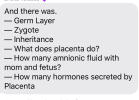 And there was. — Germ Layer — Zygote — Inheritance - What does placenta do? — How many amnionic fluid with mom and fetus? — How many hormones secreted by Placenta
4. What tissue(s) is each of the following embryonic/extraembrhyonic tissues derived from during development (list germ...
 4. What tissue(s) is each of the following embryonic/extraembrhyonic tissues derived from during development (list germ layer and embryonic/extrembryonic region): a. astrocytes b. chrorionic villi c. neurons comprising the oculomotor nerves (CNIII)
Phylum Chordata 8. What are the synapomorphies of chordates? What is the difference between a notochord...
 Phylum Chordata 8. What are the synapomorphies of chordates? What is the difference between a notochord and a nerve cord? 9. What were the advantages and challenges for vertebrates colonizing land? How did early amphibians partially solve them? Why might limbs rather than fins have been an advantage, even if the animal spent all or most of its time in the water? 10. How did early reptiles and mammals improve on the solutions that amphibians started? Now add adaptations of...
Consider the chromosomes for a germ cell from a male dihybrid with the unlinked autosomal genes...
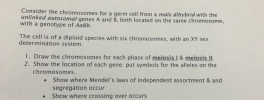 Consider the chromosomes for a germ cell from a male dihybrid with the unlinked autosomal genes A and B, both located on the same chromosome, with a genotype of AaBb. The cell is of a diploid species with six chromosomes, with an XY sex determination system. 1. Draw the chromosomes for each phase of meiosis I & meiosis II 2. Show the location of each gene: put symbols for the alleles on the chromosomes. • Show where Mendel's laws of...
Cell Structure and Function: 1. What is the basic structure of the cytoplasmic membrane, and what...
 Cell Structure and Function: 1. What is the basic structure of the cytoplasmic membrane, and what are its three critical roles in bacteria? (5) 2. What is the role of peptidoglycan in the cell, what are the two polysaccharides which make up the backbone, and what is the advantage for a cell lacking peptidoglycan? (4) 3. What is the difference between Gram-negative and Gram-positive Bacteria in the crosslinking of peptidoglycan? (2) 4. How and why does the Gram stain differentially...
1. The role of Hensen's node in a chicken versus the dorsal lip in the frog....
1. The role of Hensen's node in a chicken versus the dorsal lip in the frog. a. Hensen's Node_______________ b. Dorsal Lip___________________ 2. During the late stages of neurulation part of the neural tubes cells leave and migrate through what structure to become the peripheral nervous system (a.)? What is the germ layer from which this structure arises (b.)? a. b.
The molecular weight of wheat germ acid phosphatase is 55,000. What is its turnover number under...
The molecular weight of wheat germ acid phosphatase is 55,000. What is its turnover number under our experimental conditions? Use Vmax from the uninhibited enzyme. (Recall that the enzyme stock was 0.15 mg/ml). Vmax = 6.04 x 10^-6
1. Use the whole-body region and add one layer of the endocrine system a. Isolate the...
 1. Use the whole-body region and add one layer of the endocrine system a. Isolate the which is responsible for the production of the hormone insulin. Notice the two ducts that exit from the head of this organ, the ducts. Add one layer of the digestive system and observe that these ducts secrete their Remove the digestive system and isolate the hormones that regulate metabolism (T3 and T4). Add one layer of the respiratory system and observe that this gland...
 1) Which of the following tissue type is incorrectly paired with the germ layer it originates from? A) Ectoderm - skin B) Mesoderm - nervous system C) Endoderm - digestive system D) all pairings are correct 2) Which of the following is a function of a skeletal system? A) body posture B) transfer of forces created by muscles C) physical protection of organs and tissues D) all of the above 3) Suppose a researcher for a pest-control company developed a...
 And there was. — Germ Layer — Zygote — Inheritance - What does placenta do? — How many amnionic fluid with mom and fetus? — How many hormones secreted by Placenta
 4. What tissue(s) is each of the following embryonic/extraembrhyonic tissues derived from during development (list germ layer and embryonic/extrembryonic region): a. astrocytes b. chrorionic villi c. neurons comprising the oculomotor nerves (CNIII)
 Phylum Chordata 8. What are the synapomorphies of chordates? What is the difference between a notochord and a nerve cord? 9. What were the advantages and challenges for vertebrates colonizing land? How did early amphibians partially solve them? Why might limbs rather than fins have been an advantage, even if the animal spent all or most of its time in the water? 10. How did early reptiles and mammals improve on the solutions that amphibians started? Now add adaptations of...
 Consider the chromosomes for a germ cell from a male dihybrid with the unlinked autosomal genes A and B, both located on the same chromosome, with a genotype of AaBb. The cell is of a diploid species with six chromosomes, with an XY sex determination system. 1. Draw the chromosomes for each phase of meiosis I & meiosis II 2. Show the location of each gene: put symbols for the alleles on the chromosomes. • Show where Mendel's laws of...
 Cell Structure and Function: 1. What is the basic structure of the cytoplasmic membrane, and what are its three critical roles in bacteria? (5) 2. What is the role of peptidoglycan in the cell, what are the two polysaccharides which make up the backbone, and what is the advantage for a cell lacking peptidoglycan? (4) 3. What is the difference between Gram-negative and Gram-positive Bacteria in the crosslinking of peptidoglycan? (2) 4. How and why does the Gram stain differentially...
 1. Use the whole-body region and add one layer of the endocrine system a. Isolate the which is responsible for the production of the hormone insulin. Notice the two ducts that exit from the head of this organ, the ducts. Add one layer of the digestive system and observe that these ducts secrete their Remove the digestive system and isolate the hormones that regulate metabolism (T3 and T4). Add one layer of the respiratory system and observe that this gland...
Most questions answered within 3 hours.
-
Where is the error in this code sequence?
String s1 = "Hello";
String s2 = "ello";...
asked 10 months ago -
Financial data for Joel de Paris, Inc., for last year
follow:
Joel de Paris, Inc.
Balance...
asked 10 months ago -
Consider this reaction:
Al2(SO4)3 (aq)+ BaCl3
(aq) Al2Cl6 (aq)- +
3BaSO4(s) . What is the...
asked 10 months ago -
Suppose that Savneet is considering increasing her
recent random sample from 20 car rentals to 40...
asked 10 months ago -
Trucks arrive at an unloading terminal at an average rate of 120
per hour.
Trucks arrive...
asked 10 months ago -
Why are methanol and ethanol completely soluble in water while
octanol is not very little soluble....
asked 10 months ago -
A facilities manager at a university reads in a research report
that the mean amount of...
asked 10 months ago -
When the CuSO4 is rehydrated by adding water to the anhydrous
compound, is this an endothermic...
asked 10 months ago -
A ray of sunlight is passing from diamond into crown glass; the
angle of incidence is...
asked 10 months ago -
A block of mass 0.249 kg is placed on top of a light, vertical
spring of...
asked 10 months ago -
how do the kidneys compensate in the presences of acidosis
a) trigger hyperventilate
b) reserve acid...
asked 10 months ago -
Question 501 pts
The rental rate of capital to the firm increases. Which of the
following...
asked 10 months ago