
Homework Answers
Stem cells are the cells which has the ability to differentiate into different type of cells. As everyone know that human body loses and replaces a large number of cells daily the cells for replacement come from stem cells. Stem cells are generally of two types i) embryonic stem cells ii) Adult stem cells.
On the basis of potency stem cells are of 4 types
1) Totipotency ( totipotent stem cells) Totipotency means total potential. These are stem cells which have the ability to differentiate into any cell type including cells of extraembryonic tissues. Totipotent cells differentiate into pluripotent cells.
Example fertilized egg and zygote divided upto first 4 celled stage are totipotent cells.
2) Pluripotency ( Pluripotent stem cells) Pluri means many, which means these cells have potential to differentiate into many cells types but not all. These cells can differentiate into any cell types but not into cells of extraembryonic tissues. These cells can differentiate into three germ layer ecdoderm, mesoderm and endoderm.
Example Inner cell mass of Blastocyst stage of embryonic development can different into three germ layers.
3) Multipotent stem cells these cell type can differentiate into several cell types but can differentiate into limited cell types.
Example Hematopoietic stem cell ( a blood stem cell) is a Multipotent stem cell they can differentiate into all types of blood cells but cannot develop into brain cells.
4) Oligopotency (oligopotent stem cell ) These cells can differentiate into ony few cell types.
Example It includes lymphoid and myeloid cells formed from differentiation of Hematopoietic stem cells. lymphoid cell can give rise to B lymphocytess and T lymphocytes.
Sometimes unipotency term is also used. It includes cells which
can differentiate into single type. Like hepatocytes which form
cells of liver.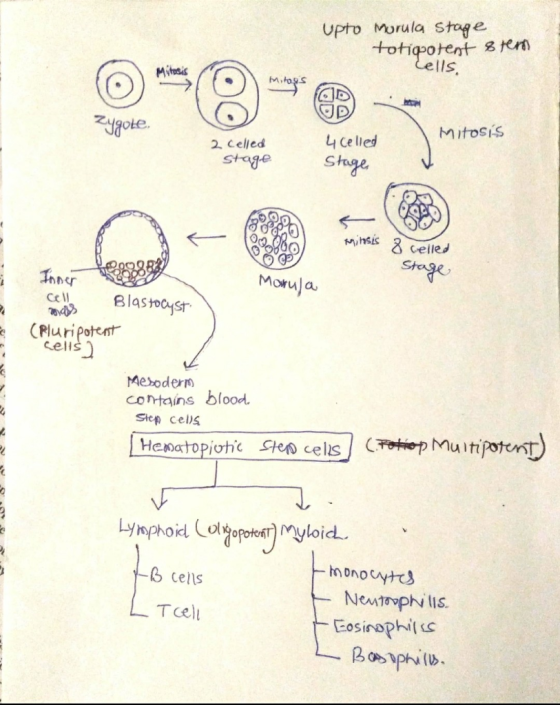
Add Answer to:
2. (a) Write down the definition of stem cell in your word. (b) Describe the four...
1. What is a stem cell line? A. Stem Cells lined up in a row. B....
1. What is a stem cell line? A. Stem Cells lined up in a row. B. Stem Cells in the lineage. C. A population of Stem Cells grown by scientists. D. A Stem Cell broken down, with it's contents placed in a line. 2. What is an Adult Stem Cell? A. A cell extracted from mature tissue. B. A cell extracted only from children. C. A cell extracted only from adults. D. Both A and C. E. None of the...
Please answer the following questions below. 1. Stem Cell Properties - List and describe the two...
Please answer the following questions below. 1. Stem Cell Properties - List and describe the two main properties of stem cells. In your answer, include the different types of potencies? 2. Normal or cancer cells? You are given two flasks of cells. One contains cells from normal tissue while the other contains cells from a human cancer. Before you begin your studies, you accidently erased the labels off both flasks. Now you no longer know the identity of each sample....
2. Describe the first cell division in Dicot development (i.e., from a one-celled zygote to a...
 2. Describe the first cell division in Dicot development (i.e., from a one-celled zygote to a two- veloping embryo). How do the two products of this cell division look? What are the two cells called and which parts of the embryo do their daughter cells give rise to?
Check Your Understanding 3.1 1 What are chromosomes made of? number 2 How many chromosomes are...
 Check Your Understanding 3.1 1 What are chromosomes made of? number 2 How many chromosomes are in a human somatic cell? 46 chromosomes 3 The term used to refer to this full complement of chromosomes is the 4 How many chromosomes are in human gametes? 5 This is referred to as the number 6 Wa chicken's skin cell has 78 chromosomes, how many chromosomes would the chicken's sperm cell have? 7 How can we distinguish the 23 types of chromosomes...
1. At the molecular level, what drives B cell development in the bone marrow? 2. What...
1. At the molecular level, what drives B cell development in the bone marrow? 2. What is the role of stromal cells in B cell development in the bone marrow? 3. Describe the sequence of events in B cell development with respect to rearrangement of heavy and light chain Ig genes. 4. Why does Ig gene rearrangement often fail to produce a functional protein product? What mechanisms exist to overcome this problem? 5. What is “allelic exclusion” and what is...
4. (a) Write down four nuclear reactions that describes decay of radioactive materials. Apart from these...
4. (a) Write down four nuclear reactions that describes decay of radioactive materials. Apart from these specific examples, write general equations for each of these four cases. (b) What are the ways to protect human lives against various radiation coming from radioactive decay processes? Do not use cursive writing. Write down the process in detail.
just question #2 Lymphocyte Development 1. B cell development in the bone marrow shares may features...
 just question #2
Lymphocyte Development 1. B cell development in the bone marrow shares may features with T cell development in the thymus. A) Discuss what you consider to be the two major goals of lymphocyte development (i.e. what is the purpose of the Bone marrow and Thymus environments). B) Describe what occurs during the Precursor B cell stage and identify/describe the analogous stage in T cells. 2. With regards to what we've discussed regarding T cell development and alloreactivity,...
just question #2
Lymphocyte Development 1. B cell development in the bone marrow shares may features with T cell development in the thymus. A) Discuss what you consider to be the two major goals of lymphocyte development (i.e. what is the purpose of the Bone marrow and Thymus environments). B) Describe what occurs during the Precursor B cell stage and identify/describe the analogous stage in T cells. 2. With regards to what we've discussed regarding T cell development and alloreactivity,...
(17) (20pt) Let F be the set of functions f : R+ → R. Prove that the binary relation "f is 0(g)" on F is: (a) (4pt) Write down the definition for "f is O(g)". (b) (4pt) Prove that the...
 (17) (20pt) Let F be the set of functions f : R+ → R. Prove that the binary relation "f is 0(g)" on F is: (a) (4pt) Write down the definition for "f is O(g)". (b) (4pt) Prove that the relation is reflexive (c) (6pt) Prove that the relation is not symmetric. (d) (6pt) Prove that the relation is transitive.
(17) (20pt) Let F be the set of functions f : R+ → R. Prove that the binary relation "f...
(17) (20pt) Let F be the set of functions f : R+ → R. Prove that the binary relation "f is 0(g)" on F is: (a) (4pt) Write down the definition for "f is O(g)". (b) (4pt) Prove that the relation is reflexive (c) (6pt) Prove that the relation is not symmetric. (d) (6pt) Prove that the relation is transitive.
(17) (20pt) Let F be the set of functions f : R+ → R. Prove that the binary relation "f...
Research Paper Outline Draft on Stem Cell Research Instructions: Please complete the following steps for your...
Research Paper Outline Draft on Stem Cell Research Instructions: Please complete the following steps for your discussion post and response. This discussion will allow you to create your outline or map for your first draft. Create a traditional outline that follows this format (Links to an external site.)Links to an external site.. Make sure you fill in the information specific to your topic and your essay. It is recommended that you complete this in a Word document (or other word...
What benefit can human stem cells provide to individuals with a genetically determine immunodeficiency? How would...
What benefit can human stem cells provide to individuals with a genetically determine immunodeficiency? How would the process work? Can individuals receive their own stem cells? Fill in the blanks with the missing information about primary and secondary lymphoid organs: The ___________ is the site of T cell development and maturation. The ________ is the site of B cell differentiation and hematopoesis. The ___________ are the sites where immune responses are mounted to antigens in the lymph. The _____________ is...
 2. Describe the first cell division in Dicot development (i.e., from a one-celled zygote to a two- veloping embryo). How do the two products of this cell division look? What are the two cells called and which parts of the embryo do their daughter cells give rise to?
 Check Your Understanding 3.1 1 What are chromosomes made of? number 2 How many chromosomes are in a human somatic cell? 46 chromosomes 3 The term used to refer to this full complement of chromosomes is the 4 How many chromosomes are in human gametes? 5 This is referred to as the number 6 Wa chicken's skin cell has 78 chromosomes, how many chromosomes would the chicken's sperm cell have? 7 How can we distinguish the 23 types of chromosomes...
 just question #2
Lymphocyte Development 1. B cell development in the bone marrow shares may features with T cell development in the thymus. A) Discuss what you consider to be the two major goals of lymphocyte development (i.e. what is the purpose of the Bone marrow and Thymus environments). B) Describe what occurs during the Precursor B cell stage and identify/describe the analogous stage in T cells. 2. With regards to what we've discussed regarding T cell development and alloreactivity,...
just question #2
Lymphocyte Development 1. B cell development in the bone marrow shares may features with T cell development in the thymus. A) Discuss what you consider to be the two major goals of lymphocyte development (i.e. what is the purpose of the Bone marrow and Thymus environments). B) Describe what occurs during the Precursor B cell stage and identify/describe the analogous stage in T cells. 2. With regards to what we've discussed regarding T cell development and alloreactivity,...
 (17) (20pt) Let F be the set of functions f : R+ → R. Prove that the binary relation "f is 0(g)" on F is: (a) (4pt) Write down the definition for "f is O(g)". (b) (4pt) Prove that the relation is reflexive (c) (6pt) Prove that the relation is not symmetric. (d) (6pt) Prove that the relation is transitive.
(17) (20pt) Let F be the set of functions f : R+ → R. Prove that the binary relation "f...
(17) (20pt) Let F be the set of functions f : R+ → R. Prove that the binary relation "f is 0(g)" on F is: (a) (4pt) Write down the definition for "f is O(g)". (b) (4pt) Prove that the relation is reflexive (c) (6pt) Prove that the relation is not symmetric. (d) (6pt) Prove that the relation is transitive.
(17) (20pt) Let F be the set of functions f : R+ → R. Prove that the binary relation "f...
Most questions answered within 3 hours.
-
Where is the error in this code sequence?
String s1 = "Hello";
String s2 = "ello";...
asked 10 months ago -
Financial data for Joel de Paris, Inc., for last year
follow:
Joel de Paris, Inc.
Balance...
asked 10 months ago -
Consider this reaction:
Al2(SO4)3 (aq)+ BaCl3
(aq) Al2Cl6 (aq)- +
3BaSO4(s) . What is the...
asked 10 months ago -
Suppose that Savneet is considering increasing her
recent random sample from 20 car rentals to 40...
asked 10 months ago -
Trucks arrive at an unloading terminal at an average rate of 120
per hour.
Trucks arrive...
asked 10 months ago -
Why are methanol and ethanol completely soluble in water while
octanol is not very little soluble....
asked 10 months ago -
A facilities manager at a university reads in a research report
that the mean amount of...
asked 10 months ago -
When the CuSO4 is rehydrated by adding water to the anhydrous
compound, is this an endothermic...
asked 10 months ago -
A ray of sunlight is passing from diamond into crown glass; the
angle of incidence is...
asked 10 months ago -
A block of mass 0.249 kg is placed on top of a light, vertical
spring of...
asked 10 months ago -
how do the kidneys compensate in the presences of acidosis
a) trigger hyperventilate
b) reserve acid...
asked 10 months ago -
Question 501 pts
The rental rate of capital to the firm increases. Which of the
following...
asked 10 months ago