
Homework Answers
The wolf spider, orb-weaver spider, and grass weaver spider are three distinct spider species that are present in the same habitat or niche.
As can be seen from the first graph on the left, the three species exhibit a distinct height of webs with almost little overlap. Hence they would not face competition based on habitat and all these can co-exist in the given niche.
The figure on the right exhibits the prey size of these spiders. The grass and orb-weaver spiders have a huge difference in their prey size with very little overlap. However, the wolf spider does exhibit a significant overlap in prey size with both the grass and the orb-weaver spiders. Thus, it will be facing huge competition in terms of food from both the species.
From the given data, we cannot talk about the carrying capacity of these spiders. Hence the first option is irrelevant to the question.
Clearly the orb spiders are not facing competitive exclusion, rather competitive exclusion is faced by the wolf spider.
And as argued earlier, the partitioning in habitat/niche is good which will promote the co-existence of these species.
Add Answer to:
what do you conclude about inter-specific competition between
these species?
wildt do you Conciue duuucci spec...
Given the transition to online learning, you now have more time to study the spiders in...
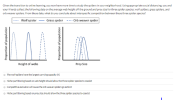 Given the transition to online learning, you now have more time to study the spiders in your neighborhood. Using appropriate social distancing, you and your friends collect the following data on the average web height off the ground and prey size for three spider species: wolf spiders, grass spiders, and orb weaver spiders. From these data, what do you conclude about interspecific competition between these three spider species? - Wolfspider — Grass spider --- Orb weaver spider Proportion of population...
 Given the transition to online learning, you now have more time to study the spiders in your neighborhood. Using appropriate social distancing, you and your friends collect the following data on the average web height off the ground and prey size for three spider species: wolf spiders, grass spiders, and orb weaver spiders. From these data, what do you conclude about interspecific competition between these three spider species? - Wolfspider — Grass spider --- Orb weaver spider Proportion of population...
Most questions answered within 3 hours.
-
Where is the error in this code sequence?
String s1 = "Hello";
String s2 = "ello";...
asked 10 months ago -
Financial data for Joel de Paris, Inc., for last year
follow:
Joel de Paris, Inc.
Balance...
asked 10 months ago -
Consider this reaction:
Al2(SO4)3 (aq)+ BaCl3
(aq) Al2Cl6 (aq)- +
3BaSO4(s) . What is the...
asked 10 months ago -
Suppose that Savneet is considering increasing her
recent random sample from 20 car rentals to 40...
asked 10 months ago -
Trucks arrive at an unloading terminal at an average rate of 120
per hour.
Trucks arrive...
asked 10 months ago -
Why are methanol and ethanol completely soluble in water while
octanol is not very little soluble....
asked 10 months ago -
A facilities manager at a university reads in a research report
that the mean amount of...
asked 10 months ago -
When the CuSO4 is rehydrated by adding water to the anhydrous
compound, is this an endothermic...
asked 10 months ago -
A ray of sunlight is passing from diamond into crown glass; the
angle of incidence is...
asked 10 months ago -
A block of mass 0.249 kg is placed on top of a light, vertical
spring of...
asked 10 months ago -
how do the kidneys compensate in the presences of acidosis
a) trigger hyperventilate
b) reserve acid...
asked 10 months ago -
Question 501 pts
The rental rate of capital to the firm increases. Which of the
following...
asked 10 months ago