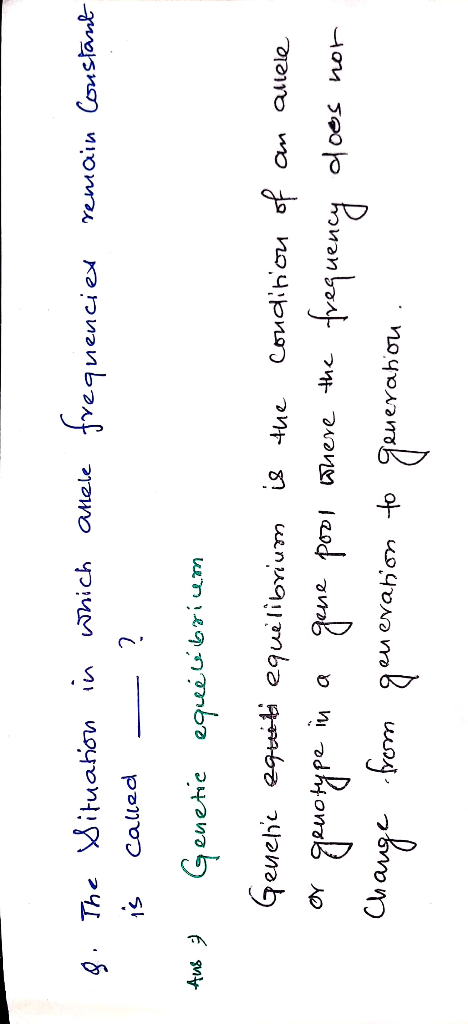
17.) 16.2 The situation in which allele frequencies remain constant is called?
17.) 16.2 The situation in which allele frequencies remain constant is called?
Homework Answers
Add Answer to:
17.) 16.2 The situation in which allele frequencies remain
constant is called?
10. Did the allele frequencies p and q remain the same from generation to generation in...
 10. Did the allele frequencies p and q remain the same from generation to generation in the population? No the allele frequencies did not remain the same from generation to generation. (????) 11. Did the population undergo microevolution? Explain your reasoning. Yes, the population undergoes microevolution. There is found negative selection for the homozygous dominant genotype. (????) I BIO 101 Lab 11: Population Genetics 16 able Chart Text Shape Media Comment Share ips Format Document 12. Based on your observations,...
You collect 34 samples from a population called KNIGHTRO. Allele frequencies are: p=0.21 and q=0.79 If...
You collect 34 samples from a population called KNIGHTRO. Allele frequencies are: p=0.21 and q=0.79 If a new allele "r" arises in KNIGHTRO, what is the probability that this allele will reach fixation assuming the locus is neutral?
In the figure, p is the frequency of allele A, and is the frequency of allele...
 In the figure, p is the frequency of allele A, and is the frequency of allele a in a diploid population. Assuming no differences in fitness, pand should also be the frequencies of A gametes and a gametes produced by the adults. The A and a gametes combine during fertilization to produce diploid zygotes. If mating is random and the population is large, the proportion of offspring with each of three genotypes (AA, Aa, and aa) can be predicted using...
The Hardy-Weinberg principle and its equations predict that frequencies of alleles and genotypes remain constant from generation to generation in populations that are not evolving
.1. The Hardy-Weinberg principle and its equations predict that frequencies of alleles and genotypes remain constant from generation to generation in populations that are not evolving. What five conditions does this prediction assume to be true about such a population? a._______ b._______ c._______ d._______ e._______ 2. Before beginning the activity, answer the following general Hardy-Weinberg problems for practice (assume that the population is at Hardy-Weinberg equilibrium).a. If the frequency of a recessive allele is 0.3, what is the frequency of the dominant...
Question 3 The cause of genetic drift is sampling error, which occurs when allele frequencies of...
 Question 3 The cause of genetic drift is sampling error, which occurs when allele frequencies of a chosen subset of a population are the same as those in the total population, by selection when allele frequencies of a chosen subset of a population are different from those in the total population, by chance when allele frequencies of a chosen subset of a population are different from those in the total population, by selection when allele frequencies of a chosen subset...
Population Genetics and Human Evolution Complete the following discussions: The Hardy-Weinberg equilibrium states that allele frequencies...
Population Genetics and Human Evolution Complete the following discussions: The Hardy-Weinberg equilibrium states that allele frequencies remain constant across generations unless certain influences are introduced, such as nonrandom matings or mutations. Describe the Hardy-Weinberg principle. Are there influences that deviate from the principle? If so, what are they? If no, why?
2. Which of the following correctly describes how inbreeding will affect genotype and allele frequencies in...
 2. Which of the following correctly describes how inbreeding will affect genotype and allele frequencies in Hardy-Weinberg populations? Genotype and allele frequencies will be unaffected. The frequency of heterozygotes will decrease, but allele frequencies will be unaffected. The frequency of homozygotes will increase, and deleterious alleles will decrease. Beneficial alleles will increase in frequency, as well as the genotypes containing those alleles. Genotype frequencies will return to H-W expectations after 1 generation of random mating. 3. Consider a population with...
Which of the following does not change allele frequencies in a population? A. genetic drift B....
Which of the following does not change allele frequencies in a population? A. genetic drift B. mutation C. migration D. nonrandom mating E. natural selection
Which combination would lead to a very narrow cline (or transition zone) in allele frequencies where...
Which combination would lead to a very narrow cline (or transition zone) in allele frequencies where one allele is favored at one end of the distribution and the other at the other end? high migration/high selection strength high migration/low selection strength low migration/low selection strength low migration/high selection strength
Match one of the following terms to each part: Natural selection, speciation, disruptive selection, allele frequencies,...
 Match one of the following terms to each part: Natural selection, speciation, disruptive selection, allele frequencies, directional selection a)Through time organisms change morphology making them different species is called? b) When an organism is fit and withstands change in their environment they can adapt and are selected to live longer and breed more is called? c)When traits change in populations the genotypes change which leads to this in the population?
 10. Did the allele frequencies p and q remain the same from generation to generation in the population? No the allele frequencies did not remain the same from generation to generation. (????) 11. Did the population undergo microevolution? Explain your reasoning. Yes, the population undergoes microevolution. There is found negative selection for the homozygous dominant genotype. (????) I BIO 101 Lab 11: Population Genetics 16 able Chart Text Shape Media Comment Share ips Format Document 12. Based on your observations,...
 In the figure, p is the frequency of allele A, and is the frequency of allele a in a diploid population. Assuming no differences in fitness, pand should also be the frequencies of A gametes and a gametes produced by the adults. The A and a gametes combine during fertilization to produce diploid zygotes. If mating is random and the population is large, the proportion of offspring with each of three genotypes (AA, Aa, and aa) can be predicted using...
 Question 3 The cause of genetic drift is sampling error, which occurs when allele frequencies of a chosen subset of a population are the same as those in the total population, by selection when allele frequencies of a chosen subset of a population are different from those in the total population, by chance when allele frequencies of a chosen subset of a population are different from those in the total population, by selection when allele frequencies of a chosen subset...
 2. Which of the following correctly describes how inbreeding will affect genotype and allele frequencies in Hardy-Weinberg populations? Genotype and allele frequencies will be unaffected. The frequency of heterozygotes will decrease, but allele frequencies will be unaffected. The frequency of homozygotes will increase, and deleterious alleles will decrease. Beneficial alleles will increase in frequency, as well as the genotypes containing those alleles. Genotype frequencies will return to H-W expectations after 1 generation of random mating. 3. Consider a population with...
 Match one of the following terms to each part: Natural selection, speciation, disruptive selection, allele frequencies, directional selection a)Through time organisms change morphology making them different species is called? b) When an organism is fit and withstands change in their environment they can adapt and are selected to live longer and breed more is called? c)When traits change in populations the genotypes change which leads to this in the population?
Most questions answered within 3 hours.
-
Where is the error in this code sequence?
String s1 = "Hello";
String s2 = "ello";...
asked 11 months ago -
Financial data for Joel de Paris, Inc., for last year
follow:
Joel de Paris, Inc.
Balance...
asked 11 months ago -
Consider this reaction:
Al2(SO4)3 (aq)+ BaCl3
(aq) Al2Cl6 (aq)- +
3BaSO4(s) . What is the...
asked 11 months ago -
Suppose that Savneet is considering increasing her
recent random sample from 20 car rentals to 40...
asked 11 months ago -
Trucks arrive at an unloading terminal at an average rate of 120
per hour.
Trucks arrive...
asked 11 months ago -
Why are methanol and ethanol completely soluble in water while
octanol is not very little soluble....
asked 11 months ago -
A facilities manager at a university reads in a research report
that the mean amount of...
asked 11 months ago -
When the CuSO4 is rehydrated by adding water to the anhydrous
compound, is this an endothermic...
asked 11 months ago -
A ray of sunlight is passing from diamond into crown glass; the
angle of incidence is...
asked 11 months ago -
A block of mass 0.249 kg is placed on top of a light, vertical
spring of...
asked 11 months ago -
how do the kidneys compensate in the presences of acidosis
a) trigger hyperventilate
b) reserve acid...
asked 11 months ago -
Question 501 pts
The rental rate of capital to the firm increases. Which of the
following...
asked 11 months ago