Molecule A has a partition coefficient of 2 and a molecule B has partition coefficient of...
Molecule A has a partition coefficient of 2 and a molecule B has partition coefficient of 4. Which molecule will move faster across the membrane? Why?
Homework Answers
Molecule B which has partition coefficient of 4 will move faster across the membrane beacuse higher the partition coefficient, the higher the permeability(ease with which molecules cross through membranes) of membrane.
Add Answer to:
Molecule A has a partition coefficient of 2 and a molecule B has
partition coefficient of...
1. Molecule A has a partition coefficient of 4 and a molecule B has partition coefficient...
1. Molecule A has a partition coefficient of 4 and a molecule B has partition coefficient of 2. Which molecule, will move faster across the membrane and why? 2. What is the osmolarity of 2M Fe2(SO4)3solution (write the units too)?
A) B) Question 7 of 13 > Attempt 2 Solute S has a partition coefficient of...
 A)
B)
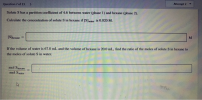
Question 7 of 13 > Attempt 2 Solute S has a partition coefficient of 4.6 between water (phase 1) and hexane (phase 2). Calculate the concentration of solute S in hexane if [S]water is 0.020 M. [Shexane = If the volume of water is 67.0 mL and the volume of hexane is 20.0 mL, find the ratio of the moles of solute S in hexane to the moles of solute S in water. mol Sheuane mol Swaler Solute...
A)
B)
Question 7 of 13 > Attempt 2 Solute S has a partition coefficient of 4.6 between water (phase 1) and hexane (phase 2). Calculate the concentration of solute S in hexane if [S]water is 0.020 M. [Shexane = If the volume of water is 67.0 mL and the volume of hexane is 20.0 mL, find the ratio of the moles of solute S in hexane to the moles of solute S in water. mol Sheuane mol Swaler Solute...
2. (15 Pt) What is partition coefficient? What is permeability? How are they related for solute...
 2. (15 Pt) What is partition coefficient? What is permeability? How are they related for solute transport across the cell membranes?
The partition coefficient of a drug was determined in two different solvent systems: A. Chloroform/water and...
 The partition coefficient of a drug was determined in two different solvent systems: A. Chloroform/water and B. Octanol/water. Which of the following is correct about these two partition coefficient? Both partition coefficents would be same Both partition coefficents would not be same Partition coefficient of any drug determined in Octanol/water solvent system would be lower than that in chloroform/water solvent systems solubility Partition coefficient of any drug determined in Octanol/water solvent system would be greater than that in chloroform/water solvent...
Solute A has a partition coefficient K = 2 for an extraction between water (phase 1)...
Solute A has a partition coefficient K = 2 for an extraction between water (phase 1) and benzene (phase 2). If 100 mL of a 0.01M solution of A in water is extracted one time with 300 mL benzene, what fraction will be extracted?
3 2 Rate of molecule transport 1 Molecule concentration difference across plasma membrane humans, fructose, a...
 3 2 Rate of molecule transport 1 Molecule concentration difference across plasma membrane humans, fructose, a disaccharide, is taken up from the intestine by facilitated transport. Respond to the following questions Adressing the transport of fructose molecules as shown in the diagram, above. the number of transport proteins is the same for the membranes with Rates 1, 2, and 3, which arrow corresponds to eatest concentration difference of fructose across the cell membrane? (Click to select) the fructose concentration difference...
Why is the partition coefficient different for benzoic acid and sodium benzoate? Explain chemical reasons why...
Why is the partition coefficient different for benzoic acid and sodium benzoate? Explain chemical reasons why the two values differ. Especially note the type of intermolecular forces that exist in the solute and the two solvents. Partition Coefficient of Benzoic Acid Benzoic acid in water layer and organic layer (dichloromethane) as organic layer. 3.1 Partition Coefficient of Sodium benzoate Benzoic acid in aqueous layer (water and sodium bicarbonate) and dichloromethane as organic layer. 0.12
What is the permeability (Pm) of a substance whose diffusion coefficient is 3.9 * 10‐9 m2/second...
What is the permeability (Pm) of a substance whose diffusion coefficient is 3.9 * 10‐9 m2/second and a partition coefficient of 0.6 across a membrane that is 18 nanometers thick? Moreover, what does this information suggest about the polarity of the substance? (2 points)
If the Partition Coefficient for Benzoic Acid in one mL each of Water and Methylene Chloride...
If the Partition Coefficient for Benzoic Acid in one mL each of Water and Methylene Chloride is 2.10, is there more Benzoic Acid in the Water layer or the Methylene Chloride layer? A) If you have one mL each of Water and Methylene Chloride in a vial, which layer is on the top? B) If the same experiment is repeated with benzoic acid between ether and water, which layer would be the top and which layer would be the bottom....
Molecule A is rapidly consumed by cells. Membrane Protein A is a carrier protein that allows...
Molecule A is rapidly consumed by cells. Membrane Protein A is a carrier protein that allows molecule A to move across a cell membrane. How would inhibiting the expression of the gene that codes for Membrane Protein A affect intracellular and extracellular concentrations of molecule A?
 A)
B)
Question 7 of 13 > Attempt 2 Solute S has a partition coefficient of 4.6 between water (phase 1) and hexane (phase 2). Calculate the concentration of solute S in hexane if [S]water is 0.020 M. [Shexane = If the volume of water is 67.0 mL and the volume of hexane is 20.0 mL, find the ratio of the moles of solute S in hexane to the moles of solute S in water. mol Sheuane mol Swaler Solute...
A)
B)
Question 7 of 13 > Attempt 2 Solute S has a partition coefficient of 4.6 between water (phase 1) and hexane (phase 2). Calculate the concentration of solute S in hexane if [S]water is 0.020 M. [Shexane = If the volume of water is 67.0 mL and the volume of hexane is 20.0 mL, find the ratio of the moles of solute S in hexane to the moles of solute S in water. mol Sheuane mol Swaler Solute...
 2. (15 Pt) What is partition coefficient? What is permeability? How are they related for solute transport across the cell membranes?
 The partition coefficient of a drug was determined in two different solvent systems: A. Chloroform/water and B. Octanol/water. Which of the following is correct about these two partition coefficient? Both partition coefficents would be same Both partition coefficents would not be same Partition coefficient of any drug determined in Octanol/water solvent system would be lower than that in chloroform/water solvent systems solubility Partition coefficient of any drug determined in Octanol/water solvent system would be greater than that in chloroform/water solvent...
 3 2 Rate of molecule transport 1 Molecule concentration difference across plasma membrane humans, fructose, a disaccharide, is taken up from the intestine by facilitated transport. Respond to the following questions Adressing the transport of fructose molecules as shown in the diagram, above. the number of transport proteins is the same for the membranes with Rates 1, 2, and 3, which arrow corresponds to eatest concentration difference of fructose across the cell membrane? (Click to select) the fructose concentration difference...
Most questions answered within 3 hours.
-
Where is the error in this code sequence?
String s1 = "Hello";
String s2 = "ello";...
asked 10 months ago -
Financial data for Joel de Paris, Inc., for last year
follow:
Joel de Paris, Inc.
Balance...
asked 10 months ago -
Consider this reaction:
Al2(SO4)3 (aq)+ BaCl3
(aq) Al2Cl6 (aq)- +
3BaSO4(s) . What is the...
asked 10 months ago -
Suppose that Savneet is considering increasing her
recent random sample from 20 car rentals to 40...
asked 10 months ago -
Trucks arrive at an unloading terminal at an average rate of 120
per hour.
Trucks arrive...
asked 10 months ago -
Why are methanol and ethanol completely soluble in water while
octanol is not very little soluble....
asked 10 months ago -
A facilities manager at a university reads in a research report
that the mean amount of...
asked 10 months ago -
When the CuSO4 is rehydrated by adding water to the anhydrous
compound, is this an endothermic...
asked 10 months ago -
A ray of sunlight is passing from diamond into crown glass; the
angle of incidence is...
asked 10 months ago -
A block of mass 0.249 kg is placed on top of a light, vertical
spring of...
asked 10 months ago -
how do the kidneys compensate in the presences of acidosis
a) trigger hyperventilate
b) reserve acid...
asked 10 months ago -
Question 501 pts
The rental rate of capital to the firm increases. Which of the
following...
asked 10 months ago