a microbiologist describes an organism as a saprobic, thermoduric, barophilic, coccus. describe the organisms metabolic, structural...
a microbiologist describes an organism as a saprobic, thermoduric, barophilic, coccus. describe the organisms metabolic, structural and growth conditions in layperson nonscience terms
Homework Answers
The microbiologist describes an organism as saprobic, thermoduric, barophilic,coccus. These microorganisms are termed in one word as Psychrophilic microorganisms. They have the ability to grow at 0 degree celsius.They have a maximum temperature for growth at 20 degree celsius and or below and are restricted to permannetly cold habitats.This ability to grow at a low temperature may be correlated with a lower temperature characteristic, an increasing proportion of unsaturated fatty acids in the lipid phase of the cell membrane, which makes it more fluid, and a protein conformation functional at lower temperature. The relatively low maximum temperature of growth for these microorganisms is often considered to be due to the thermolability of one or more essential cellular components, particularly enzymes, while some degradative activities are enhanced, resulting in an exhaustion of cell energy, a leakage of intracellular substances or complete lysis. Psychotrophic microorganisms are well-known for their degradative activities in foods.Some are pathogenic or toxinogenic for man, animals or plants. However in natural microbial ecosystems psychotrophic microorganisms can play a large role in the biodegradation of organic matter during cold seasons.
Add Answer to:
a microbiologist describes an organism as a saprobic,
thermoduric, barophilic, coccus. describe the organisms metabolic,
structural...
CRITCA HINKING A scientist describes an organism as a chemoheterotrophic, aerotolerant, mesophilic, facultatively halophilic coccus. Describe...
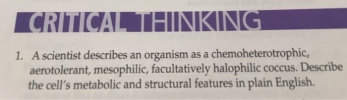 CRITCA HINKING A scientist describes an organism as a chemoheterotrophic, aerotolerant, mesophilic, facultatively halophilic coccus. Describe the cell's metabolic and structural features in plain English. 1.
Describe one example of cellular (either cells within a multicellular organism or unicellular organisms) where population...
Describe one example of cellular (either cells within a multicellular organism or unicellular organisms) where population genetics involved in survival of the cell type through at least one mechanism.
Describe and explain one major structural similarity between the protistan molds and the zygomycota (bread molds)...
Describe and explain one major structural similarity between the protistan molds and the zygomycota (bread molds) in terms of reproduction / dispersal. What similarities exist in the ecological function of these different organisms that may have resulted in this similarity? What evidence exists that allows us to view this similarity as a case convergent evolution?
describe the cell wall structure of salmonella typhi, Does salmonella typhi have any other cell envelope...
describe the cell wall structure of salmonella typhi, Does salmonella typhi have any other cell envelope layers beyond the cell wall, if so describe them. Is salmonella typhi flagellated, describe the flagellar arrangement. Does salmonella typhi form endospores ? If it does, what is the function of them? if it does not, does your organism have any other specific survival adaptations? What is the correct metabolic term for salmonella typhi? what accuratley describes oxygen requirements of my microbe? What are...
17. At temperatures higher than the maximum growth temperature for an organism, A proteins are permanently...
 17. At temperatures higher than the maximum growth temperature for an organism, A proteins are permanently denatured B membranes become too fuld for proper function Chydrogen bonds within molecules are broken DA and B E. A B and C 18 Some obligately anaerobic archaea are used in sewage treatment, and produce a fuel that can be used to produce electricity A thermophilic B. halophilic C. barophilic D. methanogenic E. psychrophilic 19. You open a jar that has been in the...
1. Please write the full exact balanced chemical equation that describes aerobic cellular respiration (the one...
1. Please write the full exact balanced chemical equation that describes aerobic cellular respiration (the one that begins with glucose) 2. Please draw chemical structures for methane, ammonia, water, carbon dioxide, oxygen, and nitrogen 3. What three conditions need to met in order for natural selection to operate 4. Describe/diagram the life of a cell becoming two cells. Include the terms mitosis, replication, growth, and cytokinesis in your description/diagram 5. How can one tell the difference between a bacterium and...
correct the ones marked wrong, and explain why they are the right answer Part I. Multiple...
 correct the ones marked wrong, and explain why they are the
right answer
Part I. Multiple Choice. 1.5 points each, 32 questions, 48 points to Fill in the blank with the correct answer choice. 1. Which of the following is NOT required for microorganisms to grow and divide? ationefoliciningisson re edcorator als D replication b. binary fission um ormation injustt e@hours. This Cequatorial septum formation d. conjugation 2. A culture of Salmonella increases from 20 cells to over 10,000 cells...
correct the ones marked wrong, and explain why they are the
right answer
Part I. Multiple Choice. 1.5 points each, 32 questions, 48 points to Fill in the blank with the correct answer choice. 1. Which of the following is NOT required for microorganisms to grow and divide? ationefoliciningisson re edcorator als D replication b. binary fission um ormation injustt e@hours. This Cequatorial septum formation d. conjugation 2. A culture of Salmonella increases from 20 cells to over 10,000 cells...
please help me. answer only first page. thank you! p. If you accidentally forgot to inoculate...
 please help me. answer only first page. thank you!
p. If you accidentally forgot to inoculate your organism in an OF-glucose tube with oil, and only had one yellow “no oil” tube, what type of carbohydrate catabolism would describe that organism (fermenter, oxidative, neither)? Explain your answer. q. What are two other results from the OF-glucose tubes other than their type of carbohydrate catabolism? r. How can organisms that don't use starch grow on a starch agar plate? Carbohydrate Catabolism...
please help me. answer only first page. thank you!
p. If you accidentally forgot to inoculate your organism in an OF-glucose tube with oil, and only had one yellow “no oil” tube, what type of carbohydrate catabolism would describe that organism (fermenter, oxidative, neither)? Explain your answer. q. What are two other results from the OF-glucose tubes other than their type of carbohydrate catabolism? r. How can organisms that don't use starch grow on a starch agar plate? Carbohydrate Catabolism...
1. Which of the following are the sites within the human body where carbon dioxide and...
1. Which of the following are the sites within the human body where carbon dioxide and oxygen are exchanged? A. Alveoli B. Arteries C. Synapses D. Venules 2. Which of the following describes the most important reason for repeating an experimental investigation? A. To verify the validity of the original findings B. To expand upon the original investigation C. To manipulate the independent variable D. To attempt to disprove the hypothesis 3. Lithium has an atomic number of 3 and...
 CRITCA HINKING A scientist describes an organism as a chemoheterotrophic, aerotolerant, mesophilic, facultatively halophilic coccus. Describe the cell's metabolic and structural features in plain English. 1.
 17. At temperatures higher than the maximum growth temperature for an organism, A proteins are permanently denatured B membranes become too fuld for proper function Chydrogen bonds within molecules are broken DA and B E. A B and C 18 Some obligately anaerobic archaea are used in sewage treatment, and produce a fuel that can be used to produce electricity A thermophilic B. halophilic C. barophilic D. methanogenic E. psychrophilic 19. You open a jar that has been in the...
 correct the ones marked wrong, and explain why they are the
right answer
Part I. Multiple Choice. 1.5 points each, 32 questions, 48 points to Fill in the blank with the correct answer choice. 1. Which of the following is NOT required for microorganisms to grow and divide? ationefoliciningisson re edcorator als D replication b. binary fission um ormation injustt e@hours. This Cequatorial septum formation d. conjugation 2. A culture of Salmonella increases from 20 cells to over 10,000 cells...
correct the ones marked wrong, and explain why they are the
right answer
Part I. Multiple Choice. 1.5 points each, 32 questions, 48 points to Fill in the blank with the correct answer choice. 1. Which of the following is NOT required for microorganisms to grow and divide? ationefoliciningisson re edcorator als D replication b. binary fission um ormation injustt e@hours. This Cequatorial septum formation d. conjugation 2. A culture of Salmonella increases from 20 cells to over 10,000 cells...
 please help me. answer only first page. thank you!
p. If you accidentally forgot to inoculate your organism in an OF-glucose tube with oil, and only had one yellow “no oil” tube, what type of carbohydrate catabolism would describe that organism (fermenter, oxidative, neither)? Explain your answer. q. What are two other results from the OF-glucose tubes other than their type of carbohydrate catabolism? r. How can organisms that don't use starch grow on a starch agar plate? Carbohydrate Catabolism...
please help me. answer only first page. thank you!
p. If you accidentally forgot to inoculate your organism in an OF-glucose tube with oil, and only had one yellow “no oil” tube, what type of carbohydrate catabolism would describe that organism (fermenter, oxidative, neither)? Explain your answer. q. What are two other results from the OF-glucose tubes other than their type of carbohydrate catabolism? r. How can organisms that don't use starch grow on a starch agar plate? Carbohydrate Catabolism...
Most questions answered within 3 hours.
-
Where is the error in this code sequence?
String s1 = "Hello";
String s2 = "ello";...
asked 10 months ago -
Financial data for Joel de Paris, Inc., for last year
follow:
Joel de Paris, Inc.
Balance...
asked 10 months ago -
Consider this reaction:
Al2(SO4)3 (aq)+ BaCl3
(aq) Al2Cl6 (aq)- +
3BaSO4(s) . What is the...
asked 10 months ago -
Suppose that Savneet is considering increasing her
recent random sample from 20 car rentals to 40...
asked 10 months ago -
Trucks arrive at an unloading terminal at an average rate of 120
per hour.
Trucks arrive...
asked 10 months ago -
Why are methanol and ethanol completely soluble in water while
octanol is not very little soluble....
asked 10 months ago -
A facilities manager at a university reads in a research report
that the mean amount of...
asked 10 months ago -
When the CuSO4 is rehydrated by adding water to the anhydrous
compound, is this an endothermic...
asked 10 months ago -
A ray of sunlight is passing from diamond into crown glass; the
angle of incidence is...
asked 10 months ago -
A block of mass 0.249 kg is placed on top of a light, vertical
spring of...
asked 10 months ago -
how do the kidneys compensate in the presences of acidosis
a) trigger hyperventilate
b) reserve acid...
asked 10 months ago -
Question 501 pts
The rental rate of capital to the firm increases. Which of the
following...
asked 10 months ago