Compare and contrast the three modes of selection we reviewed in Chapter 9, directional selection, stabilizing...
Compare and contrast the three modes of selection we reviewed in Chapter 9, directional selection, stabilizing selection and disruptive selection. You should include the similarities, fitness of the population over time, and impact on genetic variation over time.
Homework Answers
Ans) Directional selection occurs in changing environment and alters the traits mean value in one direction, fitness of poplulation increase over time because extreme phenotypes are favoured and not the average ones.Genetic variations occur due to this overtime.
Disruptive selection is little similar to directional selection but instead of one direction, both the extreme phenotypes are favoured and not one .Here also the mean value of traits is altered and genetic variations will occur overtime.
Stabilizing selection occurs in unchanging environment unlike directional and disruptive selection.In stabilizing selection,normal or average phenotypes are favoured and thus due to this homozygosity will be maintained and there will be no genetic variations unlike observed in Directional and Disruptive selection.Fitness value will not increase (since extreme phenotypes have highest fitness).Mean value of trait is not altered in Stabilizing selection.
Add Answer to:
Compare and contrast the three modes of selection we reviewed in
Chapter 9, directional selection, stabilizing...
Of the following evolutionary forces; crossing over, directional selection, mutation, speciation, stabilizing selection, sex, gene flow...
Of the following evolutionary forces; crossing over, directional selection, mutation, speciation, stabilizing selection, sex, gene flow and genetic drift which promote or maintain genetic variation within a population? a) crossing over only b) directional selection and sex c) directional selection, mutation, and speciation d) crossing over, mutation, sex, and gene flow e) only sex Of the following evolutionary forces, crossing over, directional selection, mutation, speciation, stabilizing selection, sex, gene flow and genetic drift which promote genetic differentiation (divergence) among populations?...
Part B - How does this research relate to your biology course? The following graph shows...
 Part B - How does this research relate to your biology course? The following graph shows the frequency distribution of a heritable trait -- fur color -- in a hypothetical deer mouse population. The x-axis represents variation in fur color from light to dark. The y-axis represents the percentage of individuals in the population with each particular color of fur. 333 There are three ways in which natural selection can alter the frequency distribution of a heritable trait, such as...
1. Compare and contrast the two root partnerships described in this chapter: arbuscular mycorrhizae and rhizobia....
1. Compare and contrast the two root partnerships described in this chapter: arbuscular mycorrhizae and rhizobia. Be sure to address the benefits received by the organisms involved in each symbiosis, similarities and differences between the fungal & bacterial strategies 2. Holoparasitic plants have lost many of the morphological and genetic traits necessary for an autotrophic lifestyle. From an evolutionary point of view, how do you think this happened (hint: apply Darwin’s 4 principles of natural selection)
In the case of directional selection, if the advantageous allele (b) is recessive and a less...
In the case of directional selection, if the advantageous allele (b) is recessive and a less advantageous allele (B) is dominant: A. b will be lost in the population because the dominant allele will increase in frequency by natural selection B. b will increase in frequency at the same speed as if it was a dominant advantageous allele, because what matters is the coefficient of selection and not if the allele is dominant or recessive C. b will increase in...
7) Which of the following is likely to be the result of polygenic inheritance? A) freckles...
 7) Which of the following is likely to be the result of polygenic inheritance? A) freckles B) an extra finger Chuman height D) ABO blood type 8) Genetic drift is the result of A) natural selection l o olovo od B) chance lo l o boldog C) a large gene pool h o mbo D) environmental variation of 9) Gene flow is accomplished by A) migration B) sexual recombination C) mutation D) natural selection 10) What does evolutionary fitness measure...
Climate change is a threat to the existence of many species.
 QUESTION 2 Climate change is a threat to the existence of many species. Which of the following limits to natural selection hinders the adaptation of species to the new climate conditions? The developmental plans of plants and animals are too complex. They cannot cope with the warmer temperatures. Mutations happen so frequently that beneficial alleles change before natural selection can substantially increase their frequency Many species not have gene variants in their gene pool that are beneficial in higher temperatures. Climate change happens so...
6. Kingsnakes look a bit like coral snakes in areas where there are no coral snakes....
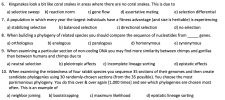 6. Kingsnakes look a bit like coral snakes in areas where there are no coral snakes. This is due to a) selective sweep b) reaction norm c) gene flow d) assortative mating e) selection differential 7. A population in which every year the largest individuals have a fitness advantage (and size is heritable) is experiencing a) stabilizing selection b) balanced selection c) directional selection d) no selection 8. When building a phylogeny of related species you should compare the sequence...
5. a) Fully compare and contrast contingent valuation and choice modeling. [7 marks b) Provide three...
 5. a) Fully compare and contrast contingent valuation and choice modeling. [7 marks b) Provide three practical examples each in the Ghanaian context for which you would apply contingent valuation and choice modeling. [3 marks c) With three specific examples in the Ghanaian context, compare intrinsic and instrumental value of a natural resource, and explain why both are important in [6 marks natural and environmental resource valuation. 6. a) Why can the economic surplus model be used to evaluate the...
INTERNATIONAL BUSINESS course short essay questions from Chapter 1-4: 1. Compare and contrast World Bank and...
INTERNATIONAL BUSINESS course short essay questions from Chapter 1-4: 1. Compare and contrast World Bank and IMF. 2. How much world trade is there and what benefits might a company have from the globalization of markets. 3. Explain globalization of production and its benefits. What type of management should a company study if it commits to globalization of production. 4. What are the two types of family group? Why does the family play an important role in affecting business activities? 5....
C++. Need some help getting started. We will also have the following two functions: 1. A...
C++. Need some help getting started. We will also have the following two functions: 1. A mutate function that randomly modifies a chromosome. 2. A crossover function that takes two chromosomes and splits each one at the same spot, then combines them together. Our genetic algorithm works by iterating over generations of chromosomes via the following process: 1. Generate random population. 2. Until we get an answer that is good enough, do the next steps in a loop: (a) Do...
 Part B - How does this research relate to your biology course? The following graph shows the frequency distribution of a heritable trait -- fur color -- in a hypothetical deer mouse population. The x-axis represents variation in fur color from light to dark. The y-axis represents the percentage of individuals in the population with each particular color of fur. 333 There are three ways in which natural selection can alter the frequency distribution of a heritable trait, such as...
 7) Which of the following is likely to be the result of polygenic inheritance? A) freckles B) an extra finger Chuman height D) ABO blood type 8) Genetic drift is the result of A) natural selection l o olovo od B) chance lo l o boldog C) a large gene pool h o mbo D) environmental variation of 9) Gene flow is accomplished by A) migration B) sexual recombination C) mutation D) natural selection 10) What does evolutionary fitness measure...
 6. Kingsnakes look a bit like coral snakes in areas where there are no coral snakes. This is due to a) selective sweep b) reaction norm c) gene flow d) assortative mating e) selection differential 7. A population in which every year the largest individuals have a fitness advantage (and size is heritable) is experiencing a) stabilizing selection b) balanced selection c) directional selection d) no selection 8. When building a phylogeny of related species you should compare the sequence...
 5. a) Fully compare and contrast contingent valuation and choice modeling. [7 marks b) Provide three practical examples each in the Ghanaian context for which you would apply contingent valuation and choice modeling. [3 marks c) With three specific examples in the Ghanaian context, compare intrinsic and instrumental value of a natural resource, and explain why both are important in [6 marks natural and environmental resource valuation. 6. a) Why can the economic surplus model be used to evaluate the...
Most questions answered within 3 hours.
-
Where is the error in this code sequence?
String s1 = "Hello";
String s2 = "ello";...
asked 10 months ago -
Financial data for Joel de Paris, Inc., for last year
follow:
Joel de Paris, Inc.
Balance...
asked 10 months ago -
Consider this reaction:
Al2(SO4)3 (aq)+ BaCl3
(aq) Al2Cl6 (aq)- +
3BaSO4(s) . What is the...
asked 10 months ago -
Suppose that Savneet is considering increasing her
recent random sample from 20 car rentals to 40...
asked 10 months ago -
Trucks arrive at an unloading terminal at an average rate of 120
per hour.
Trucks arrive...
asked 10 months ago -
Why are methanol and ethanol completely soluble in water while
octanol is not very little soluble....
asked 10 months ago -
A facilities manager at a university reads in a research report
that the mean amount of...
asked 10 months ago -
When the CuSO4 is rehydrated by adding water to the anhydrous
compound, is this an endothermic...
asked 10 months ago -
A ray of sunlight is passing from diamond into crown glass; the
angle of incidence is...
asked 10 months ago -
A block of mass 0.249 kg is placed on top of a light, vertical
spring of...
asked 10 months ago -
how do the kidneys compensate in the presences of acidosis
a) trigger hyperventilate
b) reserve acid...
asked 10 months ago -
Question 501 pts
The rental rate of capital to the firm increases. Which of the
following...
asked 10 months ago