
Homework Answers
Steps in order are:-
1. Stimulus occurs at the periphery, generating receptor potential
2. Stimulus is converted to action potential carried by sensory neuron
3. Action potential is transmitted to central nervous system.
4. Stimulus action potential reaches and interpreted by brain.
Add Answer to:
Order the steps that occur in a sensory pathway. First step Last step Answer Bank Stimulus...
Order the steps that occur during the process of taste. Food enters the mouth Brain interprets...
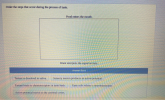 Order the steps that occur during the process of taste. Food enters the mouth Brain interprets the signal Answer Bank Tastant is dissolved in saliva. Sensory neuron produces an action potential. Polen Tistant binds to chemoreceptors in taste buds. Taste cells release a neurotransmitter. Action potential travels to the cerebral cortex.
for each, what is the right answer? B) iris 19. The Nernst Equation predicts that the...
 for each, what is the right answer?
B) iris 19. The Nernst Equation predicts that the equilibrium potential for an ion is proportional to where "in" means "inside the cell" and "out" means "outside the cell" (pick the answer that most closely matches the Nemst equation). A) log ([ion in x [ionout) B) bg ([on]out [onlin) C) log (ionin) D) bg (ion)in Vlog ([ion)out) E) log (ion)in) x log (ionout) 20. The eustachian tube connects the and the A) middle...
for each, what is the right answer?
B) iris 19. The Nernst Equation predicts that the equilibrium potential for an ion is proportional to where "in" means "inside the cell" and "out" means "outside the cell" (pick the answer that most closely matches the Nemst equation). A) log ([ion in x [ionout) B) bg ([on]out [onlin) C) log (ionin) D) bg (ion)in Vlog ([ion)out) E) log (ion)in) x log (ionout) 20. The eustachian tube connects the and the A) middle...
Efer Figure2 to answer questions 18-21: 8. produce the myelin sheaths of neurons in the central F...
 efer Figure2 to answer questions 18-21: 8. produce the myelin sheaths of neurons in the central Figure 2 nervous system. 19 form the Blood Brain Barrier 20._ are responsible for neurotransmitter release. 21 have ligand gated ion channels that are activated by neurotransmitters 22. Functionally, which cellular location is the neuron's "decision- making site" as to whether or not an action potential will be initiated? A axonal membrane B. axon hillock C. dendritic membrane D. presynaptic membrane 23. Calcium and...
Answer Thi Q. thank You The Nervous System edit) 1. The junction between one neuron and the next, or between a neuron and an effector is called: A) A synapse 8) A dendrite C) A neuotransmiter D )...
 Answer Thi Q. thank You
The Nervous System edit) 1. The junction between one neuron and the next, or between a neuron and an effector is called: A) A synapse 8) A dendrite C) A neuotransmiter D ) A ventricle E) None of the above 2. A fast excitatory synapses follows this order A) (1) neurotransmiter released (2) diftused across the synaptic cleft to a receptor protein (3) binding of the transmitter opens pores in the ion channels and positive...
Answer Thi Q. thank You
The Nervous System edit) 1. The junction between one neuron and the next, or between a neuron and an effector is called: A) A synapse 8) A dendrite C) A neuotransmiter D ) A ventricle E) None of the above 2. A fast excitatory synapses follows this order A) (1) neurotransmiter released (2) diftused across the synaptic cleft to a receptor protein (3) binding of the transmitter opens pores in the ion channels and positive...
change pas channels in the volta t ive protein to change shape. This A of the...
 change pas channels in the volta t ive protein to change shape. This A of the S l e terminal siste oplasmic reticum calcio p r eneule warcoplasm reticulum sodium ions m o nster transverse tubules sarcolemma: calcium ions Saroplasmic reticum: triadsarcolemma: calcium ions sons bind to This causes a change in shape and exposing C D E Calcium vesicle tylcholine action potential Sodium sarcolemma calcium on myosin heads Sodium sacoplasmic reticulum calcium ions actin 15. An attaches to exposed...
C. Physiology of Gustation: The sense of taste involves signal transduction of chemicals in food into...
 C. Physiology of Gustation: The sense of taste involves signal transduction of chemicals in food into electrical signals that can be sent to the CNS (Figures 15.5-15.6). 1. Taste sensations: taste relies on the detection of the following five classes of chemicals: and 2. Detection of taste begins when: Taste receptors are classified by the substance to which they detect, with only one type of receptor associated with an individual gustatory cell. 3. Activation of taste receptors. A substance must...
For each multiple choice, what is the answer and why? 5. Myelin A) is only found...
 For
each multiple choice, what is the answer and why?
5. Myelin A) is only found in the peripheral nervous system B) is secreted from the axon terminals of autonomic neurons. C) is a carbohydrate within the membranes of some neuroglia. D) is a chemical present in the plasma membrane of neurons. E) influences the rate of conduction of an electrical signal down an axon. 6. Which of the following organs/structures is (are) innervated by somatic motor nerves? (only ONE...
For
each multiple choice, what is the answer and why?
5. Myelin A) is only found in the peripheral nervous system B) is secreted from the axon terminals of autonomic neurons. C) is a carbohydrate within the membranes of some neuroglia. D) is a chemical present in the plasma membrane of neurons. E) influences the rate of conduction of an electrical signal down an axon. 6. Which of the following organs/structures is (are) innervated by somatic motor nerves? (only ONE...
please answer - What is the purpose of an EEG? What sends the signal! Wildt Which...
 please answer
- What is the purpose of an EEG? What sends the signal! Wildt Which parts of the brain are involved in movement? Practice Questions uestions. These questions are for practice. All possible content may not be represented in this subset of question Dita 1. Jn which area of the cerebrum is the visual cortex located? 2. The is thought to be the involved in learning and memory. 3. The specialization of each cerebral hemisphere for certain functions is...
please answer
- What is the purpose of an EEG? What sends the signal! Wildt Which parts of the brain are involved in movement? Practice Questions uestions. These questions are for practice. All possible content may not be represented in this subset of question Dita 1. Jn which area of the cerebrum is the visual cortex located? 2. The is thought to be the involved in learning and memory. 3. The specialization of each cerebral hemisphere for certain functions is...
1. A. Name the three planes and the positions they each describe to identify a unique...
1. A. Name the three planes and the positions they each describe to identify a unique position in the human body. B. Name the two major ventral body cavities plus the major organs found in them. C. Name the cavities that the heart and lungs reside in. D. Finally, list the six levels of organization in nature. 2. A. Describe the three components of an atom in terms of charge and location. Define atomic mass and atomic number. B. For...
BIOL 1620o, Spring 2019 NAME (Last, Preferred First): Date: 45. What is the most important means by which capillay exchange occurs? 53. Which of the following organs does NOT contain lymphatic...
 BIOL 1620o, Spring 2019 NAME (Last, Preferred First): Date: 45. What is the most important means by which capillay exchange occurs? 53. Which of the following organs does NOT contain lymphatic tissue? A. liver B. spleen C. lingual tonsils A. exocytosis B. diffusiorn C. ATP powered pumps D. facilitated diffusion E. pharyngeal tonsils. 46.According to Poiseuille's law A. blood flow is not related to resistance. B. ph of the blood influences flow C. viscosity of the blood is not related...
 Order the steps that occur during the process of taste. Food enters the mouth Brain interprets the signal Answer Bank Tastant is dissolved in saliva. Sensory neuron produces an action potential. Polen Tistant binds to chemoreceptors in taste buds. Taste cells release a neurotransmitter. Action potential travels to the cerebral cortex.
 for each, what is the right answer?
B) iris 19. The Nernst Equation predicts that the equilibrium potential for an ion is proportional to where "in" means "inside the cell" and "out" means "outside the cell" (pick the answer that most closely matches the Nemst equation). A) log ([ion in x [ionout) B) bg ([on]out [onlin) C) log (ionin) D) bg (ion)in Vlog ([ion)out) E) log (ion)in) x log (ionout) 20. The eustachian tube connects the and the A) middle...
for each, what is the right answer?
B) iris 19. The Nernst Equation predicts that the equilibrium potential for an ion is proportional to where "in" means "inside the cell" and "out" means "outside the cell" (pick the answer that most closely matches the Nemst equation). A) log ([ion in x [ionout) B) bg ([on]out [onlin) C) log (ionin) D) bg (ion)in Vlog ([ion)out) E) log (ion)in) x log (ionout) 20. The eustachian tube connects the and the A) middle...
 efer Figure2 to answer questions 18-21: 8. produce the myelin sheaths of neurons in the central Figure 2 nervous system. 19 form the Blood Brain Barrier 20._ are responsible for neurotransmitter release. 21 have ligand gated ion channels that are activated by neurotransmitters 22. Functionally, which cellular location is the neuron's "decision- making site" as to whether or not an action potential will be initiated? A axonal membrane B. axon hillock C. dendritic membrane D. presynaptic membrane 23. Calcium and...
 Answer Thi Q. thank You
The Nervous System edit) 1. The junction between one neuron and the next, or between a neuron and an effector is called: A) A synapse 8) A dendrite C) A neuotransmiter D ) A ventricle E) None of the above 2. A fast excitatory synapses follows this order A) (1) neurotransmiter released (2) diftused across the synaptic cleft to a receptor protein (3) binding of the transmitter opens pores in the ion channels and positive...
Answer Thi Q. thank You
The Nervous System edit) 1. The junction between one neuron and the next, or between a neuron and an effector is called: A) A synapse 8) A dendrite C) A neuotransmiter D ) A ventricle E) None of the above 2. A fast excitatory synapses follows this order A) (1) neurotransmiter released (2) diftused across the synaptic cleft to a receptor protein (3) binding of the transmitter opens pores in the ion channels and positive...
 change pas channels in the volta t ive protein to change shape. This A of the S l e terminal siste oplasmic reticum calcio p r eneule warcoplasm reticulum sodium ions m o nster transverse tubules sarcolemma: calcium ions Saroplasmic reticum: triadsarcolemma: calcium ions sons bind to This causes a change in shape and exposing C D E Calcium vesicle tylcholine action potential Sodium sarcolemma calcium on myosin heads Sodium sacoplasmic reticulum calcium ions actin 15. An attaches to exposed...
 C. Physiology of Gustation: The sense of taste involves signal transduction of chemicals in food into electrical signals that can be sent to the CNS (Figures 15.5-15.6). 1. Taste sensations: taste relies on the detection of the following five classes of chemicals: and 2. Detection of taste begins when: Taste receptors are classified by the substance to which they detect, with only one type of receptor associated with an individual gustatory cell. 3. Activation of taste receptors. A substance must...
 For
each multiple choice, what is the answer and why?
5. Myelin A) is only found in the peripheral nervous system B) is secreted from the axon terminals of autonomic neurons. C) is a carbohydrate within the membranes of some neuroglia. D) is a chemical present in the plasma membrane of neurons. E) influences the rate of conduction of an electrical signal down an axon. 6. Which of the following organs/structures is (are) innervated by somatic motor nerves? (only ONE...
For
each multiple choice, what is the answer and why?
5. Myelin A) is only found in the peripheral nervous system B) is secreted from the axon terminals of autonomic neurons. C) is a carbohydrate within the membranes of some neuroglia. D) is a chemical present in the plasma membrane of neurons. E) influences the rate of conduction of an electrical signal down an axon. 6. Which of the following organs/structures is (are) innervated by somatic motor nerves? (only ONE...
 please answer
- What is the purpose of an EEG? What sends the signal! Wildt Which parts of the brain are involved in movement? Practice Questions uestions. These questions are for practice. All possible content may not be represented in this subset of question Dita 1. Jn which area of the cerebrum is the visual cortex located? 2. The is thought to be the involved in learning and memory. 3. The specialization of each cerebral hemisphere for certain functions is...
please answer
- What is the purpose of an EEG? What sends the signal! Wildt Which parts of the brain are involved in movement? Practice Questions uestions. These questions are for practice. All possible content may not be represented in this subset of question Dita 1. Jn which area of the cerebrum is the visual cortex located? 2. The is thought to be the involved in learning and memory. 3. The specialization of each cerebral hemisphere for certain functions is...
 BIOL 1620o, Spring 2019 NAME (Last, Preferred First): Date: 45. What is the most important means by which capillay exchange occurs? 53. Which of the following organs does NOT contain lymphatic tissue? A. liver B. spleen C. lingual tonsils A. exocytosis B. diffusiorn C. ATP powered pumps D. facilitated diffusion E. pharyngeal tonsils. 46.According to Poiseuille's law A. blood flow is not related to resistance. B. ph of the blood influences flow C. viscosity of the blood is not related...
Most questions answered within 3 hours.
-
Where is the error in this code sequence?
String s1 = "Hello";
String s2 = "ello";...
asked 10 months ago -
Financial data for Joel de Paris, Inc., for last year
follow:
Joel de Paris, Inc.
Balance...
asked 10 months ago -
Consider this reaction:
Al2(SO4)3 (aq)+ BaCl3
(aq) Al2Cl6 (aq)- +
3BaSO4(s) . What is the...
asked 10 months ago -
Suppose that Savneet is considering increasing her
recent random sample from 20 car rentals to 40...
asked 10 months ago -
Trucks arrive at an unloading terminal at an average rate of 120
per hour.
Trucks arrive...
asked 10 months ago -
Why are methanol and ethanol completely soluble in water while
octanol is not very little soluble....
asked 10 months ago -
A facilities manager at a university reads in a research report
that the mean amount of...
asked 10 months ago -
When the CuSO4 is rehydrated by adding water to the anhydrous
compound, is this an endothermic...
asked 10 months ago -
A ray of sunlight is passing from diamond into crown glass; the
angle of incidence is...
asked 10 months ago -
A block of mass 0.249 kg is placed on top of a light, vertical
spring of...
asked 10 months ago -
how do the kidneys compensate in the presences of acidosis
a) trigger hyperventilate
b) reserve acid...
asked 10 months ago -
Question 501 pts
The rental rate of capital to the firm increases. Which of the
following...
asked 10 months ago