Describe the process of calcium-dependent fusion of synaptic vesicles with the presynaptic membrane.
Describe the process of calcium-dependent fusion of synaptic vesicles with the presynaptic membrane.
Homework Answers
Docking is the process during which the vesicle and pre-synaptic membrane line up in a fusion-ready state. Following docking, the membranes fuse to create a small opening which grows larger until the vesicle membrane collapses into the pre-synaptic membrane and exocytosis occurs. While the exact mechanisms behind synaptic fusion have not been determined in full, the process is known to be calcium dependent.
There is evidence that rab 3A and rab 3B, two G-proteins, guide synaptic vesicles to active zones. Once at the active zone, vesicle and plasma membrane proteins, with the assistance of cytoplasmic proteins, recognize each other and docking occurs. The cytoplasmic proteins, NSF and SNAPs, are involved in assuring proper vesicle targeting. NSF and SNAPs along with SNAP receptors (SNAREs) may form an initial complex between the vesicle and presynaptic membrane. Possible proteins on the vesicle membrane and pre-synaptic membrane that act as SNAREs are, respectively, synaptobrevin and syntaxin. These two proteins may allow the vesicle and presynaptic membrane to recognize each other.
Following docking, there is a second influx of calcium at the active zone, which causes the vesicle membrane to fuse to the presynaptic membrane, forming a temporary ion channel. This early fusion pore, similar to a gap junction, is a cytoplasmic bridge that connects the lumen of the vesicle with the space outside the neuronal terminal. The fusion pore is composed of two halves, one in the vesicle membrane and one in the pre-synaptic membrane. Proteins potentially involved in forming the fusion pore include synaptophysin on the vesicle membrane and physophilin on the pre-synaptic membrane. When aligned, these proteins may fuse the vesicle membrane to the pre-synaptic membrane. The formation of this pore is an energetically unfavorable event and, thus requires energy provided when NSF hydrolyzes ATP.
Without calcium influx, there is no fusion pore formed. There is evidence that the vesicle protein synaptotagmin is the key calcium sensor and plays a significant role in activating fusion. Synaptotagmin has membrane binding abilities, binds calcium, and has been observed in close proximity to the site of calcium influx. In the absence of calcium, synaptotagmin acts as a clamp and inhibits vesicle fusion; the vesicle remains in a fusion-ready state but does not form a fusion pore. Synaptotagmin acts as a calcium sensor and, with calcium influx, activates fusion. Synaptotagmin does not appear to participate in the actual fusion event but may pull the vesicle and pre-synaptic membrane into closer contact with each other or induce conformational changes in fusion proteins.
Once an initial pore is formed, it quickly dilates leading to exocytosis and neurotransmitter release. The vesicle membrane joins the plasma membrane and the contents of the vesicle are released into the synaptic cleft.
Add Answer to:
Describe the process of calcium-dependent fusion of synaptic
vesicles with the presynaptic membrane.
Question 46 2 pts are released from the synaptic vesicles and membrane receive them. on the...
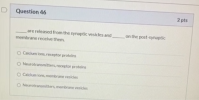 Question 46 2 pts are released from the synaptic vesicles and membrane receive them. on the post-synaptic Calcium ions receptor proteins Neurotransmitters, receptor proteins Caklumlons, membrane vesicles Neurotransmitters, membrane vesicles
35. At the relative end of synaptic transmission, the vesicles (containing stored neurotransmitter) migrate and fuse...
 35. At the relative end of synaptic transmission, the vesicles (containing stored neurotransmitter) migrate and fuse with the pre-synaptic membrane. Which of the processes/steps below causes this vesicle-migration and fusion? a. the calcium current at the axon-terminal b. the graded potential at the dendrites c. the peak of the action potential amplitude d. the potassium current that causes repolarization
4. Draw a synapse between 2 neurons. Label the following: Presynaptic neuron, Postsynaptic neuron, Synaptic vesicles,...
 4. Draw a synapse between 2 neurons. Label the following: Presynaptic neuron, Postsynaptic neuron, Synaptic vesicles, Voltage-regulated calcium channel, Chemical-regulated sodium channel. 5. Draw a diagram of the preganglionic neuron, postganglionic neuron, and effector for both Sympathetic Nervous System and Parasympathetic Nervous System. indicate which neurotransmitter is released by each neuron and label the receptors at all locations for the neurotransmitter. 6. Which cells have a resting membrane potential? Which cells can have an action potential? 7. Circle which of...
The calcium ion at is to__. . chemical synapses chemical synapses neuron cell body; depolarize the...
 The calcium ion at is to__. . chemical synapses chemical synapses neuron cell body; depolarize the axon terminal of the presynaptic cell neuron membrane; bind to neurotransmitter receptors on the postsynaptic cell chemical synapses; cause fusion of synaptic vesicles with the plasma membrane of the axon terminal electrical synapses; Interfere with IPSPs in the postsynaptic cell chemical synapses; repolarize the axon terminal of the postsynaptic cel
Describe temporal and spatial synaptic summations, and presynaptic inhibition. Describe, how these processes which express synaptic...
Describe temporal and spatial synaptic summations, and presynaptic inhibition. Describe, how these processes which express synaptic plasticity combined with different types of neuronal connections can contribute to short and long term memory
Describe the process of vesicle recognition and fusion with the target membrane.
Describe the process of vesicle recognition and fusion with the target membrane.
Describe and explain one presynaptic and one postsynaptic mechanism that pharmaceuticals can use to modify synaptic...
Describe and explain one presynaptic and one postsynaptic mechanism that pharmaceuticals can use to modify synaptic transmission.
999 1. Synaptic vesicles 3. A A 2. Membrane potential 5. AB 3. Neurotransmitters 4. AC...
 999 1. Synaptic vesicles 3. A A 2. Membrane potential 5. AB 3. Neurotransmitters 4. AC 4. Receptors 1. AD 5. Synapse 6. Myelin sheath
Before they travel across the synapse to bind with receptors on the postsynaptic membrane, chemical messengers...
Before they travel across the synapse to bind with receptors on the postsynaptic membrane, chemical messengers are stored in what location on the presynaptic membrane? a. ionotropes b. synaptic vesicles c. axons d. nodes of Ranvier
Target cells Capillary near secreting cell terminal Presynaptic neuron Postsynaptic cell Larger blood vessels More Synaptic...
 Target cells Capillary near secreting cell terminal Presynaptic neuron Postsynaptic cell Larger blood vessels More Synaptic vesicles Synaptic deft Capillary near target cell Receptor molecules Target cells Capillary near secreting cell Receptor molecules Larger blood vessels Capillary near target cell 21. Which diagram(s) represent(s) the process of chemical signaling from the initial signal in the hypothalamus to the release of adrenocorticotropic hormone? a. I b. II and III c. II and IV d. I and II
 Question 46 2 pts are released from the synaptic vesicles and membrane receive them. on the post-synaptic Calcium ions receptor proteins Neurotransmitters, receptor proteins Caklumlons, membrane vesicles Neurotransmitters, membrane vesicles
 35. At the relative end of synaptic transmission, the vesicles (containing stored neurotransmitter) migrate and fuse with the pre-synaptic membrane. Which of the processes/steps below causes this vesicle-migration and fusion? a. the calcium current at the axon-terminal b. the graded potential at the dendrites c. the peak of the action potential amplitude d. the potassium current that causes repolarization
 4. Draw a synapse between 2 neurons. Label the following: Presynaptic neuron, Postsynaptic neuron, Synaptic vesicles, Voltage-regulated calcium channel, Chemical-regulated sodium channel. 5. Draw a diagram of the preganglionic neuron, postganglionic neuron, and effector for both Sympathetic Nervous System and Parasympathetic Nervous System. indicate which neurotransmitter is released by each neuron and label the receptors at all locations for the neurotransmitter. 6. Which cells have a resting membrane potential? Which cells can have an action potential? 7. Circle which of...
 The calcium ion at is to__. . chemical synapses chemical synapses neuron cell body; depolarize the axon terminal of the presynaptic cell neuron membrane; bind to neurotransmitter receptors on the postsynaptic cell chemical synapses; cause fusion of synaptic vesicles with the plasma membrane of the axon terminal electrical synapses; Interfere with IPSPs in the postsynaptic cell chemical synapses; repolarize the axon terminal of the postsynaptic cel
 999 1. Synaptic vesicles 3. A A 2. Membrane potential 5. AB 3. Neurotransmitters 4. AC 4. Receptors 1. AD 5. Synapse 6. Myelin sheath
 Target cells Capillary near secreting cell terminal Presynaptic neuron Postsynaptic cell Larger blood vessels More Synaptic vesicles Synaptic deft Capillary near target cell Receptor molecules Target cells Capillary near secreting cell Receptor molecules Larger blood vessels Capillary near target cell 21. Which diagram(s) represent(s) the process of chemical signaling from the initial signal in the hypothalamus to the release of adrenocorticotropic hormone? a. I b. II and III c. II and IV d. I and II
Most questions answered within 3 hours.
-
Where is the error in this code sequence?
String s1 = "Hello";
String s2 = "ello";...
asked 11 months ago -
Financial data for Joel de Paris, Inc., for last year
follow:
Joel de Paris, Inc.
Balance...
asked 11 months ago -
Consider this reaction:
Al2(SO4)3 (aq)+ BaCl3
(aq) Al2Cl6 (aq)- +
3BaSO4(s) . What is the...
asked 11 months ago -
Suppose that Savneet is considering increasing her
recent random sample from 20 car rentals to 40...
asked 11 months ago -
Trucks arrive at an unloading terminal at an average rate of 120
per hour.
Trucks arrive...
asked 11 months ago -
Why are methanol and ethanol completely soluble in water while
octanol is not very little soluble....
asked 11 months ago -
A facilities manager at a university reads in a research report
that the mean amount of...
asked 11 months ago -
When the CuSO4 is rehydrated by adding water to the anhydrous
compound, is this an endothermic...
asked 11 months ago -
A ray of sunlight is passing from diamond into crown glass; the
angle of incidence is...
asked 11 months ago -
A block of mass 0.249 kg is placed on top of a light, vertical
spring of...
asked 11 months ago -
how do the kidneys compensate in the presences of acidosis
a) trigger hyperventilate
b) reserve acid...
asked 11 months ago -
Question 501 pts
The rental rate of capital to the firm increases. Which of the
following...
asked 11 months ago