please help me with this genetics question! thank you!
TS =Tumor Suppressor genes
O = Oncogenes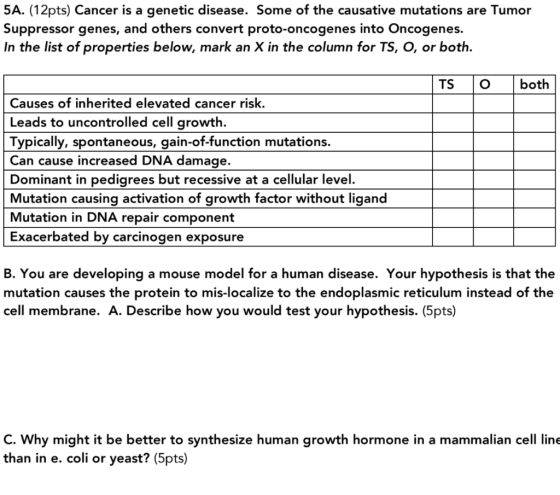
Homework Answers
Answer for 5A:
Causes of inherited elevated cancer risk: both are possible (but mostly its acquired)
Leads to uncontrolled cell growth : property of an oncogene, when activated from a proto-oncogene
Typically, spontaneous, gain of function mutations: both
Can cause increased DNA damage: TS
Dominant in pedigrees but recessive at cellular level: TS (needs both alleles to be affected for full manifestation of symptoms)
Mutation causing activation of growth factor without ligand: oncogenes (constitutively activates receptors in absence of ligand)
Mutation in DNA repair component: TS
Exacerbated by carcinogen exposure: both
Add Answer to:
please help me with this genetics question! thank you!
TS =Tumor Suppressor genes
O = Oncogenes...
a. To cause cancer, proto-oncogenes require considered mally, tumor suppressor genes inhibit the cell cycle. How...
 a. To cause cancer, proto-oncogenes require considered mally, tumor suppressor genes inhibit the cell cycle. How do mutated tumor suppressor Ben cell cycle? allele(s) to be mutated and therefore are - The mutation results in a of function. nor suppressor genes affect the a. To cause cancer, tumor suppressor genes require allele(s) to be mutated and therefore are considered - The mutation results in a _ _ of function.
Both proto-oncogenes and tumor suppressor genes help control the cell cycle. Genes called encode for cyclins...
 Both proto-oncogenes and tumor suppressor genes help control the cell cycle. Genes called encode for cyclins that promote the cell cycle, while encode for cyclins that stop the cell cycle. Mutations within these genes cause cells to continue replication without regulation and form Both proto-oncogenes and tumor suppressor genes help control the cell cycle. Genes called encode for cyclins that promote the cell cycle, while encode for cyclins that stop the cell cycle.
PATH370 2018 - risk factors/predisposing factors for carcinogenesis: tobacco, nutrition, genetics (proto-oncogenes, oncogenes, tumor suppressor genes),...
 PATH370 2018 - risk factors/predisposing factors for carcinogenesis: tobacco, nutrition, genetics (proto-oncogenes, oncogenes, tumor suppressor genes), viruses - role of p53 and Rb carcinogenesis: what is initiation, promotion, progression? - carcinogen vs mutagen vs teratogen - metastasis: define/describe, pattern of spread, tumor markers, angiogenesis, grading/staging, most common organs where metastasis occurs, first place of metastasis for many cancers - TNM system: what does each letter represent, are low or high number more severe? - generalized effects of cancer on the...
Cancer and Gene Regulation Why is a cell cycle control system needed for cell division? What...
 Cancer and Gene Regulation Why is a cell cycle control system needed for cell division? What happens when cells do NOT respond to the cell cycle control system and divide excessively? Tumor Proto-oncogeno (for protein that stimulates coll division) 6 Y DNA Benign Tumor= Mutation withln a control region of DNA Malignant Tumor Mutated promoter Metastasis Normal growth-stimulating protein in excess Oncogene Tumor-Suppressor Genes Proto-oncogene utled tara gese Samor-auppresr gane Many proto-oncogenes code for growth factors /Deletive nonimenig Normel grewt...
Both proto-oncogenes and tumor suppressor genes help control the cell cycle. Genes called encode for cyclins...
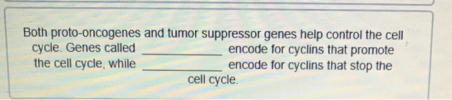 Both proto-oncogenes and tumor suppressor genes help control the cell cycle. Genes called encode for cyclins that promote the cell cycle, while encode for cyclins that stop the cell cycle.
Which ONE correctly finishes the sentence: "Proto-oncogenes are ....? O A. cancer-causing genes that are only...
 Which ONE correctly finishes the sentence: "Proto-oncogenes are ....? O A. cancer-causing genes that are only in tumor cells and not in normal cells." normal genes that encode cell-cycle control proteins." O Concogenes that are converted to proto-oncogenes by mutation." genes that code for anti-cancer proteins, such as antibodies." cancer-related genes that are expressed as extr
Question 35 (1.5 points) Which of the following does NOT lead to cancer formation? mutant proto-oncogenes...
 Question 35 (1.5 points) Which of the following does NOT lead to cancer formation? mutant proto-oncogenes mutant tumor suppressor genes passenger mutations mutant Rb Question 36 (1.5 points) The Cdk/cyclin complex can trigger cell division by removing Rb from E2F fixing damaged DNA O
Please help with answers to these questions answer the ones that are straightforward like this one...
 Please help with answers to these questions
answer the ones that are straightforward like this one
Question 24 5 pts 1. Beta-catenin is classified as a proto-oncogene and APC is classified as a tumor suppressor gene. Both are important parts of the Wnt signaling pathway. Describe the relationship between beta-catenin and APC. Explain in detail why they are classified as a proto-oncogene or tumor suppressor gene. 2. Suppose you're working in a cancer research lab and discover a small molecule...
Please help with answers to these questions
answer the ones that are straightforward like this one
Question 24 5 pts 1. Beta-catenin is classified as a proto-oncogene and APC is classified as a tumor suppressor gene. Both are important parts of the Wnt signaling pathway. Describe the relationship between beta-catenin and APC. Explain in detail why they are classified as a proto-oncogene or tumor suppressor gene. 2. Suppose you're working in a cancer research lab and discover a small molecule...
Directions: You have been studying various oncogenes and tumor suppressor genes in tumor cell lines in...
Directions: You have been studying various oncogenes and tumor suppressor genes in tumor cell lines in vitro, but would now like to address certain questions in mouse models in vivo. For each of the questions below, briefly describe the type of mouse model you would use. For xenograft/allograft experiments, briefly describe the type of cell lines you might use and the experimental end points you would be looking at. For GEMs, briefly describe the type of mouse you would make...
Consider a spontaneous mutation in the gene HER2, a tumor suppressor involved in cell cycle control...
 Consider a spontaneous mutation in the gene HER2, a tumor suppressor involved in cell cycle control Mutations happen at a rate of about 1 error per 109 bases per generation. A spontaneous deleterious mutation must occur in HER2 specifically, and not in another gene. The likelihood that a spontaneous mutation is deleterious and could lead to cancer depends on the number of mutable bases in HER2, the fraction of bases that will affect the function of HER2, and that both...
 a. To cause cancer, proto-oncogenes require considered mally, tumor suppressor genes inhibit the cell cycle. How do mutated tumor suppressor Ben cell cycle? allele(s) to be mutated and therefore are - The mutation results in a of function. nor suppressor genes affect the a. To cause cancer, tumor suppressor genes require allele(s) to be mutated and therefore are considered - The mutation results in a _ _ of function.
 Both proto-oncogenes and tumor suppressor genes help control the cell cycle. Genes called encode for cyclins that promote the cell cycle, while encode for cyclins that stop the cell cycle. Mutations within these genes cause cells to continue replication without regulation and form Both proto-oncogenes and tumor suppressor genes help control the cell cycle. Genes called encode for cyclins that promote the cell cycle, while encode for cyclins that stop the cell cycle.
 PATH370 2018 - risk factors/predisposing factors for carcinogenesis: tobacco, nutrition, genetics (proto-oncogenes, oncogenes, tumor suppressor genes), viruses - role of p53 and Rb carcinogenesis: what is initiation, promotion, progression? - carcinogen vs mutagen vs teratogen - metastasis: define/describe, pattern of spread, tumor markers, angiogenesis, grading/staging, most common organs where metastasis occurs, first place of metastasis for many cancers - TNM system: what does each letter represent, are low or high number more severe? - generalized effects of cancer on the...
 Cancer and Gene Regulation Why is a cell cycle control system needed for cell division? What happens when cells do NOT respond to the cell cycle control system and divide excessively? Tumor Proto-oncogeno (for protein that stimulates coll division) 6 Y DNA Benign Tumor= Mutation withln a control region of DNA Malignant Tumor Mutated promoter Metastasis Normal growth-stimulating protein in excess Oncogene Tumor-Suppressor Genes Proto-oncogene utled tara gese Samor-auppresr gane Many proto-oncogenes code for growth factors /Deletive nonimenig Normel grewt...
 Both proto-oncogenes and tumor suppressor genes help control the cell cycle. Genes called encode for cyclins that promote the cell cycle, while encode for cyclins that stop the cell cycle.
 Which ONE correctly finishes the sentence: "Proto-oncogenes are ....? O A. cancer-causing genes that are only in tumor cells and not in normal cells." normal genes that encode cell-cycle control proteins." O Concogenes that are converted to proto-oncogenes by mutation." genes that code for anti-cancer proteins, such as antibodies." cancer-related genes that are expressed as extr
 Question 35 (1.5 points) Which of the following does NOT lead to cancer formation? mutant proto-oncogenes mutant tumor suppressor genes passenger mutations mutant Rb Question 36 (1.5 points) The Cdk/cyclin complex can trigger cell division by removing Rb from E2F fixing damaged DNA O
 Please help with answers to these questions
answer the ones that are straightforward like this one
Question 24 5 pts 1. Beta-catenin is classified as a proto-oncogene and APC is classified as a tumor suppressor gene. Both are important parts of the Wnt signaling pathway. Describe the relationship between beta-catenin and APC. Explain in detail why they are classified as a proto-oncogene or tumor suppressor gene. 2. Suppose you're working in a cancer research lab and discover a small molecule...
Please help with answers to these questions
answer the ones that are straightforward like this one
Question 24 5 pts 1. Beta-catenin is classified as a proto-oncogene and APC is classified as a tumor suppressor gene. Both are important parts of the Wnt signaling pathway. Describe the relationship between beta-catenin and APC. Explain in detail why they are classified as a proto-oncogene or tumor suppressor gene. 2. Suppose you're working in a cancer research lab and discover a small molecule...
 Consider a spontaneous mutation in the gene HER2, a tumor suppressor involved in cell cycle control Mutations happen at a rate of about 1 error per 109 bases per generation. A spontaneous deleterious mutation must occur in HER2 specifically, and not in another gene. The likelihood that a spontaneous mutation is deleterious and could lead to cancer depends on the number of mutable bases in HER2, the fraction of bases that will affect the function of HER2, and that both...
Most questions answered within 3 hours.
-
Where is the error in this code sequence?
String s1 = "Hello";
String s2 = "ello";...
asked 11 months ago -
Financial data for Joel de Paris, Inc., for last year
follow:
Joel de Paris, Inc.
Balance...
asked 11 months ago -
Consider this reaction:
Al2(SO4)3 (aq)+ BaCl3
(aq) Al2Cl6 (aq)- +
3BaSO4(s) . What is the...
asked 11 months ago -
Suppose that Savneet is considering increasing her
recent random sample from 20 car rentals to 40...
asked 11 months ago -
Trucks arrive at an unloading terminal at an average rate of 120
per hour.
Trucks arrive...
asked 11 months ago -
Why are methanol and ethanol completely soluble in water while
octanol is not very little soluble....
asked 11 months ago -
A facilities manager at a university reads in a research report
that the mean amount of...
asked 11 months ago -
When the CuSO4 is rehydrated by adding water to the anhydrous
compound, is this an endothermic...
asked 11 months ago -
A ray of sunlight is passing from diamond into crown glass; the
angle of incidence is...
asked 11 months ago -
A block of mass 0.249 kg is placed on top of a light, vertical
spring of...
asked 11 months ago -
how do the kidneys compensate in the presences of acidosis
a) trigger hyperventilate
b) reserve acid...
asked 11 months ago -
Question 501 pts
The rental rate of capital to the firm increases. Which of the
following...
asked 11 months ago