
Homework Answers
 first question-:
Answer is false.
they have no effect on the free energy of reaction. Enzymes work by lowering the activation energy for a reaction. This increases the reaction rate. ... Thus, the enzyme does not affect the free energy of the reaction.
Question second-:
Answer is false.
A higher substrate concentration will increase enzyme activity, but when the enzymes become saturated, there is no further increase in processing activity no matter how much substrate is present.
By increasing the enzyme concentration, the maximum reaction rate greatly increases. Conclusions: The rate of a chemical reaction increases as the substrate concentration increases. Enzymes can greatly speed up the rate of a reaction. However, enzymes become saturated when the substrate concentration is high.
Add Answer to:
Question 49 2 pts Enzymes work either by lowering the activation energy or increasing the free...
Question 49 2 pts Enzymes work either by lowering the activation energy or increasing the free...
 Question 49 2 pts Enzymes work either by lowering the activation energy or increasing the free energy of a reaction. True False Question 50 2 pts Adding more substrate will always speed up an enzyme catalyzed reaction, but adding more enzyme will never speed up the reaction rate. True False Question 47 2 pts Because of C4 photosynthesis's ability to reduce photorespiration, all plants will evolve into C4 plants in the future. True False Question 48 2 pts If plants...
Question 41 2 pts Adding more substrate will always speed up an enzyme catalyzed reaction, but...
 Question 41 2 pts Adding more substrate will always speed up an enzyme catalyzed reaction, but adding more enzyme will never speed up the reaction rate. True O False Question 42 2 pts Non-competitive inhibition is a more effective way to completely stop a reaction than competitive inhibition. True False 00000000
Enzymes are biological catalysts and Unction by A) increasing the free energy in a system. B)...
 Enzymes are biological catalysts and Unction by A) increasing the free energy in a system. B) lowering the activation energy of a reaction. C) lowering entropy in a system. D) increasing the temperature near a reaction. E) altering the equilibrium of a reaction. Which of the following contributes to the specificity of enzymes? A) Each enzyme has a wide range of temperature and pH optimum B) Each enzyme has an active site that interacts with many C) Substrates themselves may...
Enzymes work by lowering the _____ of a reaction. Select one: a. activation energy b. entropy...
Enzymes work by lowering the _____ of a reaction. Select one: a. activation energy b. entropy c. change in free energy d. free energy
X 41. If plants were all the same color of green, then they would probably use...
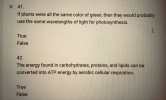 X 41. If plants were all the same color of green, then they would probably use the same wavelengths of light for photosynthesis. True False 42. The energy found in carbohydrates, proteins, and lipids can be converted into ATP energy by aerobic cellular respiration. True False 43. Resonance energy transfer in the antenna complex of a photosystem involves a series of electron transfer (redox) reactions. True False 44. Adding more substrate will always speed up an enzyme catalyzed reaction, but...
An enzyme facilitates chemical reactions by: Select one: a. Increasing the free-energy difference between reactants and...
An enzyme facilitates chemical reactions by: Select one: a. Increasing the free-energy difference between reactants and products. b. Decreasing the free-energy difference between reactants and products. c. Lowering the activation energy of the reaction. d. Raising the activation energy of the reaction. e. None of the above. Q2. Enzymes are important components of biological systems because they: Select one: a. Speed up reactions. b. Reduce the activation energy of reactions allowing them to occur. c. Catalyze specific reactions, allowing for...
barrier? Can lowering the activation energy make a reaction go in either direction spontaneously? What if...
 barrier? Can lowering the activation energy make a reaction go in either direction spontaneously? What if the concentrations of products and reactants were altered, making the reverse reaction a thermodynamically favored reaction. Could the enzyme function to speed up the reverse reaction in those circumstances?
the activation energy di the reaction with an enzyme. the progress of the reaction. All of...
 the activation energy di the reaction with an enzyme. the progress of the reaction. All of the following statements regarding the figure are correct EXCEPT? Figure 2. Energy profile of a chemical reaction with and without an enzyme Free Energy Progress of reaction - Even with the addition of an enzyme, an input of energy is needed for the reaction to progress. Energy is released from the reaction with or without an enzyme Even with the addition of an enzyme,...
Part A - Overview of enzyme structure and enzymatic reactions Enzymes are large globular proteins. Much...
 Part A - Overview of enzyme structure and enzymatic reactions Enzymes are large globular proteins. Much of their three dimensional shape is the result of interactions between the R (variable) groups of their amino acids. The active site is the portion of the enzyme that will interact with the substrate the molecule that the enzyme acts upon. The nature and arrangement of amino acids in the active site make each enzyme specific to a substrate and to the reaction it...
I have the need to complete the sentences. Thanks for your help < Energy and Enzymes...
 I have the need to complete the sentences.
Thanks for your help
< Energy and Enzymes Building Vocabulary: Enzymes Part A Drag the terms on the left to the appropriate blanks on the right to complete the sentences. Reset Help an enzyme, causing it to lose its shape and High temperatures or changes in pH can biological activity Enzymes speed up chemical reactions by lowering the proceed much more quickly An enzyme is considered a(n) used up activation energy induced...
I have the need to complete the sentences.
Thanks for your help
< Energy and Enzymes Building Vocabulary: Enzymes Part A Drag the terms on the left to the appropriate blanks on the right to complete the sentences. Reset Help an enzyme, causing it to lose its shape and High temperatures or changes in pH can biological activity Enzymes speed up chemical reactions by lowering the proceed much more quickly An enzyme is considered a(n) used up activation energy induced...
 Question 49 2 pts Enzymes work either by lowering the activation energy or increasing the free energy of a reaction. True False Question 50 2 pts Adding more substrate will always speed up an enzyme catalyzed reaction, but adding more enzyme will never speed up the reaction rate. True False Question 47 2 pts Because of C4 photosynthesis's ability to reduce photorespiration, all plants will evolve into C4 plants in the future. True False Question 48 2 pts If plants...
 Question 41 2 pts Adding more substrate will always speed up an enzyme catalyzed reaction, but adding more enzyme will never speed up the reaction rate. True O False Question 42 2 pts Non-competitive inhibition is a more effective way to completely stop a reaction than competitive inhibition. True False 00000000
 Enzymes are biological catalysts and Unction by A) increasing the free energy in a system. B) lowering the activation energy of a reaction. C) lowering entropy in a system. D) increasing the temperature near a reaction. E) altering the equilibrium of a reaction. Which of the following contributes to the specificity of enzymes? A) Each enzyme has a wide range of temperature and pH optimum B) Each enzyme has an active site that interacts with many C) Substrates themselves may...
 X 41. If plants were all the same color of green, then they would probably use the same wavelengths of light for photosynthesis. True False 42. The energy found in carbohydrates, proteins, and lipids can be converted into ATP energy by aerobic cellular respiration. True False 43. Resonance energy transfer in the antenna complex of a photosystem involves a series of electron transfer (redox) reactions. True False 44. Adding more substrate will always speed up an enzyme catalyzed reaction, but...
 barrier? Can lowering the activation energy make a reaction go in either direction spontaneously? What if the concentrations of products and reactants were altered, making the reverse reaction a thermodynamically favored reaction. Could the enzyme function to speed up the reverse reaction in those circumstances?
 the activation energy di the reaction with an enzyme. the progress of the reaction. All of the following statements regarding the figure are correct EXCEPT? Figure 2. Energy profile of a chemical reaction with and without an enzyme Free Energy Progress of reaction - Even with the addition of an enzyme, an input of energy is needed for the reaction to progress. Energy is released from the reaction with or without an enzyme Even with the addition of an enzyme,...
 Part A - Overview of enzyme structure and enzymatic reactions Enzymes are large globular proteins. Much of their three dimensional shape is the result of interactions between the R (variable) groups of their amino acids. The active site is the portion of the enzyme that will interact with the substrate the molecule that the enzyme acts upon. The nature and arrangement of amino acids in the active site make each enzyme specific to a substrate and to the reaction it...
 I have the need to complete the sentences.
Thanks for your help
< Energy and Enzymes Building Vocabulary: Enzymes Part A Drag the terms on the left to the appropriate blanks on the right to complete the sentences. Reset Help an enzyme, causing it to lose its shape and High temperatures or changes in pH can biological activity Enzymes speed up chemical reactions by lowering the proceed much more quickly An enzyme is considered a(n) used up activation energy induced...
I have the need to complete the sentences.
Thanks for your help
< Energy and Enzymes Building Vocabulary: Enzymes Part A Drag the terms on the left to the appropriate blanks on the right to complete the sentences. Reset Help an enzyme, causing it to lose its shape and High temperatures or changes in pH can biological activity Enzymes speed up chemical reactions by lowering the proceed much more quickly An enzyme is considered a(n) used up activation energy induced...
Most questions answered within 3 hours.
-
Where is the error in this code sequence?
String s1 = "Hello";
String s2 = "ello";...
asked 10 months ago -
Financial data for Joel de Paris, Inc., for last year
follow:
Joel de Paris, Inc.
Balance...
asked 10 months ago -
Consider this reaction:
Al2(SO4)3 (aq)+ BaCl3
(aq) Al2Cl6 (aq)- +
3BaSO4(s) . What is the...
asked 10 months ago -
Suppose that Savneet is considering increasing her
recent random sample from 20 car rentals to 40...
asked 10 months ago -
Trucks arrive at an unloading terminal at an average rate of 120
per hour.
Trucks arrive...
asked 10 months ago -
Why are methanol and ethanol completely soluble in water while
octanol is not very little soluble....
asked 10 months ago -
A facilities manager at a university reads in a research report
that the mean amount of...
asked 10 months ago -
When the CuSO4 is rehydrated by adding water to the anhydrous
compound, is this an endothermic...
asked 10 months ago -
A ray of sunlight is passing from diamond into crown glass; the
angle of incidence is...
asked 10 months ago -
A block of mass 0.249 kg is placed on top of a light, vertical
spring of...
asked 10 months ago -
how do the kidneys compensate in the presences of acidosis
a) trigger hyperventilate
b) reserve acid...
asked 10 months ago -
Question 501 pts
The rental rate of capital to the firm increases. Which of the
following...
asked 10 months ago