
Homework Answers
Answer - Option 1 will be CORRECT.
ATP inhibits the phosphofructokinase reaction by raising the K m for fructose‐6‐phosphate. AMP activates the reaction. Thus, when energy is required (Means when ATPs are low), glycolysis is activated. When energy is plentiful, the reaction is slowed down.
Thanks
Add Answer to:
Question 38 (1 point) the regulatory enzyme, A metabolic pathway, glycolysis, is active when cellular energy...
Question 4 Q . OH ATP OH POH ОН Fructose 6-phosphate Fructose 1.6-bisphosphate Figure 1. Reaction...
 Question 4 Q . OH ATP OH POH ОН Fructose 6-phosphate Fructose 1.6-bisphosphate Figure 1. Reaction catalyzed by phosphofructokinase (PFK) during glycolysis Phosphofructokinase (PFK) is an enzyme that catalyzes the conversion of fructose 6- phosphate to fructose 1,6-bisphosphate during glycolysis, as represented in Figure 1. PFK can be allosterically inhibited by ATP at high concentrations. Which of the following is the benefit of regulating glycolysis by the concentration of ATP? Glycolysis proceeds when the intracellular concentration of ATP is low,...
6 Cells also regulate enzyme function using dhac inhibition in this type of regulation, metabolic pathway...
 6 Cells also regulate enzyme function using dhac inhibition in this type of regulation, metabolic pathway etabolic pathway will inhibit the function of an eneme in an early phase of the metabolic path produces it. lon. In this type of regulation, the end product of a early phase of the metabolic pathway that What is the advantage of using feedback inhibition to regulate enzymes for cells? b. Cellular respiration is the process of generating ATP by breaking down sugar completely...
Question 30 (1 point) The enzyme phosphofructokinase is the major regulatory enzyme of glycolysis. What reaction...
 Question 30 (1 point) The enzyme phosphofructokinase is the major regulatory enzyme of glycolysis. What reaction does it catalyze? the phosphorylation of fructose 6- phosphate. the substrate-level phosphorylation reaction whereby phosphoenolpyruvate is converted to pyruvate the isomerization of glucose 6-phosphate to fructose 6-phosphate. the first of the 10 reactions of glycolysis.
Question 30 (1 point) The enzyme phosphofructokinase is the major regulatory enzyme of glycolysis. What reaction...
 Question 30 (1 point) The enzyme phosphofructokinase is the major regulatory enzyme of glycolysis. What reaction does it catalyze? o the phosphorylation of fructose 6-phosphate the substrate-level phosphorylation reaction whereby phosphoenolpyruvate is converted to pyruvate 0 the isomerization of glucose 6-phosphate to fructose 6-phosphate. 0 the first of the 10 reactions of glycolysis. 0
Match the description to the approptiate cell type gluconeogenesis pathway is unfavorable glycolysis pathway is favorable...
 Match the description to the approptiate cell type gluconeogenesis pathway is unfavorable glycolysis pathway is favorable expresses phosphofructokinase y glycerol stimulates the rate of 1. muscle 2. liver cell 3. both 4. neither glucose formation reciprocally regulates glycolysis and gluconeogenesis regulates the rate of expresses pyruvate carboxylase y cannot regulate the rate of expresses fructose 1.6 bisphosphatase Match the description with the process to which it applies transports glucose into mitochondria AMP regulates rate stimulated by high cellular glucose concentration...
Adenosine monophosphate (AMP) is a regulatory molecule in metabolic processes such as glycolysis and gluconeogenesis. For...
Adenosine monophosphate (AMP) is a regulatory molecule in metabolic processes such as glycolysis and gluconeogenesis. For example, it stimulates the glycolytic enzyme phosphofructokinase, and therefore ATP production, and it inhibits the gluconeogenic enzyme fructose 1,6-bisphosphatase. Adenylate kinase catalyzes the reversible reaction shown here: 2 ADP =(Mg2+)= ATP + AMP During periods of intense activity, when glycolysis is used in the generation of ATP, the reaction lies to the right, decreasing [ADP], generating ATP, and accumulating AMP. However, [ATP] is usually...
If a cell does not have mitochondria, it cannot harvest the entire energy stored in a...
If a cell does not have mitochondria, it cannot harvest the entire energy stored in a molecule of glucose? A)True B)False Phosphofructokinase is an enzyme that is important for the breakdown of the glucose molecule to generate ATP. In regards to that, when the ATP levels are high, the phosphofructokinase is inhibited. What do you expect to happen to the enzyme when the levels of ATP within the cell drop? 1.The enzyme will be activated. 2.The enzyme will be deactivated....
QUESTION 3 2 points Save Answer Which of the following events releases free energy for metabolic...
 QUESTION 3 2 points Save Answer Which of the following events releases free energy for metabolic processes? a. Dissipation of electrochemical gradients b. ATP → ADP + P c. Hydrolysis of inorganic pyrophosphate (PP) d. all of the above OA OB OC OD QUESTION 4 2 points Save Answer Which scenario would not favor glycolysis? a. phosphofructokinase 2 (PFK2) is active b. insulin is secreted c. blood glucose is high d. ATP levels are high oc
PEK-1 is an enzyme that catalyzes step 3 of glycolysis. The activity of this enzyme is...
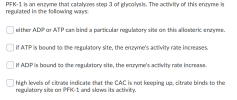 PEK-1 is an enzyme that catalyzes step 3 of glycolysis. The activity of this enzyme is regulated in the following ways: O either ADP or ATP can bind a particular regulatory site on this allosteric enzyme. O if ATP is bound to the regulatory site, the enzyme's activity rate increases. if ADP is bound to the regulatory site, the enzyme's activity rate increase. high levels of citrate indicate that the CAC is not keeping up, citrate binds to the regulatory...
From the following which is true about cellular respiration (select all that apply) 1. In prokaryotes,...
From the following which is true about cellular respiration (select all that apply) 1. In prokaryotes, the electrons transport is in the plasma membrane 2. Prokaryotic fermentation net yield is 4 ATP and oxidative respiration has 32 ATP 3. The major regulatory enzyme of glycolysis is Hexokinase 4. Substrate-level phosphorylation is catalyzed by kinase and transfers the phosphate group from an intermediate in a metabolic pathway directly to a molecule of ADP
 Question 4 Q . OH ATP OH POH ОН Fructose 6-phosphate Fructose 1.6-bisphosphate Figure 1. Reaction catalyzed by phosphofructokinase (PFK) during glycolysis Phosphofructokinase (PFK) is an enzyme that catalyzes the conversion of fructose 6- phosphate to fructose 1,6-bisphosphate during glycolysis, as represented in Figure 1. PFK can be allosterically inhibited by ATP at high concentrations. Which of the following is the benefit of regulating glycolysis by the concentration of ATP? Glycolysis proceeds when the intracellular concentration of ATP is low,...
 6 Cells also regulate enzyme function using dhac inhibition in this type of regulation, metabolic pathway etabolic pathway will inhibit the function of an eneme in an early phase of the metabolic path produces it. lon. In this type of regulation, the end product of a early phase of the metabolic pathway that What is the advantage of using feedback inhibition to regulate enzymes for cells? b. Cellular respiration is the process of generating ATP by breaking down sugar completely...
 Question 30 (1 point) The enzyme phosphofructokinase is the major regulatory enzyme of glycolysis. What reaction does it catalyze? the phosphorylation of fructose 6- phosphate. the substrate-level phosphorylation reaction whereby phosphoenolpyruvate is converted to pyruvate the isomerization of glucose 6-phosphate to fructose 6-phosphate. the first of the 10 reactions of glycolysis.
 Question 30 (1 point) The enzyme phosphofructokinase is the major regulatory enzyme of glycolysis. What reaction does it catalyze? o the phosphorylation of fructose 6-phosphate the substrate-level phosphorylation reaction whereby phosphoenolpyruvate is converted to pyruvate 0 the isomerization of glucose 6-phosphate to fructose 6-phosphate. 0 the first of the 10 reactions of glycolysis. 0
 Match the description to the approptiate cell type gluconeogenesis pathway is unfavorable glycolysis pathway is favorable expresses phosphofructokinase y glycerol stimulates the rate of 1. muscle 2. liver cell 3. both 4. neither glucose formation reciprocally regulates glycolysis and gluconeogenesis regulates the rate of expresses pyruvate carboxylase y cannot regulate the rate of expresses fructose 1.6 bisphosphatase Match the description with the process to which it applies transports glucose into mitochondria AMP regulates rate stimulated by high cellular glucose concentration...
 QUESTION 3 2 points Save Answer Which of the following events releases free energy for metabolic processes? a. Dissipation of electrochemical gradients b. ATP → ADP + P c. Hydrolysis of inorganic pyrophosphate (PP) d. all of the above OA OB OC OD QUESTION 4 2 points Save Answer Which scenario would not favor glycolysis? a. phosphofructokinase 2 (PFK2) is active b. insulin is secreted c. blood glucose is high d. ATP levels are high oc
 PEK-1 is an enzyme that catalyzes step 3 of glycolysis. The activity of this enzyme is regulated in the following ways: O either ADP or ATP can bind a particular regulatory site on this allosteric enzyme. O if ATP is bound to the regulatory site, the enzyme's activity rate increases. if ADP is bound to the regulatory site, the enzyme's activity rate increase. high levels of citrate indicate that the CAC is not keeping up, citrate binds to the regulatory...
Most questions answered within 3 hours.
-
Where is the error in this code sequence?
String s1 = "Hello";
String s2 = "ello";...
asked 10 months ago -
Financial data for Joel de Paris, Inc., for last year
follow:
Joel de Paris, Inc.
Balance...
asked 10 months ago -
Consider this reaction:
Al2(SO4)3 (aq)+ BaCl3
(aq) Al2Cl6 (aq)- +
3BaSO4(s) . What is the...
asked 10 months ago -
Suppose that Savneet is considering increasing her
recent random sample from 20 car rentals to 40...
asked 10 months ago -
Trucks arrive at an unloading terminal at an average rate of 120
per hour.
Trucks arrive...
asked 10 months ago -
Why are methanol and ethanol completely soluble in water while
octanol is not very little soluble....
asked 10 months ago -
A facilities manager at a university reads in a research report
that the mean amount of...
asked 10 months ago -
When the CuSO4 is rehydrated by adding water to the anhydrous
compound, is this an endothermic...
asked 10 months ago -
A ray of sunlight is passing from diamond into crown glass; the
angle of incidence is...
asked 10 months ago -
A block of mass 0.249 kg is placed on top of a light, vertical
spring of...
asked 10 months ago -
how do the kidneys compensate in the presences of acidosis
a) trigger hyperventilate
b) reserve acid...
asked 10 months ago -
Question 501 pts
The rental rate of capital to the firm increases. Which of the
following...
asked 10 months ago