HIV is able to change its RNA into DNA to allow for replication by CD8+ cells....
HIV is able to change its RNA into DNA to allow for replication by CD8+ cells. True or False.
Homework Answers
False, like all viruses, HIV can replicate only inside cells, commandeering the cell's machinery to reproduce. However, only HIV and other retroviruses, once inside a cell, use an enzyme called reverse transcriptase to convert their RNA into DNA, which can be incorporated into the host cell's genes.While HIV-specific CD8+ T-cells control the virus during acute HIV/SIV infection, their cytotoxic potential dramatically decreases along with disease progression and are no longer capable of exerting an appropriate antiviral response
HIV is a retrovirus, which means it carries single-stranded RNA is its genetic material rather than the double-stranded DNA human cells carry. Retroviruses also have the enzyme reverse transcriptase, which allow it to copy RNA into DNA and use that DNA "copy" to infect human, or host, cells.
Add Answer to:
HIV is able to change its RNA into DNA to allow for replication
by CD8+ cells....
1. In retroviral replication (such as HIV) reverse transcriptase is used to convert viral ds RNA...
1. In retroviral replication (such as HIV) reverse transcriptase is used to convert viral ds RNA into viral ds DNA viral ss RNA viral mRNA viral ss DNA 2. Many viruses undergo an uncoating process prior to replication. Which statement depicts the uncoating process? the virus destroys the host nuclear membrane allowing it access to DNA the virus sheds its protein coat the virus shed its envelope when entering the cell via the cell membrane the virus sheds its...
HIV is a retrovirus. Given that, which of the following must be true? HIV is able...
HIV is a retrovirus. Given that, which of the following must be true? HIV is able to integrate itself into the host genome. HIV is a DNA virus HIV uses lytic transmission from its host cells HIV is double stranded
DNA, RNA, nucleotides, plasmid, helicase, DNA polymerase, primase, RNA primer of DNA replication
Define termsDNA, RNA, nucleotides, plasmid, helicase, DNA polymerase, primase, RNA primer of DNA replication, mutation, gene, amino acid, polypeptide chain, protein, codon, promoter region of a gene, RNA polymerase, transcription, mRNA, tRNA, RNA, ribosomes, translation, gene expression, conjugation, conjugative pilus, transformation, transductionExplain concept or process• Describe how nucleotides are linked together to form a single strand of nucleic acid• Explain the concept of a complementary pairing • Describe how DNA replication occurs in bacteria • Explain why a primer is necessary for...
Fill in the blank: During chromosome replication, the _________ enzyme synthesizes short RNA primers that get...
Fill in the blank: During chromosome replication, the _________ enzyme synthesizes short RNA primers that get extended to form the ___________ fragments. This process uses the __________ strand as the template. Type II topoisomerases such as DNA gyrase change the LINKING number of DNA in increments of ____. They use a _________ amino-acid side chain at the active site to form a ___________ linkage to the broken DNA strands. The protein core of a nucleosome consists of ___ copies each...
Which of the following statements in NOT true about DNA replication? DNA replication involves synthesis of...
 Which of the following statements in NOT true about DNA replication? DNA replication involves synthesis of multiple RNA primers DNA ligase is needed for successful DNA replication DNA replication requires deoxyribonucleotide triphosphates High fidelity of DNA replication is ensured by 5-3' exonuclease activity of DNA polymerase High fidelity of DNA replication is ensured by 3-5' exonuclease activity of DNA polymerases Next
Which of the following statements in NOT true about DNA replication? DNA replication involves synthesis of...
 Which of the following statements in NOT true about DNA replication? DNA replication involves synthesis of multiple RNA primers DNA ligase is needed for successful DNA replication DNA replication requires deoxyribonucleotide triphosphates High fidelity of DNA replication is ensured by 5-3 exonuclease activity of DNA polymerase High fidelity of DNA replication is ensured by 3-5' exonuclease activity of DNA polymerases Next
8) The "backbones" of DNA and RNA molecules are identical. a. TRUE b. FALSE 9) The...
 8) The "backbones" of DNA and RNA molecules are identical. a. TRUE b. FALSE 9) The 20 standard amino acids are distinguished from each other based by the presence of primary, secondary, or tertiary amino groups on the α carbon a. TRUE b. FALSE 10) The hairpin loop located opposite the open end of a tRNA molecule is the site where the tRNA hydrogen bonds to the hnRNA. a, TRUE b● FALSE 11) Replication usually begins at multiple places on...
Question 10 A human chromosome has 3 origins of replication. Assuming that all 3 origins of...
 Question 10 A human chromosome has 3 origins of replication. Assuming that all 3 origins of replication are used at the same time, what is the maximum number of helicases present on DNA during DNA replication (not including DNA repair)? 12 O 3 O2 Question 11 Which of the following correctly compares primase and telomerase? O Both primase and telomerase synthesize DNA using a DNA template. O Primase synthesizes RNA using an RNA template, but telomerase synthesizes DNA using a...
You are measuring DNA replication in E. coli cells using radioisotopes. If DNA replication was unidirectional...
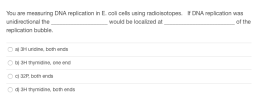 You are measuring DNA replication in E. coli cells using radioisotopes. If DNA replication was unidirectional the would be localized at of the replication bubble. O a) 3H uridine, both ends Ob) 3H thymidine, one end OC) 32P, both ends d) 3H thymidine, both ends
Question 24 2 pts RNA differs from DNA because RNA can self-replicate, whereas DNA replication requires...
 Question 24 2 pts RNA differs from DNA because RNA can self-replicate, whereas DNA replication requires enzymes. is double-stranded, whereas DNA is not. is replicated along with DNA, but does not require strand separation like DNA does. is never single-stranded, whereas DNA may or may not be. may double back and base pair with itself, whereas DNA does not.
 Which of the following statements in NOT true about DNA replication? DNA replication involves synthesis of multiple RNA primers DNA ligase is needed for successful DNA replication DNA replication requires deoxyribonucleotide triphosphates High fidelity of DNA replication is ensured by 5-3' exonuclease activity of DNA polymerase High fidelity of DNA replication is ensured by 3-5' exonuclease activity of DNA polymerases Next
 Which of the following statements in NOT true about DNA replication? DNA replication involves synthesis of multiple RNA primers DNA ligase is needed for successful DNA replication DNA replication requires deoxyribonucleotide triphosphates High fidelity of DNA replication is ensured by 5-3 exonuclease activity of DNA polymerase High fidelity of DNA replication is ensured by 3-5' exonuclease activity of DNA polymerases Next
 8) The "backbones" of DNA and RNA molecules are identical. a. TRUE b. FALSE 9) The 20 standard amino acids are distinguished from each other based by the presence of primary, secondary, or tertiary amino groups on the α carbon a. TRUE b. FALSE 10) The hairpin loop located opposite the open end of a tRNA molecule is the site where the tRNA hydrogen bonds to the hnRNA. a, TRUE b● FALSE 11) Replication usually begins at multiple places on...
 Question 10 A human chromosome has 3 origins of replication. Assuming that all 3 origins of replication are used at the same time, what is the maximum number of helicases present on DNA during DNA replication (not including DNA repair)? 12 O 3 O2 Question 11 Which of the following correctly compares primase and telomerase? O Both primase and telomerase synthesize DNA using a DNA template. O Primase synthesizes RNA using an RNA template, but telomerase synthesizes DNA using a...
 You are measuring DNA replication in E. coli cells using radioisotopes. If DNA replication was unidirectional the would be localized at of the replication bubble. O a) 3H uridine, both ends Ob) 3H thymidine, one end OC) 32P, both ends d) 3H thymidine, both ends
 Question 24 2 pts RNA differs from DNA because RNA can self-replicate, whereas DNA replication requires enzymes. is double-stranded, whereas DNA is not. is replicated along with DNA, but does not require strand separation like DNA does. is never single-stranded, whereas DNA may or may not be. may double back and base pair with itself, whereas DNA does not.
Most questions answered within 3 hours.
-
Where is the error in this code sequence?
String s1 = "Hello";
String s2 = "ello";...
asked 11 months ago -
Financial data for Joel de Paris, Inc., for last year
follow:
Joel de Paris, Inc.
Balance...
asked 11 months ago -
Consider this reaction:
Al2(SO4)3 (aq)+ BaCl3
(aq) Al2Cl6 (aq)- +
3BaSO4(s) . What is the...
asked 11 months ago -
Suppose that Savneet is considering increasing her
recent random sample from 20 car rentals to 40...
asked 11 months ago -
Trucks arrive at an unloading terminal at an average rate of 120
per hour.
Trucks arrive...
asked 11 months ago -
Why are methanol and ethanol completely soluble in water while
octanol is not very little soluble....
asked 11 months ago -
A facilities manager at a university reads in a research report
that the mean amount of...
asked 11 months ago -
When the CuSO4 is rehydrated by adding water to the anhydrous
compound, is this an endothermic...
asked 11 months ago -
A ray of sunlight is passing from diamond into crown glass; the
angle of incidence is...
asked 11 months ago -
A block of mass 0.249 kg is placed on top of a light, vertical
spring of...
asked 11 months ago -
how do the kidneys compensate in the presences of acidosis
a) trigger hyperventilate
b) reserve acid...
asked 11 months ago -
Question 501 pts
The rental rate of capital to the firm increases. Which of the
following...
asked 11 months ago