


Homework Answers
You have asked two questions here. As per Chegg Q&A Guidelines, I am answering the first question, both the subparts.
a) The reaction rate is very-well captured by Michelis-Menten kinetics stated by the equation:
![v = \frac{v_{max}[S]}{[S]+K_M}](http://img.homeworklib.com/questions/0779ce00-ebd6-11eb-97fc-8d07beffd117.png?x-oss-process=image/resize,w_560)
where v is the rate of the reaction, v_max is the maximum rate of the reaction, [S] is the concentration of the substrate and K_M is the Michelis' Menten constant.
K_M and v_max are substrate independent and are the characteristics of the enzyme.
K_M determines the concentration of the substrate at which the rate of the reaction is half-maximum, while v_max refers to the maximum reaction rate which the enzyme can undergo.
Now, v_max can be stated as:
![v_{max} = [E]_T k_{cat}](http://img.homeworklib.com/questions/07cf4920-ebd6-11eb-9e3e-956c0c0780dc.png?x-oss-process=image/resize,w_560)
where [E]_T is the total enzyme concentration and k_cat is the turnover number of the enzyme which determines the number of product molecules formed from the substrate molecules in one second.
Now, there is one more quantity called the specificity constant specified by

This quantity determines the enzyme efficiency. The higher is the specificity constant, the higher the ability does the enzyme have to react with the substrate.
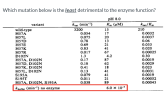
Now, as can be seen in the table, the mutations are mentioned accompanied by the kinetic constants K_M, k_cat, and c.
A mutation that leads to a lower decrease in specificity constant has the least effect on the enzyme activity and hence is the least detrimental for enzyme function.
Here we can see that the mutation with the highest specificity constant is D102N with a specificity constant c = 0.3.
Hence the correct answer for the first subpart is D102N.
b) The enzyme works by lowering the activation energy for the reaction. It has an active site that binds to the substrate reorients it so that the activation energy is lowered and hence the reaction is facilitated. The active pocket also has a catalytic site that speeds up the conversion of a substrate molecule to the product molecule.
In this enzyme, the mutations H57A, D102N, and S195A result in the loss of the catalytic site. However, these sites do not prevent the binding of the substrate to the active pocket of the enzyme and the reorientation of the enzyme that will still favor the reaction to a large extent.
Hence the answer for the second subpart is Orienting reaction groups favorably.
Add Answer to:
kcal/K 210 Which mutation below is the least detrimental to the enzyme function? PH 8.0 variant...
Which mutation below is the least detrimental to the enzyme function? pH 8.0 Km (AM) 15...
 Which mutation below is the least detrimental to the enzyme function? pH 8.0 Km (AM) 15 17 20 13 21 41 variant wild-type H57A H57L H57D H57E H57K HSOR D102N H57A, D102N H57D, D102N HSOK, D102N H57L, D102N S195A S195T H57A, D102N, S195A kbuffer (min) no enzyme kost (min-') 3200 0.054 0.075 0.78 0.69 0.83 0.017 1.3 0.17 0.18 0.41 0.13 0.079 0.011 0.038 67 keaK 210 0.0032 0.0037 0.06 0.033 0.020 0.00025 0.30 0.0019 0.0029 0.023 0.0031 0.0019 0.00052...
 Which mutation below is the least detrimental to the enzyme function? pH 8.0 Km (AM) 15 17 20 13 21 41 variant wild-type H57A H57L H57D H57E H57K HSOR D102N H57A, D102N H57D, D102N HSOK, D102N H57L, D102N S195A S195T H57A, D102N, S195A kbuffer (min) no enzyme kost (min-') 3200 0.054 0.075 0.78 0.69 0.83 0.017 1.3 0.17 0.18 0.41 0.13 0.079 0.011 0.038 67 keaK 210 0.0032 0.0037 0.06 0.033 0.020 0.00025 0.30 0.0019 0.0029 0.023 0.0031 0.0019 0.00052...
Most questions answered within 3 hours.
-
Where is the error in this code sequence?
String s1 = "Hello";
String s2 = "ello";...
asked 10 months ago -
Financial data for Joel de Paris, Inc., for last year
follow:
Joel de Paris, Inc.
Balance...
asked 10 months ago -
Consider this reaction:
Al2(SO4)3 (aq)+ BaCl3
(aq) Al2Cl6 (aq)- +
3BaSO4(s) . What is the...
asked 10 months ago -
Suppose that Savneet is considering increasing her
recent random sample from 20 car rentals to 40...
asked 10 months ago -
Trucks arrive at an unloading terminal at an average rate of 120
per hour.
Trucks arrive...
asked 10 months ago -
Why are methanol and ethanol completely soluble in water while
octanol is not very little soluble....
asked 10 months ago -
A facilities manager at a university reads in a research report
that the mean amount of...
asked 10 months ago -
When the CuSO4 is rehydrated by adding water to the anhydrous
compound, is this an endothermic...
asked 10 months ago -
A ray of sunlight is passing from diamond into crown glass; the
angle of incidence is...
asked 10 months ago -
A block of mass 0.249 kg is placed on top of a light, vertical
spring of...
asked 10 months ago -
how do the kidneys compensate in the presences of acidosis
a) trigger hyperventilate
b) reserve acid...
asked 10 months ago -
Question 501 pts
The rental rate of capital to the firm increases. Which of the
following...
asked 10 months ago