
Homework Answers
Pathogenic bacteria are chemoheterotrophs. As chemoheterotrophs are unable to synthesize their own food so they depend on other sources to obtain their food which they do by oxidatising different inorganic molecules like carbohydrates, lipids etc. So most of them infect different variety of hosts and obtain their carbon sources from them.
Thank you
Add Answer to:
14 1 point Most pathogenic bacteria are classified as. 0 Photoheterotrophs Chemoheterotrophs Photoautotrophs 0 O Chemoautotrophs...
answer 7) The substrate of an eye a) Allosterves to the b) Reactant c) Coenzyme d)...
 answer
7) The substrate of an eye a) Allosterves to the b) Reactant c) Coenzyme d) Active site 8) Which of the following is FALSE regarding Gestrandorten a) When living "S" strain (encapsulated strain was (b) The "R" strain and "S" strain exchanged genes via segi c) After DNA from the heat killed "S"strain was mad with strain became pathogenic. d) When heat-killed "S" strain was injected into mice, the mic 9) Bacteria that live in deep sea hydrothermal vents...
answer
7) The substrate of an eye a) Allosterves to the b) Reactant c) Coenzyme d) Active site 8) Which of the following is FALSE regarding Gestrandorten a) When living "S" strain (encapsulated strain was (b) The "R" strain and "S" strain exchanged genes via segi c) After DNA from the heat killed "S"strain was mad with strain became pathogenic. d) When heat-killed "S" strain was injected into mice, the mic 9) Bacteria that live in deep sea hydrothermal vents...
25 1 point Identifying pathogenic microorganism from specimen containing normal flora usually requires use of selective...
 25 1 point Identifying pathogenic microorganism from specimen containing normal flora usually requires use of selective media. O False O True Previous Exam 2 com.c.edu Ret 39:07 < Time Remaining 27 pont As organism that uses reduced amount of oxygen to grow is called a(n) microacrophile O o obligate scrobe O r tolerant anaerobe facultative anaerobe o Previous 26 1 point Most bacteria can degrade Agar O False O True Previous
1). What are some potentially pathogenic bacteria that are lactose fermenters that will grow on MacConkey...
1). What are some potentially pathogenic bacteria that are lactose fermenters that will grow on MacConkey agar?” 2). What are some potentially pathogenic bacteria that do not ferment lactose that will grow on MacConkey agar?”
Bacterial Flagella Many pathogenic bacteria that infect the intestinal tract have flagella. (Hint: See Flagella, section...
Bacterial Flagella Many pathogenic bacteria that infect the intestinal tract have flagella. (Hint: See Flagella, section F.) 1. Why might having flagella better enable those bacteria to cause disease? 2. Most pathogenic spirochetes such as Treponema pallidum and Borrelia burgdorferi disseminate from the original infection site. How are they able to do this?
THE Question 14 (1 point) Inventory is classified as: The o 1) intangible fixed assets. X...
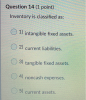 THE Question 14 (1 point) Inventory is classified as: The o 1) intangible fixed assets. X . HE main relier ARSE ( 2) current liabilities. C HAI # 3) tangible fixed assets. ARSENAL BERG DHE CARLO LEDERE de EDHE SEEDS TERELD SELLE BE THE FRESH SERIES 4) noncash expenses. h ELLE ERREU ILDER 5) current assets. ERE FREE
Section B (Plant Microbes) 1. Compare the ecology and spread of plant-pathogenic bacteria and fungi. (maximum...
 Section B (Plant Microbes) 1. Compare the ecology and spread of plant-pathogenic bacteria and fungi. (maximum two pages) 20 marks
"Air! Airll Airl!! I must have air screamed the a. Obligate anaerobe b. Facultative aerobe c....
 "Air! Airll Airl!! I must have air screamed the a. Obligate anaerobe b. Facultative aerobe c. Facultative anaerobe d. Obligate aerobe None of the above 12. Which of the following are extremophiles? Halobacteria b. Chlamydia trachomatis c. Cyanobacteria d. Picrophilus oshimne e. "n" and "d" 13. A or an is the organism of syphilis a. Pseudomonad b. Endospore forming bacteria c. Chlamydian d. Spirochaete e. None of the above 14. Which of the following situations would be an example of...
Question 34 1 pts True or False: All bacteria can be classified as either Gram positive...
 Question 34 1 pts True or False: All bacteria can be classified as either Gram positive or Gam negative. O True O False
1. You have encountered 2 different pathogenic bacteria in the past 3 months and developed an upper respiratory tra...
 1. You have encountered 2 different pathogenic bacteria in the past 3 months and developed an upper respiratory tract infection of the same approximaté magnitude each time. The inoculum size of organism #1 was 100 organisms, the inoculum size of organism #2 was 500 organisms. Explain how this is possible- that each would produce the same amount of disease
Question 25 (1 point) Leishmaniasis is caused by? virus archaebacteria O bacteria fungi O protist Show...
 Question 25 (1 point) Leishmaniasis is caused by? virus archaebacteria O bacteria fungi O protist
 answer
7) The substrate of an eye a) Allosterves to the b) Reactant c) Coenzyme d) Active site 8) Which of the following is FALSE regarding Gestrandorten a) When living "S" strain (encapsulated strain was (b) The "R" strain and "S" strain exchanged genes via segi c) After DNA from the heat killed "S"strain was mad with strain became pathogenic. d) When heat-killed "S" strain was injected into mice, the mic 9) Bacteria that live in deep sea hydrothermal vents...
answer
7) The substrate of an eye a) Allosterves to the b) Reactant c) Coenzyme d) Active site 8) Which of the following is FALSE regarding Gestrandorten a) When living "S" strain (encapsulated strain was (b) The "R" strain and "S" strain exchanged genes via segi c) After DNA from the heat killed "S"strain was mad with strain became pathogenic. d) When heat-killed "S" strain was injected into mice, the mic 9) Bacteria that live in deep sea hydrothermal vents...
 25 1 point Identifying pathogenic microorganism from specimen containing normal flora usually requires use of selective media. O False O True Previous Exam 2 com.c.edu Ret 39:07 < Time Remaining 27 pont As organism that uses reduced amount of oxygen to grow is called a(n) microacrophile O o obligate scrobe O r tolerant anaerobe facultative anaerobe o Previous 26 1 point Most bacteria can degrade Agar O False O True Previous
 THE Question 14 (1 point) Inventory is classified as: The o 1) intangible fixed assets. X . HE main relier ARSE ( 2) current liabilities. C HAI # 3) tangible fixed assets. ARSENAL BERG DHE CARLO LEDERE de EDHE SEEDS TERELD SELLE BE THE FRESH SERIES 4) noncash expenses. h ELLE ERREU ILDER 5) current assets. ERE FREE
 Section B (Plant Microbes) 1. Compare the ecology and spread of plant-pathogenic bacteria and fungi. (maximum two pages) 20 marks
 "Air! Airll Airl!! I must have air screamed the a. Obligate anaerobe b. Facultative aerobe c. Facultative anaerobe d. Obligate aerobe None of the above 12. Which of the following are extremophiles? Halobacteria b. Chlamydia trachomatis c. Cyanobacteria d. Picrophilus oshimne e. "n" and "d" 13. A or an is the organism of syphilis a. Pseudomonad b. Endospore forming bacteria c. Chlamydian d. Spirochaete e. None of the above 14. Which of the following situations would be an example of...
 Question 34 1 pts True or False: All bacteria can be classified as either Gram positive or Gam negative. O True O False
 1. You have encountered 2 different pathogenic bacteria in the past 3 months and developed an upper respiratory tract infection of the same approximaté magnitude each time. The inoculum size of organism #1 was 100 organisms, the inoculum size of organism #2 was 500 organisms. Explain how this is possible- that each would produce the same amount of disease
 Question 25 (1 point) Leishmaniasis is caused by? virus archaebacteria O bacteria fungi O protist
Most questions answered within 3 hours.
-
Where is the error in this code sequence?
String s1 = "Hello";
String s2 = "ello";...
asked 10 months ago -
Financial data for Joel de Paris, Inc., for last year
follow:
Joel de Paris, Inc.
Balance...
asked 10 months ago -
Consider this reaction:
Al2(SO4)3 (aq)+ BaCl3
(aq) Al2Cl6 (aq)- +
3BaSO4(s) . What is the...
asked 10 months ago -
Suppose that Savneet is considering increasing her
recent random sample from 20 car rentals to 40...
asked 10 months ago -
Trucks arrive at an unloading terminal at an average rate of 120
per hour.
Trucks arrive...
asked 10 months ago -
Why are methanol and ethanol completely soluble in water while
octanol is not very little soluble....
asked 10 months ago -
A facilities manager at a university reads in a research report
that the mean amount of...
asked 10 months ago -
When the CuSO4 is rehydrated by adding water to the anhydrous
compound, is this an endothermic...
asked 10 months ago -
A ray of sunlight is passing from diamond into crown glass; the
angle of incidence is...
asked 10 months ago -
A block of mass 0.249 kg is placed on top of a light, vertical
spring of...
asked 10 months ago -
how do the kidneys compensate in the presences of acidosis
a) trigger hyperventilate
b) reserve acid...
asked 10 months ago -
Question 501 pts
The rental rate of capital to the firm increases. Which of the
following...
asked 10 months ago