
Homework Answers

Add Answer to:
QUESTION 3 A population of deer is growing logistically with K=200 and r=0.03. At what size...
Based on logistic growth, at what population size (N) is the population growing at the fastest...
Based on logistic growth, at what population size (N) is the population growing at the fastest rate (largest increase per time)? Group of answer choices When N is near 0. When N is near K. When N = K/2. The growth rate is not related to N.
2. In 1900 the population of white tailed deer in the US declined to ca. 4...
 2. In 1900 the population of white tailed deer in the US declined to ca. 4 million from as high as 30 million in 1450. What would be the projected population size in the year 1910 if the species did not face any environmental resistance and had an intrinsic rate of growth was 0.1 during the period of time? (Show all calculations to receive any credit) (10 Holt calculated that a deer population in one of the ranches in Stephenville...
a) You are studying a population of aphids with an initial population size of 500. During...
 a) You are studying a population of aphids with an initial
population size of 500. During a one-month period, you observe 40
births and 15 deaths in the population. Estimate the value of r for
that month, and predict the population size in three months (from
the initial population size). Remember that r is the per capita
rate of population increase. (Assume exponential population
growth).
b) Imagine you are growing ciliates in a laboratory flask. The
carrying capacity is 1000...
a) You are studying a population of aphids with an initial
population size of 500. During a one-month period, you observe 40
births and 15 deaths in the population. Estimate the value of r for
that month, and predict the population size in three months (from
the initial population size). Remember that r is the per capita
rate of population increase. (Assume exponential population
growth).
b) Imagine you are growing ciliates in a laboratory flask. The
carrying capacity is 1000...
Population growth problems BIDE model: No.1 N, +(B + 1) - ( D Rates: b =...
 Population growth problems BIDE model: No.1 N, +(B + 1) - ( D Rates: b = B/N; d = D/N: E) Net growth rate: R = b-d Exponential growth (discrete): N, NR* where R = 1+b-d Intrinsic rate of increase: r = InR Exponential growth (continuous): N:Noe -or-dN/dt = IN Logistic growth 1. Suppose a species of fish in a lake is modeled by a logistic population model with relative growth rate ofr 0.3 per year and carrying capacity of...
Do the calculations and fill in the chart below. You may want to do this in...
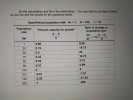 Do the calculations and fill in the chart below. You may want to do this in Excel, so you can plot the results for the questions below Hypothetical population with No 1, K 100, r 1.0 Rate of change in Population "Unused capacity for growth"population size size dN art = rn(K.KR) 25 50 75 95 0.99 0.75 0.5 0.25 0.05 0.01 0.99 18.75 25 18.75 4.75 0.99 100 101 125 200 -0.01 -0.25 -1 31.25 -200 21. At what population...
QUESTION 4 This graph shows how the growth rate of a certain population changes with population...
 QUESTION 4 This graph shows how the growth rate of a certain population changes with population size. A A If the population starts at size "x", what will be the eventual size of the dN/dt population (choose A-E)? OOOO QUESTION 5 This graph shows the per-capita birth and death rates for a certain population as a function of population size, N.  If the population starts at size "x", what will be the eventual size of the population (choose A-E)?...
A population proportion is 0.5. A sample of size 200 will be taken and the sample...
A population proportion is 0.5. A sample of size 200 will be taken and the sample proportion p will be used to estimate the population proportion. Round your answers to four decimal places. a. What is the probability that the sample proportion will be within ±0.03 of the population proportion? b. What is the probability that the sample proportion will be within ±0.07 of the population proportion?
Model exponential growth Question The population of a bee hive is growing with a monthly percentage...
 Model exponential growth Question The population of a bee hive is growing with a monthly percentage rate compounded continuously. The population doubles in 3 months. Assuming that every month has 30 days, which formula could be used to find the monthly percentage rate according to the exponential growth function?
1- Assume a pond’s carrying capacity of frogs is 300 and the intrinsic growth rate is...
1- Assume a pond’s carrying capacity of frogs is 300 and the intrinsic growth rate is 0.3. What is the growth rate of frogs if there are 30 individuals currently present? Hint: dN/dt=rN((K-N)/K). a. 8 b. 5 c. 13 d. 3 2- If a starting population of cicadas is 100, the birth rate per capita is 0.6, the death rate per capita is 0.3, how big will the population of cicadas at 10 years? Hint: Nt=N0ert, r=b-d, and e=2.718. a....
What is the doubling time of a continuously growing population with an r = 0.003?
What is the doubling time of a continuously growing population with an r = 0.003?
 2. In 1900 the population of white tailed deer in the US declined to ca. 4 million from as high as 30 million in 1450. What would be the projected population size in the year 1910 if the species did not face any environmental resistance and had an intrinsic rate of growth was 0.1 during the period of time? (Show all calculations to receive any credit) (10 Holt calculated that a deer population in one of the ranches in Stephenville...
 a) You are studying a population of aphids with an initial
population size of 500. During a one-month period, you observe 40
births and 15 deaths in the population. Estimate the value of r for
that month, and predict the population size in three months (from
the initial population size). Remember that r is the per capita
rate of population increase. (Assume exponential population
growth).
b) Imagine you are growing ciliates in a laboratory flask. The
carrying capacity is 1000...
a) You are studying a population of aphids with an initial
population size of 500. During a one-month period, you observe 40
births and 15 deaths in the population. Estimate the value of r for
that month, and predict the population size in three months (from
the initial population size). Remember that r is the per capita
rate of population increase. (Assume exponential population
growth).
b) Imagine you are growing ciliates in a laboratory flask. The
carrying capacity is 1000...
 Population growth problems BIDE model: No.1 N, +(B + 1) - ( D Rates: b = B/N; d = D/N: E) Net growth rate: R = b-d Exponential growth (discrete): N, NR* where R = 1+b-d Intrinsic rate of increase: r = InR Exponential growth (continuous): N:Noe -or-dN/dt = IN Logistic growth 1. Suppose a species of fish in a lake is modeled by a logistic population model with relative growth rate ofr 0.3 per year and carrying capacity of...
 Do the calculations and fill in the chart below. You may want to do this in Excel, so you can plot the results for the questions below Hypothetical population with No 1, K 100, r 1.0 Rate of change in Population "Unused capacity for growth"population size size dN art = rn(K.KR) 25 50 75 95 0.99 0.75 0.5 0.25 0.05 0.01 0.99 18.75 25 18.75 4.75 0.99 100 101 125 200 -0.01 -0.25 -1 31.25 -200 21. At what population...
 QUESTION 4 This graph shows how the growth rate of a certain population changes with population size. A A If the population starts at size "x", what will be the eventual size of the dN/dt population (choose A-E)? OOOO QUESTION 5 This graph shows the per-capita birth and death rates for a certain population as a function of population size, N.  If the population starts at size "x", what will be the eventual size of the population (choose A-E)?...
 Model exponential growth Question The population of a bee hive is growing with a monthly percentage rate compounded continuously. The population doubles in 3 months. Assuming that every month has 30 days, which formula could be used to find the monthly percentage rate according to the exponential growth function?
Most questions answered within 3 hours.
-
Where is the error in this code sequence?
String s1 = "Hello";
String s2 = "ello";...
asked 10 months ago -
Financial data for Joel de Paris, Inc., for last year
follow:
Joel de Paris, Inc.
Balance...
asked 10 months ago -
Consider this reaction:
Al2(SO4)3 (aq)+ BaCl3
(aq) Al2Cl6 (aq)- +
3BaSO4(s) . What is the...
asked 10 months ago -
Suppose that Savneet is considering increasing her
recent random sample from 20 car rentals to 40...
asked 10 months ago -
Trucks arrive at an unloading terminal at an average rate of 120
per hour.
Trucks arrive...
asked 10 months ago -
Why are methanol and ethanol completely soluble in water while
octanol is not very little soluble....
asked 10 months ago -
A facilities manager at a university reads in a research report
that the mean amount of...
asked 10 months ago -
When the CuSO4 is rehydrated by adding water to the anhydrous
compound, is this an endothermic...
asked 10 months ago -
A ray of sunlight is passing from diamond into crown glass; the
angle of incidence is...
asked 10 months ago -
A block of mass 0.249 kg is placed on top of a light, vertical
spring of...
asked 10 months ago -
how do the kidneys compensate in the presences of acidosis
a) trigger hyperventilate
b) reserve acid...
asked 10 months ago -
Question 501 pts
The rental rate of capital to the firm increases. Which of the
following...
asked 10 months ago