
Homework Answers
1.Smokers have a greater risk of developing type 2diabetes than do nonsmokers. The risk of developing diabetes increases with the number of cigarettes smoked per day.
The fact is true but there's bias. The study was conducted on a small group and also including hospital staff.
4. The magnitude is here underestimated. Smoking may make your body more resistant to insulin, which can lead to higher blood sugar levels. Uncontrolled blood sugar can lead to serious complications from diabetes, including problems with your kidneys, heart, and blood vessels.
Add Answer to:
Smoking and Diabetes A study to assess the association of diabetes and smoking compared a group...
Lung Cancer & Smoking Case Study A causal relationship between cigarette smoking and lung cancer was first suspected...
Lung Cancer & Smoking Case Study A causal relationship between cigarette smoking and lung cancer was first suspected in the 1920s on the basis of clinical observations. To test this apparent association, numerous epidemiologic studies were undertaken between 1930 and 1960. Two studies were conducted by Richard Doll and Austin Bradford Hill in Great Britain. The first was a case-control study begun in 1947 comparing the smoking habits of lung cancer patients with the smoking habits of other patients. The...
A study of the association of breast cancer with duration of oral contraceptive (OC) use compared...
 A study of the association of breast cancer with duration of
oral contraceptive (OC) use compared a group of women with breast
cancer with a group of women of similar ages who were admitted to
the same hospital for non-cancer diseases. From interviewing the
subjects it could be determined who had used OC in the past and for
how long. The following data were gathered:
Calculate the appropriate measure of association for this case
control study and the 95% CI...
A study of the association of breast cancer with duration of
oral contraceptive (OC) use compared a group of women with breast
cancer with a group of women of similar ages who were admitted to
the same hospital for non-cancer diseases. From interviewing the
subjects it could be determined who had used OC in the past and for
how long. The following data were gathered:
Calculate the appropriate measure of association for this case
control study and the 95% CI...
Lung Cancer & Smoking Case Study A causal relationship between cigarette smoking and lung cancer was...
 Lung Cancer & Smoking Case Study A causal relationship between cigarette smoking and lung cancer was first suspected in the 1920s on the basis of clinical observations. To test this apparent association, numerous epidemiologic studies were undertaken between 1930 and 1960. Two studies were conducted by Richard Doll and Austin Bradford Hill in Great Britain The first was a case-control study begun in 1947 over a 4-year period (April 1948-February 1952). Initially, 20 hospitals, and later more, were asked to...
For questions match the appropriate term that BEST matches the description on in each statement. Some...
For questions match the appropriate term that BEST matches the description on in each statement. Some terms may be used more than once. A. Information Bias B. Selection Bias C. Analytic Bias D. Structure Bias E. Confounding F. Ecologic Bias G. Effect Modification H. Recall Bias ______1 .A study examining the association between high blood sugar and type II diabetes concluded a significant association between high blood sugar and type II diabetes (OR 1.7, p<.0001). However, nearly a year after...
A GWAS (Genome Wide Association Study) study is genotyping 1,000 individuals (300 controls and 700 cases)...
A GWAS (Genome Wide Association Study) study is genotyping 1,000 individuals (300 controls and 700 cases) for 500,000 different SNPs in search for genes involved in the (non-fictional) disease lupus. At position 45,897,592 of chromosome 2, the measurements are as follows for a C/T SNP: -control individuals: 50 C : 550 T -case individuals: 200 C : 1200 T 2.1) Is one allele more frequent among the cases compared to the controls? Which one? 2.2) To test if the difference...
QUESTION 15: WHAT DO THESE RESULTS TELL YOU? QUESTION 16: WHAT ARE THE OTHER POSSIBLE EXPLANATIONS...
 QUESTION 15: WHAT DO
THESE RESULTS TELL YOU?
QUESTION 16: WHAT ARE THE OTHER POSSIBLE EXPLANATIONS
FOR THE APPARENT ASSOCIATION? INCLUDE AND EXPLAIN 3 SPECIFIC BIAS
THAT PERTAIN TO THIS STUDY.
Lung Cancer & Smoking Case Study A causal relationship between cigarette smoking and lung cancer was first suspected in the 1920s on the basis of clinical observations. To test this apparent association, numerous epidemiologic studies were undertaken between 1930 and 1960. Two studies were conducted by Richard Doll and...
QUESTION 15: WHAT DO
THESE RESULTS TELL YOU?
QUESTION 16: WHAT ARE THE OTHER POSSIBLE EXPLANATIONS
FOR THE APPARENT ASSOCIATION? INCLUDE AND EXPLAIN 3 SPECIFIC BIAS
THAT PERTAIN TO THIS STUDY.
Lung Cancer & Smoking Case Study A causal relationship between cigarette smoking and lung cancer was first suspected in the 1920s on the basis of clinical observations. To test this apparent association, numerous epidemiologic studies were undertaken between 1930 and 1960. Two studies were conducted by Richard Doll and...
A study comparing smokers to non-smokers history as a risk factor for Parkinson’s Disease reports an...
A study comparing smokers to non-smokers history as a risk factor for Parkinson’s Disease reports an incidence rate ratio of 0.3 comparing smokers to non-smokers. 1. What is the study design? 2. If the association is real, do these findings indicate an increase or decrease in risk for Parkinson’s disease? 3. A case-control study comparing Alzheimer’s cases to controls reported cases were less likely to have reported past smoking. Then, what kind of bias may explain these results?
In a case-control study by Bonita et al., the relationship between smoking and the incidence of...
In a case-control study by Bonita et al., the relationship between smoking and the incidence of premature stroke was assessed. The study included 132 cases (e.g. stroke) and 1,586 controls (e.g. no stroke). Among the cases, 66 were smokers. Among the controls, 424 were smokers. 1) If you set up a two by two table, what number would be A? 2) If you set up a two by two table, what number would be D? 3) If you set up...
A study comparing smokers to non-smokers history as a risk factor for Parkinson's Disease reports an...
 A study comparing smokers to non-smokers history as a risk factor for Parkinson's Disease reports an incidence rate ratio of 0.3 comparing smokers to non-smokers. Explain your answers. 1) What is the study design? 2) If the association is real, do these findings indicate an increase or decrease in risk for Parkinson's disease? 3) A case-control study comparing Alzheimer's cases to controls reported cases were less likely to have reported past smoking. What kind of bias may explain these results?
4. A study was performed with 100 patients at a hospital newly diagnosed with oropharyngeal cance...
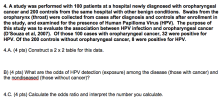 4. A study was performed with 100 patients at a hospital newly diagnosed with oropharyngeal cancer and 200 controls from the same hospital with other benign conditions. Swabs from the oropharynx (throat) were collected from cases after diagnosis and controls after enrollment in the study, and examined for the presence of Human Papilloma Virus (HPV). The purpose of this study was to evaluate the association between HPV infection and oropharyngeal cancer (D'Souza et al, 2007). Of those 100 cases with...
 A study of the association of breast cancer with duration of
oral contraceptive (OC) use compared a group of women with breast
cancer with a group of women of similar ages who were admitted to
the same hospital for non-cancer diseases. From interviewing the
subjects it could be determined who had used OC in the past and for
how long. The following data were gathered:
Calculate the appropriate measure of association for this case
control study and the 95% CI...
A study of the association of breast cancer with duration of
oral contraceptive (OC) use compared a group of women with breast
cancer with a group of women of similar ages who were admitted to
the same hospital for non-cancer diseases. From interviewing the
subjects it could be determined who had used OC in the past and for
how long. The following data were gathered:
Calculate the appropriate measure of association for this case
control study and the 95% CI...
 Lung Cancer & Smoking Case Study A causal relationship between cigarette smoking and lung cancer was first suspected in the 1920s on the basis of clinical observations. To test this apparent association, numerous epidemiologic studies were undertaken between 1930 and 1960. Two studies were conducted by Richard Doll and Austin Bradford Hill in Great Britain The first was a case-control study begun in 1947 over a 4-year period (April 1948-February 1952). Initially, 20 hospitals, and later more, were asked to...
 QUESTION 15: WHAT DO
THESE RESULTS TELL YOU?
QUESTION 16: WHAT ARE THE OTHER POSSIBLE EXPLANATIONS
FOR THE APPARENT ASSOCIATION? INCLUDE AND EXPLAIN 3 SPECIFIC BIAS
THAT PERTAIN TO THIS STUDY.
Lung Cancer & Smoking Case Study A causal relationship between cigarette smoking and lung cancer was first suspected in the 1920s on the basis of clinical observations. To test this apparent association, numerous epidemiologic studies were undertaken between 1930 and 1960. Two studies were conducted by Richard Doll and...
QUESTION 15: WHAT DO
THESE RESULTS TELL YOU?
QUESTION 16: WHAT ARE THE OTHER POSSIBLE EXPLANATIONS
FOR THE APPARENT ASSOCIATION? INCLUDE AND EXPLAIN 3 SPECIFIC BIAS
THAT PERTAIN TO THIS STUDY.
Lung Cancer & Smoking Case Study A causal relationship between cigarette smoking and lung cancer was first suspected in the 1920s on the basis of clinical observations. To test this apparent association, numerous epidemiologic studies were undertaken between 1930 and 1960. Two studies were conducted by Richard Doll and...
 A study comparing smokers to non-smokers history as a risk factor for Parkinson's Disease reports an incidence rate ratio of 0.3 comparing smokers to non-smokers. Explain your answers. 1) What is the study design? 2) If the association is real, do these findings indicate an increase or decrease in risk for Parkinson's disease? 3) A case-control study comparing Alzheimer's cases to controls reported cases were less likely to have reported past smoking. What kind of bias may explain these results?
 4. A study was performed with 100 patients at a hospital newly diagnosed with oropharyngeal cancer and 200 controls from the same hospital with other benign conditions. Swabs from the oropharynx (throat) were collected from cases after diagnosis and controls after enrollment in the study, and examined for the presence of Human Papilloma Virus (HPV). The purpose of this study was to evaluate the association between HPV infection and oropharyngeal cancer (D'Souza et al, 2007). Of those 100 cases with...
Most questions answered within 3 hours.
-
Where is the error in this code sequence?
String s1 = "Hello";
String s2 = "ello";...
asked 10 months ago -
Financial data for Joel de Paris, Inc., for last year
follow:
Joel de Paris, Inc.
Balance...
asked 10 months ago -
Consider this reaction:
Al2(SO4)3 (aq)+ BaCl3
(aq) Al2Cl6 (aq)- +
3BaSO4(s) . What is the...
asked 10 months ago -
Suppose that Savneet is considering increasing her
recent random sample from 20 car rentals to 40...
asked 10 months ago -
Trucks arrive at an unloading terminal at an average rate of 120
per hour.
Trucks arrive...
asked 10 months ago -
Why are methanol and ethanol completely soluble in water while
octanol is not very little soluble....
asked 10 months ago -
A facilities manager at a university reads in a research report
that the mean amount of...
asked 10 months ago -
When the CuSO4 is rehydrated by adding water to the anhydrous
compound, is this an endothermic...
asked 10 months ago -
A ray of sunlight is passing from diamond into crown glass; the
angle of incidence is...
asked 10 months ago -
A block of mass 0.249 kg is placed on top of a light, vertical
spring of...
asked 10 months ago -
how do the kidneys compensate in the presences of acidosis
a) trigger hyperventilate
b) reserve acid...
asked 10 months ago -
Question 501 pts
The rental rate of capital to the firm increases. Which of the
following...
asked 10 months ago