What factors affect the energy yield from an energy source-TEA reaction? - The element in the...
What factors affect the energy yield from an energy source-TEA reaction?
- The element in the energy source that is oxidized.
- The oxidation state of the element in the energy source that is oxidized.
- The extent to which the element in the energy source is oxidized in the reaction.
- The TEA and the element in the TEA that is reduced.
A. One of the above.
B. Two of the above.
C. Three of the above.
D. All of the above.
Homework Answers
Question: What factors affect the energy yield from an energy source-TEA reaction?
- The element in the energy source that is oxidized.
- The oxidation state of the element in the energy source that is oxidized.
- The extent to which the element in the energy source is oxidized in the reaction.
- The TEA and the element in the TEA that is reduced.
Answer: Option C- Three of the above. The factors that affect the energy yield from an energy source- TEA reaction are the element in the energy source that is oxidised, the oxidation rate of the element, extent the element iss being oxidised in the reaction and also the molecular mass of the energy source.
Add Answer to:
What factors affect the energy yield from an energy source-TEA
reaction?
- The element in the...
a In the following reaction, identify which element is oxidized and which is reduced by assigning...
 a In the following reaction, identify which element is oxidized and which is reduced by assigning oxidation numbers: Ba(s)S(s)BaS (s) barium is reduced; sulfur is reduced barium is reduced; sulfur is oxidized barium is oxidized; sulfur is oxidized barium is oxidized; sulfur is reduced Submit b In the following reaction, identify which element is oxidized and which is reduced by assigning oxidation number 2Sr(s)02(g)> 2SrO(s) strontium is reduced; oxygen is reduced strontium is oxidized; oxygen is reduced strontium is oxidized;...
Given the following reaction, 2Ag +H2S ------> Ag2 + H2 What element is oxidized? What does...
Given the following reaction, 2Ag +H2S ------> Ag2 + H2 What element is oxidized? What does the oxidation number change from? What element is reduced? How does its oxidation number change? What is the oxidizing agent? What is the reducing agent?
10) Which of the following is always true for the oxidation numbers in an oxidation-reduction reaction?...
 10) Which of the following is always true for the oxidation numbers in an oxidation-reduction reaction? a) The value for the oxidation number for atoms of the element being oxidized must increase as we go from reactants to products b) The initial value for the oxidation number for atoms of the element being oxidized must be positive c) The final value for the oxidation number for atoms of the element being oxidized must be positive d) Both band c e)...
Figure out whether the balanced chemical reaction shown below involves oxidation reduction. If it does figure...
 Figure out whether the balanced chemical reaction shown below
involves oxidation reduction. If it does figure out which element
becomes oxidized by the reaction and which element becomes reduced
by the reaction. Pick the correct statement about
this reaction from the multiple choices.
4 KMnO4(aq) + 5 CH3OH(aq) + 12 HCl(aq)
4 MnCl2(aq) + 5 HCO2H(aq) +
4 KCl(aq) + 11 H2O(l)
a) This reaction is not a redox reaction.
b) In this reaction H becomes oxidized and Cl becomes...
Figure out whether the balanced chemical reaction shown below
involves oxidation reduction. If it does figure out which element
becomes oxidized by the reaction and which element becomes reduced
by the reaction. Pick the correct statement about
this reaction from the multiple choices.
4 KMnO4(aq) + 5 CH3OH(aq) + 12 HCl(aq)
4 MnCl2(aq) + 5 HCO2H(aq) +
4 KCl(aq) + 11 H2O(l)
a) This reaction is not a redox reaction.
b) In this reaction H becomes oxidized and Cl becomes...
There are several factors that affect the rate of a reaction. These factors include temperature, activation...
There are several factors that affect the rate of a reaction. These factors include temperature, activation energy, steric factors (orientation), and also collision frequency, which changes with concentration and phase. All the factors that affect reaction rate can be summarized in an equation called the Arrhenius equation: k=Ae−Ea/RT, where k is the rate constant, A is the frequency factor, Ea is the activation energy, R=8.314 J mol−1 K−1 is the gas constant, and T is the absolute temperature. A certain...
There are several factors that affect the rate of a reaction. These factors include temperature, activation...
There are several factors that affect the rate of a reaction. These factors include temperature, activation energy, steric factors (orientation), and also collision frequency, which changes with concentration and phase. All the factors that affect reaction rate can be summarized in an equation called the Arrhenius equation: k=Ae−Ea/RT, where k is the rate constant, A is the frequency factor, Ea is the activation energy, R=8.314 J mol−1 K−1 is the gas constant, and T is the absolute temperature. A certain...
25. a) What is the oxidation number of the element in bold? Pb + PbO2 +...
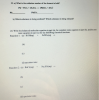 25. a) What is the oxidation number of the element in bold? Pb + PbO2 + 2H2SO. - 2PbSO. + 2H30 PbSO. b) Which substance is being oxidized? Which substance is being reduced? 26. Write the balanced molecular equation in part (a), the complete ionic equation in part (b), and the net ionic equation in part (c) for the following chemical reactions. Reaction 1: (a) KOH(aq) + FeNO3(aq) (d) spectator ions Reaction 2: (a) BaCl(aq) + Na:SO (aq) - (d)...
10) Which of the following is always true for the oxidation numbers in an oxidation-reduction reaction?...
 10) Which of the following is always true for the oxidation numbers in an oxidation-reduction reaction? a) The value for the oxidation number for atoms of the element being oxidized must increase as we go from reactants to products b) The initial value for the oxidation number for atoms of the element being oxidized must be positive c) The final value for the oxidation number for atoms of the element being oxidized must be positive d) Both b and c...
10) Which of the following is always true for the oxidation numbers in an oxidation-reduction reaction?...
 10) Which of the following is always true for the oxidation numbers in an oxidation-reduction reaction? a) The value for the oxidation number for atoms of the element being oxidized must increase as we go from reactants to products b) The initial value for the oxidation number for atoms of the element being oxidized must be positive c) The final value for the oxidation number for atoms of the element being oxidized must be positive d) Both b and c...
For chemical thermodynamic reasons that have nothing to do with biological issues, only certain energy source-TEA...
For chemical thermodynamic reasons that have nothing to do with biological issues, only certain energy source-TEA reactions can be used to obtain energy. Which of the following energy source-TEA combinations is NOT used by any prokaryote to obtain energy? A. Molecular hydrogen-carbon dioxide B. Hydrogen sulfide- molecular oxygen C. Ferric iron-nitrate D. Ammonium-nitrit
 a In the following reaction, identify which element is oxidized and which is reduced by assigning oxidation numbers: Ba(s)S(s)BaS (s) barium is reduced; sulfur is reduced barium is reduced; sulfur is oxidized barium is oxidized; sulfur is oxidized barium is oxidized; sulfur is reduced Submit b In the following reaction, identify which element is oxidized and which is reduced by assigning oxidation number 2Sr(s)02(g)> 2SrO(s) strontium is reduced; oxygen is reduced strontium is oxidized; oxygen is reduced strontium is oxidized;...
 10) Which of the following is always true for the oxidation numbers in an oxidation-reduction reaction? a) The value for the oxidation number for atoms of the element being oxidized must increase as we go from reactants to products b) The initial value for the oxidation number for atoms of the element being oxidized must be positive c) The final value for the oxidation number for atoms of the element being oxidized must be positive d) Both band c e)...
 Figure out whether the balanced chemical reaction shown below
involves oxidation reduction. If it does figure out which element
becomes oxidized by the reaction and which element becomes reduced
by the reaction. Pick the correct statement about
this reaction from the multiple choices.
4 KMnO4(aq) + 5 CH3OH(aq) + 12 HCl(aq)
4 MnCl2(aq) + 5 HCO2H(aq) +
4 KCl(aq) + 11 H2O(l)
a) This reaction is not a redox reaction.
b) In this reaction H becomes oxidized and Cl becomes...
Figure out whether the balanced chemical reaction shown below
involves oxidation reduction. If it does figure out which element
becomes oxidized by the reaction and which element becomes reduced
by the reaction. Pick the correct statement about
this reaction from the multiple choices.
4 KMnO4(aq) + 5 CH3OH(aq) + 12 HCl(aq)
4 MnCl2(aq) + 5 HCO2H(aq) +
4 KCl(aq) + 11 H2O(l)
a) This reaction is not a redox reaction.
b) In this reaction H becomes oxidized and Cl becomes...
 25. a) What is the oxidation number of the element in bold? Pb + PbO2 + 2H2SO. - 2PbSO. + 2H30 PbSO. b) Which substance is being oxidized? Which substance is being reduced? 26. Write the balanced molecular equation in part (a), the complete ionic equation in part (b), and the net ionic equation in part (c) for the following chemical reactions. Reaction 1: (a) KOH(aq) + FeNO3(aq) (d) spectator ions Reaction 2: (a) BaCl(aq) + Na:SO (aq) - (d)...
 10) Which of the following is always true for the oxidation numbers in an oxidation-reduction reaction? a) The value for the oxidation number for atoms of the element being oxidized must increase as we go from reactants to products b) The initial value for the oxidation number for atoms of the element being oxidized must be positive c) The final value for the oxidation number for atoms of the element being oxidized must be positive d) Both b and c...
 10) Which of the following is always true for the oxidation numbers in an oxidation-reduction reaction? a) The value for the oxidation number for atoms of the element being oxidized must increase as we go from reactants to products b) The initial value for the oxidation number for atoms of the element being oxidized must be positive c) The final value for the oxidation number for atoms of the element being oxidized must be positive d) Both b and c...
Most questions answered within 3 hours.
-
Where is the error in this code sequence?
String s1 = "Hello";
String s2 = "ello";...
asked 10 months ago -
Financial data for Joel de Paris, Inc., for last year
follow:
Joel de Paris, Inc.
Balance...
asked 10 months ago -
Consider this reaction:
Al2(SO4)3 (aq)+ BaCl3
(aq) Al2Cl6 (aq)- +
3BaSO4(s) . What is the...
asked 10 months ago -
Suppose that Savneet is considering increasing her
recent random sample from 20 car rentals to 40...
asked 10 months ago -
Trucks arrive at an unloading terminal at an average rate of 120
per hour.
Trucks arrive...
asked 10 months ago -
Why are methanol and ethanol completely soluble in water while
octanol is not very little soluble....
asked 10 months ago -
A facilities manager at a university reads in a research report
that the mean amount of...
asked 10 months ago -
When the CuSO4 is rehydrated by adding water to the anhydrous
compound, is this an endothermic...
asked 10 months ago -
A ray of sunlight is passing from diamond into crown glass; the
angle of incidence is...
asked 10 months ago -
A block of mass 0.249 kg is placed on top of a light, vertical
spring of...
asked 10 months ago -
how do the kidneys compensate in the presences of acidosis
a) trigger hyperventilate
b) reserve acid...
asked 10 months ago -
Question 501 pts
The rental rate of capital to the firm increases. Which of the
following...
asked 10 months ago