
Homework Answers
A carcinogen is any substance, radionuclide, or radiation that promotes carcinogenesis, the formation of cancer. This may be due to the ability to damage the genome or to the disruption of cellular metabolic processes. Several radioactive substances are considered carcinogens, but their carcinogenic activity is attributed to the radiation, for example gamma rays and alpha particles, which they emit. Common examples of non-radioactive carcinogens are inhaled asbestos, certain dioxins, and tobacco smoke. Although the public generally associates carcinogenicity with synthetic chemicals, it is equally likely to arise in both natural and synthetic substances. Carcinogens are not necessarily immediately toxic; thus, their effect can be insidious.
The virus is transmitted by exposure to infectious blood or body fluids. Infection around the time of birth or from contact with other people's blood during childhood is the most frequent method by which hepatitis B is acquired in areas where the disease is common. In areas where the disease is rare, intravenous drug use and sexual intercourse are the most frequent routes of infection. Other risk factors include working in healthcare, blood transfusions, dialysis, living with an infected person, travel in countries where the infection rate is high, and living in an institution. Tattooing and acupuncture led to a significant number of cases in the 1980s; however, this has become less common with improved sterilization. The hepatitis B viruses cannot be spread by holding hands, sharing eating utensils, kissing, hugging, coughing, sneezing, or breastfeeding. The infection can be diagnosed 30 to 60 days after exposure. The diagnosis is usually confirmed by testing the blood for parts of the virus and for antibodies against the virus. It is one of five main hepatitis viruses: A, B, C, D, and E.
Add Answer to:
4. Consider the Figure below. Based on the information flow, state the NULL hypothesis and interpret...
STATE NULL HYPOTHESIS EXPLAIN MECHANISTICALLY THE DIFFERENT OUTCOMES 4. Consider the Figure below. Based on the...
 STATE NULL HYPOTHESIS
EXPLAIN MECHANISTICALLY THE DIFFERENT OUTCOMES
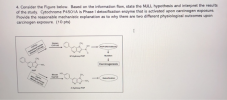
4. Consider the Figure below. Based on the information flow, state the NULL hypothesis and interpret the results of the study. Cytochrome P4501A is Phase I detoxification enzyme that is activated upon carcinogen exposure. Provide the reasonable mechanistic explanation as to why there are two different physiological outcomes upon carcinogen exposure. (10 pts) H ORA Mutation Carcinogenesis Human CYP1A2 NOH PhIP-DNA Adducts > N CYP1A- humanized mouse (Human CYP1A2) NH N2-Hydroxy-PhIP Mutation...
STATE NULL HYPOTHESIS
EXPLAIN MECHANISTICALLY THE DIFFERENT OUTCOMES
4. Consider the Figure below. Based on the information flow, state the NULL hypothesis and interpret the results of the study. Cytochrome P4501A is Phase I detoxification enzyme that is activated upon carcinogen exposure. Provide the reasonable mechanistic explanation as to why there are two different physiological outcomes upon carcinogen exposure. (10 pts) H ORA Mutation Carcinogenesis Human CYP1A2 NOH PhIP-DNA Adducts > N CYP1A- humanized mouse (Human CYP1A2) NH N2-Hydroxy-PhIP Mutation...
First, read the article on "The Delphi Method for Graduate Research." ------ Article is posted below...
First, read the article on "The Delphi Method for Graduate Research." ------ Article is posted below Include each of the following in your answer (if applicable – explain in a paragraph) Research problem: what do you want to solve using Delphi? Sample: who will participate and why? (answer in 5 -10 sentences) Round one questionnaire: include 5 hypothetical questions you would like to ask Discuss: what are possible outcomes of the findings from your study? Hint: this is the conclusion....
 STATE NULL HYPOTHESIS
EXPLAIN MECHANISTICALLY THE DIFFERENT OUTCOMES
4. Consider the Figure below. Based on the information flow, state the NULL hypothesis and interpret the results of the study. Cytochrome P4501A is Phase I detoxification enzyme that is activated upon carcinogen exposure. Provide the reasonable mechanistic explanation as to why there are two different physiological outcomes upon carcinogen exposure. (10 pts) H ORA Mutation Carcinogenesis Human CYP1A2 NOH PhIP-DNA Adducts > N CYP1A- humanized mouse (Human CYP1A2) NH N2-Hydroxy-PhIP Mutation...
STATE NULL HYPOTHESIS
EXPLAIN MECHANISTICALLY THE DIFFERENT OUTCOMES
4. Consider the Figure below. Based on the information flow, state the NULL hypothesis and interpret the results of the study. Cytochrome P4501A is Phase I detoxification enzyme that is activated upon carcinogen exposure. Provide the reasonable mechanistic explanation as to why there are two different physiological outcomes upon carcinogen exposure. (10 pts) H ORA Mutation Carcinogenesis Human CYP1A2 NOH PhIP-DNA Adducts > N CYP1A- humanized mouse (Human CYP1A2) NH N2-Hydroxy-PhIP Mutation...
Most questions answered within 3 hours.
-
Where is the error in this code sequence?
String s1 = "Hello";
String s2 = "ello";...
asked 10 months ago -
Financial data for Joel de Paris, Inc., for last year
follow:
Joel de Paris, Inc.
Balance...
asked 10 months ago -
Consider this reaction:
Al2(SO4)3 (aq)+ BaCl3
(aq) Al2Cl6 (aq)- +
3BaSO4(s) . What is the...
asked 10 months ago -
Suppose that Savneet is considering increasing her
recent random sample from 20 car rentals to 40...
asked 10 months ago -
Trucks arrive at an unloading terminal at an average rate of 120
per hour.
Trucks arrive...
asked 10 months ago -
Why are methanol and ethanol completely soluble in water while
octanol is not very little soluble....
asked 10 months ago -
A facilities manager at a university reads in a research report
that the mean amount of...
asked 10 months ago -
When the CuSO4 is rehydrated by adding water to the anhydrous
compound, is this an endothermic...
asked 10 months ago -
A ray of sunlight is passing from diamond into crown glass; the
angle of incidence is...
asked 10 months ago -
A block of mass 0.249 kg is placed on top of a light, vertical
spring of...
asked 10 months ago -
how do the kidneys compensate in the presences of acidosis
a) trigger hyperventilate
b) reserve acid...
asked 10 months ago -
Question 501 pts
The rental rate of capital to the firm increases. Which of the
following...
asked 10 months ago