
Homework Answers
HIV is a example of retrovirus.
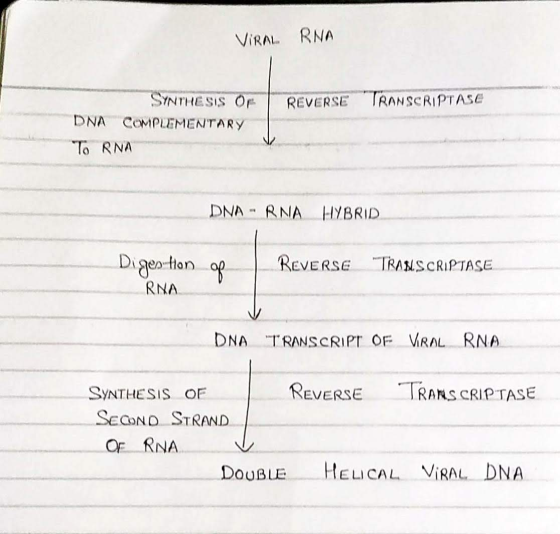
RNA viruses comprises the retroviruses, so called because the genetic information flows from RNA to DNA rather than from DNA to RNA. This class includes the Human immunodeficiency virus-1 (HIV-1), the cause of AIDS.
Retroviruses contains the single stranded RNA. Flow of information from RNA to DNA in retrovirus is as follows:
Add Answer to:
HIV is an example of this type of virus Select one or more: I a. Bacteriophage...
Bacteriophage replication differs from animal virus replication because only bacteriophage replication involves: Select one: O a....
 Bacteriophage replication differs from animal virus replication because only bacteriophage replication involves: Select one: O a. injection of naked nucleic acid into the host cell. O b. adsorption to specific receptors. O c. replication of viral nucleic acid. O d. lysis of the host cell. e. assembly of viral components. Which of the following can contribute to postoperative infections? Select one: O a. antibiotic resistance O b. using syringes more than once O c. errors in aseptic technique d. normal...
1. The virus repressor protein A) controls the prophage's lytic genes but not the incoming genomes...
1. The virus repressor protein A) controls the prophage's lytic genes but not the incoming genomes of the same virus. B) does not control the prophage's lytic genes but does control the incoming genomes of the same virus. C) controls both the lytic genes on the prophage and prevents an incoming virus of the same type. D) has different actions in different situations. 2. The primer for retrovirus reverse transcription is a specific A) tRNA encoded by the cell. B)...
help solve please Which statement is not true (meaning False) about the virus capsid? Select one:...
 help solve please
Which statement is not true (meaning False) about the virus capsid? Select one: O a. Because the capsid is not essential to the virus, it's not a useful target for antiviral drugs. b. The capsid is made of one or more types of protein subunits. O c. The capsid determines the shape of the virus. O d. The capsid functions as a package for the viral genetic material. O e. Both bacteriophage and animal viruses have capsids....
help solve please
Which statement is not true (meaning False) about the virus capsid? Select one: O a. Because the capsid is not essential to the virus, it's not a useful target for antiviral drugs. b. The capsid is made of one or more types of protein subunits. O c. The capsid determines the shape of the virus. O d. The capsid functions as a package for the viral genetic material. O e. Both bacteriophage and animal viruses have capsids....
HIV is a retrovirus (a virus that uses reverse transcriptase). a. What is reverse transcriptase? b....
HIV is a retrovirus (a virus that uses reverse transcriptase). a. What is reverse transcriptase? b. How is a retrovirus different from other viruses? c. How does a retrovirus infect a cell and reproduce itself? 2. Review of the immune system. a. What is a T cell? b. What varieties of T cell exist? How are they functionally different? c. What are their roles in the human body? d. How is each T cell variety differentiated from the others (molecularly)?...
Lysogenic, or temperate, bacteriophage can undergo which type of life cycle?
Lysogenic, or temperate, bacteriophage can undergo which type of life cycle? A. Lytic cycle B. Lysogenic cycle C. both A and B at the same time D. Either A or B, depending on conditions
Gleevec is an example of: Select one or more: O a. a monoclonal antibody b. a...
 Gleevec is an example of: Select one or more: O a. a monoclonal antibody b. a targeted therapy drug O c. gene therapy Xenotransplantation is: Select one or more: a. a type of transplantation that uses incompatible human organs b. the same thing as autografting c. a type of transplantation that uses animal organs
HIV, the virus which causes AIDS, interacts with two receptors on the host cell membrane: CD4...
 HIV, the virus which causes AIDS, interacts with two receptors on the host cell membrane: CD4 and CCR5. A small percentage of individuals have a genetic mutation which causes their cells to lack CCR5. These individuals will never develop AIDS nor are they able to pass HIV on to others. Which part of viral replication is being blocked by the lack of a receptor? Select one: o a. Newly assembled virions cannot be released from the host cell. O b....
Thank you angels its an example problem 4.2 Binomial distribution The genome of the HIV-1 virus,...
 Thank you angels its an example problem
4.2 Binomial distribution The genome of the HIV-1 virus, like any genome, is a string of "letters" (basepai an "alphabet"containing only four letters. The message for HIV is rather rs) in short, just 101 letters in all. Because any of the letters can mutat choices, there's a total of 30 000 possible distinct one-letter mutations. e to any of the three other In 1995, A. Perelson and D. Ho found that every day...
Thank you angels its an example problem
4.2 Binomial distribution The genome of the HIV-1 virus, like any genome, is a string of "letters" (basepai an "alphabet"containing only four letters. The message for HIV is rather rs) in short, just 101 letters in all. Because any of the letters can mutat choices, there's a total of 30 000 possible distinct one-letter mutations. e to any of the three other In 1995, A. Perelson and D. Ho found that every day...
35. Bacteriophage Research: Below is an example of experimental results from a bacteriophage one-step growth curve....
 35. Bacteriophage Research: Below is an example of experimental results from a bacteriophage one-step growth curve. This experiment was conducted to compare the number of bacteriophages produced in the presence or absence of a newly identified natural remedy nicknamed "Bacteriophage-Be-Gone" that has been shown by others to reduce virus production. Please analyze the results and answer the questions below. Number of bacteriophages 30 60 180 210 240 90 120 150 time (min) a. (10 points) Please label (on the graph)...
3. The lysogenic bacteriophage lamda uses a variety of proteins and promoter/operator regions to determine course...
3. The lysogenic bacteriophage lamda uses a variety of proteins and promoter/operator regions to determine course of action (lytic or lysogenic). Choose any five of the following genes, proteins or regulatory sequences and write a brief description of their function in the 'decision' process of this virus: a) PRM b) c2 c) N d) Q e) Int f) Xis
 Bacteriophage replication differs from animal virus replication because only bacteriophage replication involves: Select one: O a. injection of naked nucleic acid into the host cell. O b. adsorption to specific receptors. O c. replication of viral nucleic acid. O d. lysis of the host cell. e. assembly of viral components. Which of the following can contribute to postoperative infections? Select one: O a. antibiotic resistance O b. using syringes more than once O c. errors in aseptic technique d. normal...
 help solve please
Which statement is not true (meaning False) about the virus capsid? Select one: O a. Because the capsid is not essential to the virus, it's not a useful target for antiviral drugs. b. The capsid is made of one or more types of protein subunits. O c. The capsid determines the shape of the virus. O d. The capsid functions as a package for the viral genetic material. O e. Both bacteriophage and animal viruses have capsids....
help solve please
Which statement is not true (meaning False) about the virus capsid? Select one: O a. Because the capsid is not essential to the virus, it's not a useful target for antiviral drugs. b. The capsid is made of one or more types of protein subunits. O c. The capsid determines the shape of the virus. O d. The capsid functions as a package for the viral genetic material. O e. Both bacteriophage and animal viruses have capsids....
 Gleevec is an example of: Select one or more: O a. a monoclonal antibody b. a targeted therapy drug O c. gene therapy Xenotransplantation is: Select one or more: a. a type of transplantation that uses incompatible human organs b. the same thing as autografting c. a type of transplantation that uses animal organs
 HIV, the virus which causes AIDS, interacts with two receptors on the host cell membrane: CD4 and CCR5. A small percentage of individuals have a genetic mutation which causes their cells to lack CCR5. These individuals will never develop AIDS nor are they able to pass HIV on to others. Which part of viral replication is being blocked by the lack of a receptor? Select one: o a. Newly assembled virions cannot be released from the host cell. O b....
 Thank you angels its an example problem
4.2 Binomial distribution The genome of the HIV-1 virus, like any genome, is a string of "letters" (basepai an "alphabet"containing only four letters. The message for HIV is rather rs) in short, just 101 letters in all. Because any of the letters can mutat choices, there's a total of 30 000 possible distinct one-letter mutations. e to any of the three other In 1995, A. Perelson and D. Ho found that every day...
Thank you angels its an example problem
4.2 Binomial distribution The genome of the HIV-1 virus, like any genome, is a string of "letters" (basepai an "alphabet"containing only four letters. The message for HIV is rather rs) in short, just 101 letters in all. Because any of the letters can mutat choices, there's a total of 30 000 possible distinct one-letter mutations. e to any of the three other In 1995, A. Perelson and D. Ho found that every day...
 35. Bacteriophage Research: Below is an example of experimental results from a bacteriophage one-step growth curve. This experiment was conducted to compare the number of bacteriophages produced in the presence or absence of a newly identified natural remedy nicknamed "Bacteriophage-Be-Gone" that has been shown by others to reduce virus production. Please analyze the results and answer the questions below. Number of bacteriophages 30 60 180 210 240 90 120 150 time (min) a. (10 points) Please label (on the graph)...
Most questions answered within 3 hours.
-
Where is the error in this code sequence?
String s1 = "Hello";
String s2 = "ello";...
asked 11 months ago -
Financial data for Joel de Paris, Inc., for last year
follow:
Joel de Paris, Inc.
Balance...
asked 11 months ago -
Consider this reaction:
Al2(SO4)3 (aq)+ BaCl3
(aq) Al2Cl6 (aq)- +
3BaSO4(s) . What is the...
asked 11 months ago -
Suppose that Savneet is considering increasing her
recent random sample from 20 car rentals to 40...
asked 11 months ago -
Trucks arrive at an unloading terminal at an average rate of 120
per hour.
Trucks arrive...
asked 11 months ago -
Why are methanol and ethanol completely soluble in water while
octanol is not very little soluble....
asked 11 months ago -
A facilities manager at a university reads in a research report
that the mean amount of...
asked 11 months ago -
When the CuSO4 is rehydrated by adding water to the anhydrous
compound, is this an endothermic...
asked 11 months ago -
A ray of sunlight is passing from diamond into crown glass; the
angle of incidence is...
asked 11 months ago -
A block of mass 0.249 kg is placed on top of a light, vertical
spring of...
asked 11 months ago -
how do the kidneys compensate in the presences of acidosis
a) trigger hyperventilate
b) reserve acid...
asked 11 months ago -
Question 501 pts
The rental rate of capital to the firm increases. Which of the
following...
asked 11 months ago