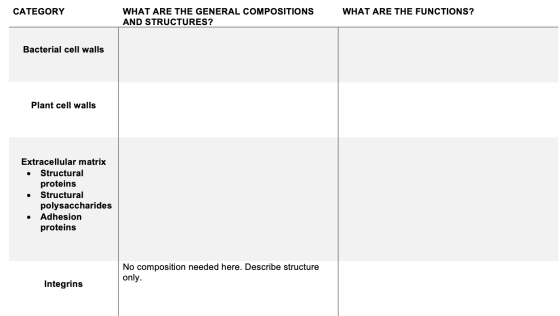
In the table below, describe the composition and macromolecule structure for each of the extracellular or cell interaction components. Do not include specific amino acids or monosaccharides. Also, describe the function(s) of each cell component.
Computer typed, please.
Homework Answers
| CATEGORY | GENERAL COMPOSITION AND STRUCTURES | FUNCTIONS |
| Bacterial cell walls | Made of peptidoglycan in which the alternating polysaccharides(NAM and NAG) are linked by peptides | It protects the bacteria from external stresses and maintains osmolarity and shape and interity of the organism |
| Plant cell walls | Made up of cellulose , pectin and hemicellulose and also amounts of enzymes,proteins and lignin |
Protection of the cell from various stress factors. Maintniing of structure,integrity and support |
| EXTRACELLULAR MATRIX | ||
| Structural proteins | Structural proteins are the fibrous proteins mainly collagenand elastin in their precursor state | The differentiation of cells like endotheilal ,epithelial and the smooth muscles is promoted by these proteins |
| Structural polysaccharides | Glycosaminoglycans which are a part of preoteoglycans and heparin sulfate |
Storage of growth factors Hydartion of the matrix (ECM) Heparin sulfate : cell proliferation,blood coagulation |
| Ahesion proteins | Laminin and fibronectin |
Fcailitates the motion of cells during processes like repair after injury Provides tensile strength |
| Integrins | Integrin is made of two subunits (alpha and beta) which are heterodimers in a noncovalent fashion forming a binding head for a ligand | Provides mechanical support by facilitating the attachment of these molecules to the ECM |
Add Answer to:
In the table below, describe the composition
and macromolecule structure for each of the
extracellular or...
Determine whether the structure, location, and functions describe proteoglycans, peptidoglycan, glycoproteins, or glycolipids. GlcNAc is N-acetylglucosamine;...
 Determine whether the structure, location, and functions describe proteoglycans, peptidoglycan, glycoproteins, or glycolipids. GlcNAc is N-acetylglucosamine; MurNAc is N-acetylmuramic acid. Proteoglycans Peptidoglycan Glycoproteins Glycolipids Structure Location part of proteins at outer surface of plasma membrane, in extracellular matrix, and in blood Functions many functions, including cell adhesion strength for cell envelope Answer Bank glycosaminoglycan covalently joined to a protein at a Ser residue many functions, including acting as hormones bacterial cell wall extracellular matrix; some are integral membrane proteins outer...
(a) Identify all the amino acids from the structures below and use these structures to describe...
 (a) Identify all the amino acids from the structures below and use these structures to describe the meaning of the following in terms of protein structure; i. an intramolecular disulphide bond, "hydrophobic interaction”, iii. pH dependent electrostatic forces. а) соон yoon с) соон H.N—C—H H.N— C—H HNg–H | d) соон H,N—C—H CH2 SH CH, CH (b) Describe the process of protein denaturation and explain why high temperatures promote denaturation. Include a description of the role of protein denaturation in the...
Describe the structure, composition, function and importance of the major prokaryotic and eukaryotic structures below. Structures...
Describe the structure, composition, function and importance of the major prokaryotic and eukaryotic structures below. Structures common to all cells: Cell wall Cell membrane Cytoplasm Ribosome Nucleus/nucleoid region (genome) Flagella Structures unique to prokaryotic cells: Endospore Pilus Capsule plasmid Structures unique to eukaryotic cells: Mitochondria Chloroplast Vesicle Cytoskeleton
MULTIPLE CHOICE QUESTION 1: Which of the following is true in comparing the protein versus nonprotein...
MULTIPLE CHOICE QUESTION 1: Which of the following is true in comparing the protein versus nonprotein components of the extracellular matrix (ECM)? A. The protein and nonprotein components of the ECM are both extensively negatively charged. B. The individual protein component molecules and nonprotein component molecules are both branching structures. C. The nonprotein component of the ECM contains hydroxyl functional groups, whereas the protein components of the ECM do not. D. The nonprotein component of the ECM is dominated by...
Study Guide for Exam #2 Carbohydrates • Differences between Type Tune Il Diabetes and gestational Diabetes....
 Study Guide for Exam #2 Carbohydrates • Differences between Type Tune Il Diabetes and gestational Diabetes. How do you treat each one? What is the normal range for blood glucose? How is glucose regulated in the body? What hormones play a role in glucose reuptake or release? Fiber requirements for men and women. What does fiber do? What does fiber help prevent? What are the differences between monosaccharides, disaccharides, polysaccharides? What are their compositions? What is the composition of table...
Chapter 8: Microbial Genetics and Genetic Engineering Reading Assignment: Chapter 8 1. Describe the structure and...
 Chapter 8: Microbial Genetics and Genetic Engineering Reading Assignment: Chapter 8 1. Describe the structure and function of DNA in the microbial cell. List the chemical components of DNA including the nitrogen bases and the role of histones. 2. Define the following: genome, chromosome, gene, genotype, phenotype, and palindrome. 3. Describe the process of DNA replication in microbes. Explain the term semi-conservative replication 4. Describe the steps in protein synthesis. Compare and contrast transcription and translation. Describe the roles of...
1) Discuss the importance of magnification and resolution in microscopy. How are the magnification and resolution...
1) Discuss the importance of magnification and resolution in microscopy. How are the magnification and resolution of a light microscope different from that of an electron microscope? 2) Which microscope would you use to study the following? a) the changes in shape of a living human white blood cell b) the finest details of the surface texture of a human hair c) the detailed structure of an organelle in a liver cell 3) State the cell theory?...
____ 1. The diagram below represents serine, a polar, uncharged amino acid. Which functional group gives...
 ____ 1. The diagram below represents serine, a polar, uncharged
amino acid. Which functional group gives serine its
distinct property?
a. H3
b. CH2OH
c. –H
d. COO–
____ 2. The monomers shown below are monomers for which of the
following natural polymers?
a. polysaccharides
b. plastics
c. DNA
d. proteins
____ 3. Which of the following processes illustrates the production
of a protein?
a. specific code for amino acids --> amino acid chain -->
gene --> DNA --> specific...
____ 1. The diagram below represents serine, a polar, uncharged
amino acid. Which functional group gives serine its
distinct property?
a. H3
b. CH2OH
c. –H
d. COO–
____ 2. The monomers shown below are monomers for which of the
following natural polymers?
a. polysaccharides
b. plastics
c. DNA
d. proteins
____ 3. Which of the following processes illustrates the production
of a protein?
a. specific code for amino acids --> amino acid chain -->
gene --> DNA --> specific...
The smallest chemical units of matter are atoms b) molecules c) protons d) neutrons e) electrons...
 The smallest chemical units of matter are atoms b) molecules c) protons d) neutrons e) electrons . Which of the following would have the largest size? a) an atom b) a molecule c) a proton d) a neutron e) an electron 3. Isotopes of an element differ in the number of a) protons in the nucleus b) electrons in the nucleus © neutrons in the nucleus d) electron clouds e) energy levels they contain 4. VO The atomic number represents...
Answer the questions below from the presentation and use the information to study for your quiz...
Answer the questions below from the presentation and use the information to study for your quiz Viruses: What are the 2 main components of a virus. ___________________________________ What additional structure do some viruses have? _______________________________ Which type of virus is the smallest? __________________________________________ Viruses are grouped according to their ____________ and ________________________ How do viruses replicate? __________________________________________________ Viruses that infect bacteria are called _________________________________________ Name 2 ways to prevent the spread of virus infections ___________________________ Who developed the earliest vaccine?...
 Determine whether the structure, location, and functions describe proteoglycans, peptidoglycan, glycoproteins, or glycolipids. GlcNAc is N-acetylglucosamine; MurNAc is N-acetylmuramic acid. Proteoglycans Peptidoglycan Glycoproteins Glycolipids Structure Location part of proteins at outer surface of plasma membrane, in extracellular matrix, and in blood Functions many functions, including cell adhesion strength for cell envelope Answer Bank glycosaminoglycan covalently joined to a protein at a Ser residue many functions, including acting as hormones bacterial cell wall extracellular matrix; some are integral membrane proteins outer...
 (a) Identify all the amino acids from the structures below and use these structures to describe the meaning of the following in terms of protein structure; i. an intramolecular disulphide bond, "hydrophobic interaction”, iii. pH dependent electrostatic forces. а) соон yoon с) соон H.N—C—H H.N— C—H HNg–H | d) соон H,N—C—H CH2 SH CH, CH (b) Describe the process of protein denaturation and explain why high temperatures promote denaturation. Include a description of the role of protein denaturation in the...
 Study Guide for Exam #2 Carbohydrates • Differences between Type Tune Il Diabetes and gestational Diabetes. How do you treat each one? What is the normal range for blood glucose? How is glucose regulated in the body? What hormones play a role in glucose reuptake or release? Fiber requirements for men and women. What does fiber do? What does fiber help prevent? What are the differences between monosaccharides, disaccharides, polysaccharides? What are their compositions? What is the composition of table...
 Chapter 8: Microbial Genetics and Genetic Engineering Reading Assignment: Chapter 8 1. Describe the structure and function of DNA in the microbial cell. List the chemical components of DNA including the nitrogen bases and the role of histones. 2. Define the following: genome, chromosome, gene, genotype, phenotype, and palindrome. 3. Describe the process of DNA replication in microbes. Explain the term semi-conservative replication 4. Describe the steps in protein synthesis. Compare and contrast transcription and translation. Describe the roles of...
 ____ 1. The diagram below represents serine, a polar, uncharged
amino acid. Which functional group gives serine its
distinct property?
a. H3
b. CH2OH
c. –H
d. COO–
____ 2. The monomers shown below are monomers for which of the
following natural polymers?
a. polysaccharides
b. plastics
c. DNA
d. proteins
____ 3. Which of the following processes illustrates the production
of a protein?
a. specific code for amino acids --> amino acid chain -->
gene --> DNA --> specific...
____ 1. The diagram below represents serine, a polar, uncharged
amino acid. Which functional group gives serine its
distinct property?
a. H3
b. CH2OH
c. –H
d. COO–
____ 2. The monomers shown below are monomers for which of the
following natural polymers?
a. polysaccharides
b. plastics
c. DNA
d. proteins
____ 3. Which of the following processes illustrates the production
of a protein?
a. specific code for amino acids --> amino acid chain -->
gene --> DNA --> specific...
 The smallest chemical units of matter are atoms b) molecules c) protons d) neutrons e) electrons . Which of the following would have the largest size? a) an atom b) a molecule c) a proton d) a neutron e) an electron 3. Isotopes of an element differ in the number of a) protons in the nucleus b) electrons in the nucleus © neutrons in the nucleus d) electron clouds e) energy levels they contain 4. VO The atomic number represents...
Most questions answered within 3 hours.
-
Where is the error in this code sequence?
String s1 = "Hello";
String s2 = "ello";...
asked 10 months ago -
Financial data for Joel de Paris, Inc., for last year
follow:
Joel de Paris, Inc.
Balance...
asked 10 months ago -
Consider this reaction:
Al2(SO4)3 (aq)+ BaCl3
(aq) Al2Cl6 (aq)- +
3BaSO4(s) . What is the...
asked 10 months ago -
Suppose that Savneet is considering increasing her
recent random sample from 20 car rentals to 40...
asked 10 months ago -
Trucks arrive at an unloading terminal at an average rate of 120
per hour.
Trucks arrive...
asked 10 months ago -
Why are methanol and ethanol completely soluble in water while
octanol is not very little soluble....
asked 10 months ago -
A facilities manager at a university reads in a research report
that the mean amount of...
asked 10 months ago -
When the CuSO4 is rehydrated by adding water to the anhydrous
compound, is this an endothermic...
asked 10 months ago -
A ray of sunlight is passing from diamond into crown glass; the
angle of incidence is...
asked 10 months ago -
A block of mass 0.249 kg is placed on top of a light, vertical
spring of...
asked 10 months ago -
how do the kidneys compensate in the presences of acidosis
a) trigger hyperventilate
b) reserve acid...
asked 10 months ago -
Question 501 pts
The rental rate of capital to the firm increases. Which of the
following...
asked 10 months ago