
Homework Answers
Add Answer to:
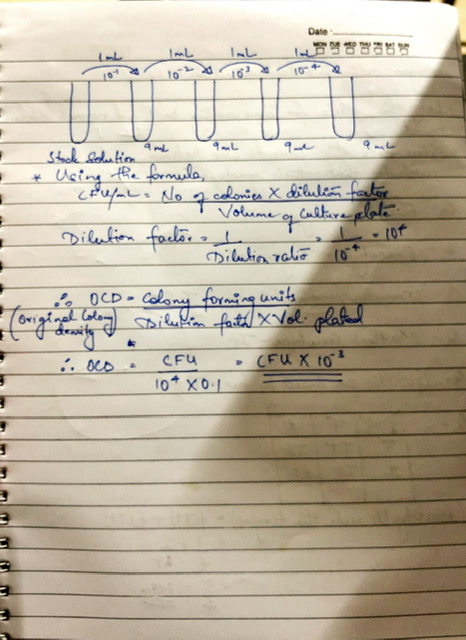
Draw an illustration of a series of a 1:10 dilut les of a 1:10 dilution to...
how to solve 9-10 9. After plating 0.1ml of a 10 dilution, 158 colonies grow. What...
 how to solve 9-10
9. After plating 0.1ml of a 10 dilution, 158 colonies grow. What is the OCD? (CFU/ml) 158 3,514 (105) = 1.58×10 CFU/mL a account for Sci not. dec. 10. After plating 0.2 ml of a 10 tube dilution, 437 colonies grow. What is the CFU/ml or how would you report this info? 437 0/2 OCD 2.16x100 CP /ML 0.2110-5)
how to solve 9-10
9. After plating 0.1ml of a 10 dilution, 158 colonies grow. What is the OCD? (CFU/ml) 158 3,514 (105) = 1.58×10 CFU/mL a account for Sci not. dec. 10. After plating 0.2 ml of a 10 tube dilution, 437 colonies grow. What is the CFU/ml or how would you report this info? 437 0/2 OCD 2.16x100 CP /ML 0.2110-5)
help me with the math. m e usually performed, e.g., 10°>10% 10% 10%, etc. Two-fold or...
 help me with the math.
m e usually performed, e.g., 10°>10% 10% 10%, etc. Two-fold or other dilution schemes can be applied as well. For accurate quantitation, it is important to use the selected dilution scheme consistently. correction factor is 10 (0.1 ml X 10-10 ml). If you plated 0.5 ml, the correction factor is 2. 1.-CFU/Dr Initial concentration, (lc) equals colony forming units (cfu) divided by dilution factor (Df). Note that each step of the dilution procedure reduces the...
help me with the math.
m e usually performed, e.g., 10°>10% 10% 10%, etc. Two-fold or other dilution schemes can be applied as well. For accurate quantitation, it is important to use the selected dilution scheme consistently. correction factor is 10 (0.1 ml X 10-10 ml). If you plated 0.5 ml, the correction factor is 2. 1.-CFU/Dr Initial concentration, (lc) equals colony forming units (cfu) divided by dilution factor (Df). Note that each step of the dilution procedure reduces the...
Draw (or describe) a dilution scheme for making the following bacteriophage titer plates: 1:100 (10-2), 1:1000...
Draw (or describe) a dilution scheme for making the following bacteriophage titer plates: 1:100 (10-2), 1:1000 (10-3), and 1:10,000 (10-4) using a maximum of 2 dilution blanks. Show (or include in your description) all of the volumes including transfers, amounts in tubes and amounts plated.
please help with whatever possible. thank you so much in advance. Name One use of serial...
 please help with whatever possible. thank you so much in
advance.
Name One use of serial dilutions is to calculate the concentration of microorganisms. Since it would usually be challenging or even impossible to actually count the number of microorganisms in a sample, the sample is diluted and plated to get a reasonable number of colonies to count (usually between 25 to 250 colonies is the goal). Since each colony on an agar plate theoretically grew from a single microorganism,...
please help with whatever possible. thank you so much in
advance.
Name One use of serial dilutions is to calculate the concentration of microorganisms. Since it would usually be challenging or even impossible to actually count the number of microorganisms in a sample, the sample is diluted and plated to get a reasonable number of colonies to count (usually between 25 to 250 colonies is the goal). Since each colony on an agar plate theoretically grew from a single microorganism,...
Problem solving Question: 1. If you were to serially dilute a sample with three 1:10 dilutions,...
 Problem solving Question: 1. If you were to serially dilute a sample with three 1:10 dilutions, what would be the final dilution of the last tube? 2. If you add 1 ml of sample to 99 ml of water, and then add 0.1ml (100pl) to the agar plate what is the dilution of the sample on the plate? 3. If you count 98 colonies on the 10-5 plate, how many bacteria/ml were in your sample? 4. What are three ways...
RESULTS For your dilution plates draw your results below. IMI Calculate the original CFU/ml in your...
 RESULTS For your dilution plates draw your results below. IMI Calculate the original CFU/ml in your original broth tube, if you are within 500 CFU/ml of what the instructor calculated, you earn an extra credit point REVIEW QUESTIONS 1. A plate has 72 colonies with a total dilution factor of 10-7.0.1 ml was pipetted onto the plate, what was the original CFU/ml concentration of that sample?
strain (thrleut his pro pan bio). At each gene, + . (5 points) One triply auxotrophic...
 strain (thrleut his pro pan bio). At each gene, + . (5 points) One triply auxotrophic E.coli strain (thr leur his pro pant bio*) is transforme ONA from a second triply auxotro ndicates prototrophy. - auxotrophy. After transformation, bacteria are plated on complete the master plate) and then replica plated onto minimal medium or minimal media with add nutrients as indicted in the figure below (recall that replica plating means that the positio colonies is the same in all plates)....
2. A series of 1 ml samples from tube #4 of the dilution s eries below are spread on agar plates,...
 2. A series of 1 ml samples from tube #4 of the dilution s eries below are spread on agar plates, resulting in the growth of an average of 68 colonies per plate. What is the concentration of colony-forming units (cfu/mi) present in the original culture? 0.1 ml 0.1 ml 1 ml 1 ml 100 ml 9.9 ml 9.9 ml 9 ml 9 ml 2 4 3. The culture flask at left contains a total of 3.2 x 10s cfu....
You come into lab and notice your lab partner did a 1:10 dilution series on a...
You come into lab and notice your lab partner did a 1:10 dilution series on a stock that you ordered. You see that the final dilution has a concentration of 0.0004 Molar and that your partner had diluted the stock seven times. What is the concentration of the original stock solution? is it 40,0000?
Results for QPCR report: Absolute quantification (Standard curve) – Using a dilution series of known template...
 Results for QPCR report:
Absolute quantification (Standard curve) – Using a dilution
series of known template controls – Fluorescence is measured
against the standard curve – At least four points (in duplicate)
should be run for an accurate curve to be produced – The linearity
of the curve (Rsq value) should be close to 1
• To indicate the amplification efficiency is consistent across
all template concentrations
Your DNA standard 1 contains 1.0 x 10⁶ copies of DNA, and you...
Results for QPCR report:
Absolute quantification (Standard curve) – Using a dilution
series of known template controls – Fluorescence is measured
against the standard curve – At least four points (in duplicate)
should be run for an accurate curve to be produced – The linearity
of the curve (Rsq value) should be close to 1
• To indicate the amplification efficiency is consistent across
all template concentrations
Your DNA standard 1 contains 1.0 x 10⁶ copies of DNA, and you...
 how to solve 9-10
9. After plating 0.1ml of a 10 dilution, 158 colonies grow. What is the OCD? (CFU/ml) 158 3,514 (105) = 1.58×10 CFU/mL a account for Sci not. dec. 10. After plating 0.2 ml of a 10 tube dilution, 437 colonies grow. What is the CFU/ml or how would you report this info? 437 0/2 OCD 2.16x100 CP /ML 0.2110-5)
how to solve 9-10
9. After plating 0.1ml of a 10 dilution, 158 colonies grow. What is the OCD? (CFU/ml) 158 3,514 (105) = 1.58×10 CFU/mL a account for Sci not. dec. 10. After plating 0.2 ml of a 10 tube dilution, 437 colonies grow. What is the CFU/ml or how would you report this info? 437 0/2 OCD 2.16x100 CP /ML 0.2110-5)
 help me with the math.
m e usually performed, e.g., 10°>10% 10% 10%, etc. Two-fold or other dilution schemes can be applied as well. For accurate quantitation, it is important to use the selected dilution scheme consistently. correction factor is 10 (0.1 ml X 10-10 ml). If you plated 0.5 ml, the correction factor is 2. 1.-CFU/Dr Initial concentration, (lc) equals colony forming units (cfu) divided by dilution factor (Df). Note that each step of the dilution procedure reduces the...
help me with the math.
m e usually performed, e.g., 10°>10% 10% 10%, etc. Two-fold or other dilution schemes can be applied as well. For accurate quantitation, it is important to use the selected dilution scheme consistently. correction factor is 10 (0.1 ml X 10-10 ml). If you plated 0.5 ml, the correction factor is 2. 1.-CFU/Dr Initial concentration, (lc) equals colony forming units (cfu) divided by dilution factor (Df). Note that each step of the dilution procedure reduces the...
 please help with whatever possible. thank you so much in
advance.
Name One use of serial dilutions is to calculate the concentration of microorganisms. Since it would usually be challenging or even impossible to actually count the number of microorganisms in a sample, the sample is diluted and plated to get a reasonable number of colonies to count (usually between 25 to 250 colonies is the goal). Since each colony on an agar plate theoretically grew from a single microorganism,...
please help with whatever possible. thank you so much in
advance.
Name One use of serial dilutions is to calculate the concentration of microorganisms. Since it would usually be challenging or even impossible to actually count the number of microorganisms in a sample, the sample is diluted and plated to get a reasonable number of colonies to count (usually between 25 to 250 colonies is the goal). Since each colony on an agar plate theoretically grew from a single microorganism,...
 Problem solving Question: 1. If you were to serially dilute a sample with three 1:10 dilutions, what would be the final dilution of the last tube? 2. If you add 1 ml of sample to 99 ml of water, and then add 0.1ml (100pl) to the agar plate what is the dilution of the sample on the plate? 3. If you count 98 colonies on the 10-5 plate, how many bacteria/ml were in your sample? 4. What are three ways...
 RESULTS For your dilution plates draw your results below. IMI Calculate the original CFU/ml in your original broth tube, if you are within 500 CFU/ml of what the instructor calculated, you earn an extra credit point REVIEW QUESTIONS 1. A plate has 72 colonies with a total dilution factor of 10-7.0.1 ml was pipetted onto the plate, what was the original CFU/ml concentration of that sample?
 strain (thrleut his pro pan bio). At each gene, + . (5 points) One triply auxotrophic E.coli strain (thr leur his pro pant bio*) is transforme ONA from a second triply auxotro ndicates prototrophy. - auxotrophy. After transformation, bacteria are plated on complete the master plate) and then replica plated onto minimal medium or minimal media with add nutrients as indicted in the figure below (recall that replica plating means that the positio colonies is the same in all plates)....
 2. A series of 1 ml samples from tube #4 of the dilution s eries below are spread on agar plates, resulting in the growth of an average of 68 colonies per plate. What is the concentration of colony-forming units (cfu/mi) present in the original culture? 0.1 ml 0.1 ml 1 ml 1 ml 100 ml 9.9 ml 9.9 ml 9 ml 9 ml 2 4 3. The culture flask at left contains a total of 3.2 x 10s cfu....
 Results for QPCR report:
Absolute quantification (Standard curve) – Using a dilution
series of known template controls – Fluorescence is measured
against the standard curve – At least four points (in duplicate)
should be run for an accurate curve to be produced – The linearity
of the curve (Rsq value) should be close to 1
• To indicate the amplification efficiency is consistent across
all template concentrations
Your DNA standard 1 contains 1.0 x 10⁶ copies of DNA, and you...
Results for QPCR report:
Absolute quantification (Standard curve) – Using a dilution
series of known template controls – Fluorescence is measured
against the standard curve – At least four points (in duplicate)
should be run for an accurate curve to be produced – The linearity
of the curve (Rsq value) should be close to 1
• To indicate the amplification efficiency is consistent across
all template concentrations
Your DNA standard 1 contains 1.0 x 10⁶ copies of DNA, and you...
Most questions answered within 3 hours.
-
Where is the error in this code sequence?
String s1 = "Hello";
String s2 = "ello";...
asked 11 months ago -
Financial data for Joel de Paris, Inc., for last year
follow:
Joel de Paris, Inc.
Balance...
asked 11 months ago -
Consider this reaction:
Al2(SO4)3 (aq)+ BaCl3
(aq) Al2Cl6 (aq)- +
3BaSO4(s) . What is the...
asked 11 months ago -
Suppose that Savneet is considering increasing her
recent random sample from 20 car rentals to 40...
asked 11 months ago -
Trucks arrive at an unloading terminal at an average rate of 120
per hour.
Trucks arrive...
asked 11 months ago -
Why are methanol and ethanol completely soluble in water while
octanol is not very little soluble....
asked 11 months ago -
A facilities manager at a university reads in a research report
that the mean amount of...
asked 11 months ago -
When the CuSO4 is rehydrated by adding water to the anhydrous
compound, is this an endothermic...
asked 11 months ago -
A ray of sunlight is passing from diamond into crown glass; the
angle of incidence is...
asked 11 months ago -
A block of mass 0.249 kg is placed on top of a light, vertical
spring of...
asked 11 months ago -
how do the kidneys compensate in the presences of acidosis
a) trigger hyperventilate
b) reserve acid...
asked 11 months ago -
Question 501 pts
The rental rate of capital to the firm increases. Which of the
following...
asked 11 months ago