1). what is scientific explanation for why all organisms on earth have DNA, RNA, and use...
1). what is scientific explanation for why all organisms on earth have DNA, RNA, and use ATP?
2). what are homologous structures? give a real world example of homologous structures.
Homework Answers
ANSWER
(1) DNA is found in every nucleus of anorganism that is exactly same in all the cells and is true to all the life forms on earth and the synthesis of the RNA firmDNA is called as translation and formed into proteins and is made of amino acids and these proteins re essential for the development of the living organisms.
The most common example is adenosine triphosphate (ATP). For the very different function of energy storage, a molecule identical to one of the building blocks of the nucleic acids (both DNA and RNA) is employed.
All cells, for example, require the phosphorylated nucleotide ATP (adenosine triphosphate) as a building block for the synthesis of DNA and RNA; and all cells also make and consume this molecule as a carrier of free energy and phosphate groups to drive many other chemical reactions.
(2)The definition of a homologous structure is an organ or body part that appears in different animals and is similar in structure and location, but doesn't necessarily share the same purpose. An example of a homologous structure is the human arm as compared to the wing on a bird.
Add Answer to:
1). what is scientific explanation
for why all organisms on earth have DNA, RNA, and use...
There are two types of nucleic acids, DNA and RNA. Nearly all organisms use DNA, not...
There are two types of nucleic acids, DNA and RNA. Nearly all organisms use DNA, not RNA, as the central repository for genetic information. Choose the statements that explain this phenomenon. DNA contains adenine as one of its nitrogenous bases. DNA has a double‑stranded structure that ensures an accurate mechanism of duplication. DNA contains an −OH−OH group at the 2′2′ carbon. DNA is flexible and forms complex catalytic structures. DNA is more resistant against enzymes that break down nucleic acids.
Why are all organisms on Earth expected to have differing optimum functional temperatures?
Why are all organisms on Earth expected to have differing optimum functional temperatures?
Question 29 Which of the enzymes below would nearly all RNA viruses have? DNA-=dependent DNA polymerase...
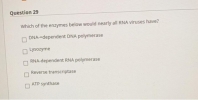 Question 29 Which of the enzymes below would nearly all RNA viruses have? DNA-=dependent DNA polymerase Lysozyme RNA-dependent RNA polymerase Reverse transcriptase ATP synthase
6. The RNA World hypothesis includes the idea that: a. RNA is the most important molecule...
 6. The RNA World hypothesis includes the idea that: a. RNA is the most important molecule in living organisms today b. Ear;ly cells could not produce because they did not yet have DNA c. Viruses evolved from RNA d. Early cells was made entirely of RNA e. Proteins may not have been necessary for the earliest biological reactions to occur 7. In early human embryos, the gene HoxB7 is involved in patterning the central nervous system. In later embryos, the...
What are the three components of a nucleotide? Name the nitrogenous bases for DNA/RNA What is...
What are the three components of a nucleotide? Name the nitrogenous bases for DNA/RNA What is the complementary base pairing rule? Please, include the hydrogen bonds Give two examples of Monosaccharide Disaccharide Polysaccharide What is the difference between alpha 1, 4 glycosidic and beta 1, 4 glycosidic linkages? For each linkage, give 2 examples of organisms that use the linkage and what is the function of the linkage? What is an isomer? Give two examples What type of bond/linkage is...
DNA is the molecule used to store the genetic code of most living organisms on earth....
 DNA is the molecule used to store the genetic code of most living organisms on earth. Its structure was famously proposed by Watson and Crick who proposed double helix structure published in the journal Nature, April 25, 1953. For this the Nobel Prize was awarded to Watson, Crick & Wilkins in 1962. (a) (i) (ii) Show the chemical structure of the DNA backbone. What is a 1. the backbone, 2. a nucleoside, 3. a nucleotide 4. a nucleic acid? (b)...
DNA, RNA, nucleotides, plasmid, helicase, DNA polymerase, primase, RNA primer of DNA replication
Define termsDNA, RNA, nucleotides, plasmid, helicase, DNA polymerase, primase, RNA primer of DNA replication, mutation, gene, amino acid, polypeptide chain, protein, codon, promoter region of a gene, RNA polymerase, transcription, mRNA, tRNA, RNA, ribosomes, translation, gene expression, conjugation, conjugative pilus, transformation, transductionExplain concept or process• Describe how nucleotides are linked together to form a single strand of nucleic acid• Explain the concept of a complementary pairing • Describe how DNA replication occurs in bacteria • Explain why a primer is necessary for...
Nucleotides are the basic building blocks for all DNA and RNA. They can have two different...
Nucleotides are the basic building blocks for all DNA and RNA. They can have two different ring structures depending on how they’re made. In this worksheet we will examine purine and pyrimidine biosynthesis pathways. Which nucleic acids can be made from this process?
QUESTION 1 Select ALL mismatched pairs. Louis Pasteur - Aseptic technique DNA and RNA - single...
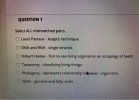 QUESTION 1 Select ALL mismatched pairs. Louis Pasteur - Aseptic technique DNA and RNA - single strands Robert Hooke - first to see living organisms on scrapings of teeth. Taxonomy - classifying living things. Phylogeny - represents relationship been organisms lipids - glycerol and fatty acids
1) why is RNA "locked" into an A-form helix? 2) why is DNA synthesized 5' to...
1) why is RNA "locked" into an A-form helix? 2) why is DNA synthesized 5' to 3', not 3' to 5'?
 Question 29 Which of the enzymes below would nearly all RNA viruses have? DNA-=dependent DNA polymerase Lysozyme RNA-dependent RNA polymerase Reverse transcriptase ATP synthase
 6. The RNA World hypothesis includes the idea that: a. RNA is the most important molecule in living organisms today b. Ear;ly cells could not produce because they did not yet have DNA c. Viruses evolved from RNA d. Early cells was made entirely of RNA e. Proteins may not have been necessary for the earliest biological reactions to occur 7. In early human embryos, the gene HoxB7 is involved in patterning the central nervous system. In later embryos, the...
 DNA is the molecule used to store the genetic code of most living organisms on earth. Its structure was famously proposed by Watson and Crick who proposed double helix structure published in the journal Nature, April 25, 1953. For this the Nobel Prize was awarded to Watson, Crick & Wilkins in 1962. (a) (i) (ii) Show the chemical structure of the DNA backbone. What is a 1. the backbone, 2. a nucleoside, 3. a nucleotide 4. a nucleic acid? (b)...
 QUESTION 1 Select ALL mismatched pairs. Louis Pasteur - Aseptic technique DNA and RNA - single strands Robert Hooke - first to see living organisms on scrapings of teeth. Taxonomy - classifying living things. Phylogeny - represents relationship been organisms lipids - glycerol and fatty acids
Most questions answered within 3 hours.
-
Where is the error in this code sequence?
String s1 = "Hello";
String s2 = "ello";...
asked 10 months ago -
Financial data for Joel de Paris, Inc., for last year
follow:
Joel de Paris, Inc.
Balance...
asked 10 months ago -
Consider this reaction:
Al2(SO4)3 (aq)+ BaCl3
(aq) Al2Cl6 (aq)- +
3BaSO4(s) . What is the...
asked 10 months ago -
Suppose that Savneet is considering increasing her
recent random sample from 20 car rentals to 40...
asked 10 months ago -
Trucks arrive at an unloading terminal at an average rate of 120
per hour.
Trucks arrive...
asked 10 months ago -
Why are methanol and ethanol completely soluble in water while
octanol is not very little soluble....
asked 10 months ago -
A facilities manager at a university reads in a research report
that the mean amount of...
asked 10 months ago -
When the CuSO4 is rehydrated by adding water to the anhydrous
compound, is this an endothermic...
asked 10 months ago -
A ray of sunlight is passing from diamond into crown glass; the
angle of incidence is...
asked 10 months ago -
A block of mass 0.249 kg is placed on top of a light, vertical
spring of...
asked 10 months ago -
how do the kidneys compensate in the presences of acidosis
a) trigger hyperventilate
b) reserve acid...
asked 10 months ago -
Question 501 pts
The rental rate of capital to the firm increases. Which of the
following...
asked 10 months ago