
Homework Answers
Add Answer to:
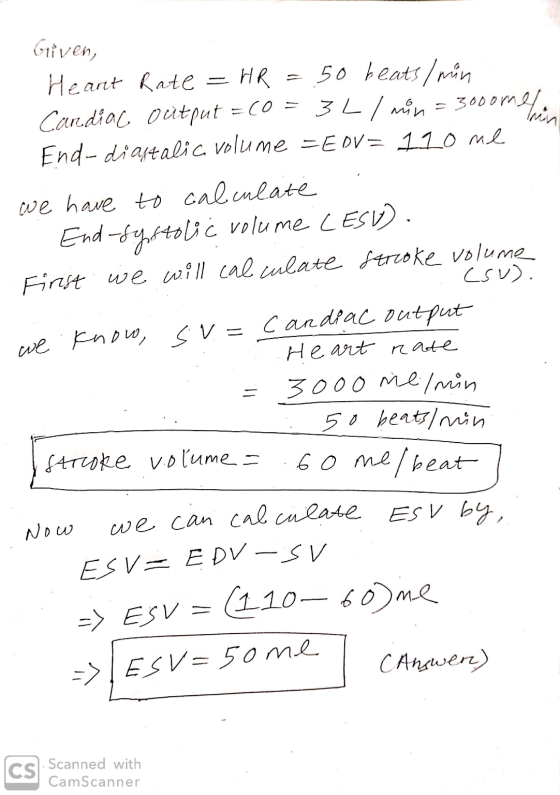
B. Another patient's heart rate is only 50 beats/min. Her cardiac output is 3 L/min and...
3. Define Cardiac Output. 4. If the stroke volume is 75 ml/beat and heart rate is...
 3. Define Cardiac Output. 4. If the stroke volume is 75 ml/beat and heart rate is 70 beats/min, calculate the cardiac output in L/min.
Data set: ABP=90/60 mm Hg, HR 110 beats/min, cardiac output = 3 L/min, CVP = 15 mm Hg, PAP = 50/35 mm Hg, PCWP = 6 mm Hg...
Data set: ABP=90/60 mm Hg, HR 110 beats/min, cardiac output = 3 L/min, CVP = 15 mm Hg, PAP = 50/35 mm Hg, PCWP = 6 mm Hg, EF = 60%. Please show all work to justify answer 1. Calculate the PVR
Steve is a runner with a target heart rate of 135 bpm. His resting pulse is...
 Steve is a runner with a target heart rate of 135 bpm. His resting pulse is 70 bpm. His blood volume is approximately 6.8 liters. At rest, his cardiac output is 63 tr/min A What must his stroke volume be? B. What is his EDV if his ESV is 50 ml? C. During his workout, his heart rate increases to 136 born and his cardiac output to 13,500 mL/min. Did his SV change with exercise? If his EDV is 160...
J4.Person A has a heart rate 90 heartbeats per min, a cardiac output of 6.8 L blood per minute an...
 j4.Person A has a heart rate 90 heartbeats per min, a cardiac output of 6.8 L blood per minute and an end- diastolic volume of 170 mL blood. From this information, calculate the ciection fraction. Show your work Is the calculated value found to be normal, below normal or low? (2 marks for your work + 2 marks for correct answer 4 marks in total) 15. Answer the following questions based on the types of vertebrate circulatory systems a. List...
A. Your patient has an EDV of 150 ml/beat and an ESV of 130 ml/beat. His...
 A. Your patient has an EDV of 150 ml/beat and an ESV of 130 ml/beat. His HR is 160 bpm. What is his CO? Is it normal? Show your work, indicate proper units, and circle your answer. (You will need to know your two cardiac equations to figure this out.)
Case 1- New data set: ABP: 90/60 mm Hg, HR 145 beats/min, cardiac output=3 l/min, CVP=0...
Case 1- New data set: ABP: 90/60 mm Hg, HR 145 beats/min, cardiac output=3 l/min, CVP=0 mm Hg, PAP=30/10 mm Hg, PCWP=2 mm Hg. I calculated that MAP=70 mm Hg, SVR=1866.7 dynes, PA mea=16.7 mm HG, PVR=139.2 dynes, and SV=20.1 ml. I just need help with the conceptual questions: A. How would SV normally respond if venous return increases? (increase, decrease, or nothing) B. What would be the best treatment for the patient? (diuretics, aortic balloon pump, intravenous fluid admin,...
In an adult, a heart rate of 60-100 beats/min is a normal sinus rhythm (NSR). A...
 In an adult, a heart rate of 60-100 beats/min is a normal sinus rhythm (NSR). A heart rate at or above 101 beats/min is called tachycardia, but in young children, this rate would be considered normal. Heart rates belovw 60 beats/min are normal for highly conditioned individuals, but in most adults this is bradycardia I. Calculate the heart rate for the ECGx.0 Diagnosis P-R intervals: Normal P-R intervals are between 0.12 and 0.2 seconds, averaging about 0.16 seconds. P-F intervals...
Experiment was conducted on bodily exercise of an individual and the cardiac output of such indiv...
 Experiment was conducted on bodily exercise of an individual and the cardiac output of such individual rises to 25 L min1 from a resting Level of 5 L min-1. The heart rate of a well-trained athlete might rise from 60 beats per minute to 105 beats per minute and the mean arterial pressure may rise from 100 to 300 mmHg, whereas the heart rate of a secondary person might rise from 72 beats per minute to 125 beats per minute...
Case 1 – New data set: ABP = 90/60 mm Hg, HR 145 Beats/min, cardiac output...
Case 1 – New data set: ABP = 90/60 mm Hg, HR 145 Beats/min, cardiac output = 3 l/min, CVP = 0 mm Hg, PAP = 30/10 mm Hg, PCWP = 2 mm Hg. Calculate the SV and fill in the table below and answer the question below. Mean arterial pressure (MAP) mmHg Systemic vascular resistance (SVR) dynes Mean pulmonary artery pressure (PA mean) mmHg Pulmonary vascular resistance (PVR) dynes Stroke volume (SV) ml Regarding Case 1. The cardiac output...
Luke Skywalker went to the hospital for annual heart check-up, The ECG investigation shows left ventricular...
Luke Skywalker went to the hospital for annual heart check-up, The ECG investigation shows left ventricular hypertrophy. He has heart rate (HR) of 120 bpm. His ventricle has an end-diastolic volume (EDV) of 130 mL, and cardiac output (CO) is 3.6 L/min. What are Luke's stroke volume (SV), ejection fraction (EF), and end-systolic volume. Show all you work!
 3. Define Cardiac Output. 4. If the stroke volume is 75 ml/beat and heart rate is 70 beats/min, calculate the cardiac output in L/min.
 Steve is a runner with a target heart rate of 135 bpm. His resting pulse is 70 bpm. His blood volume is approximately 6.8 liters. At rest, his cardiac output is 63 tr/min A What must his stroke volume be? B. What is his EDV if his ESV is 50 ml? C. During his workout, his heart rate increases to 136 born and his cardiac output to 13,500 mL/min. Did his SV change with exercise? If his EDV is 160...
 j4.Person A has a heart rate 90 heartbeats per min, a cardiac output of 6.8 L blood per minute and an end- diastolic volume of 170 mL blood. From this information, calculate the ciection fraction. Show your work Is the calculated value found to be normal, below normal or low? (2 marks for your work + 2 marks for correct answer 4 marks in total) 15. Answer the following questions based on the types of vertebrate circulatory systems a. List...
 A. Your patient has an EDV of 150 ml/beat and an ESV of 130 ml/beat. His HR is 160 bpm. What is his CO? Is it normal? Show your work, indicate proper units, and circle your answer. (You will need to know your two cardiac equations to figure this out.)
 In an adult, a heart rate of 60-100 beats/min is a normal sinus rhythm (NSR). A heart rate at or above 101 beats/min is called tachycardia, but in young children, this rate would be considered normal. Heart rates belovw 60 beats/min are normal for highly conditioned individuals, but in most adults this is bradycardia I. Calculate the heart rate for the ECGx.0 Diagnosis P-R intervals: Normal P-R intervals are between 0.12 and 0.2 seconds, averaging about 0.16 seconds. P-F intervals...
 Experiment was conducted on bodily exercise of an individual and the cardiac output of such individual rises to 25 L min1 from a resting Level of 5 L min-1. The heart rate of a well-trained athlete might rise from 60 beats per minute to 105 beats per minute and the mean arterial pressure may rise from 100 to 300 mmHg, whereas the heart rate of a secondary person might rise from 72 beats per minute to 125 beats per minute...
Most questions answered within 3 hours.
-
Where is the error in this code sequence?
String s1 = "Hello";
String s2 = "ello";...
asked 10 months ago -
Financial data for Joel de Paris, Inc., for last year
follow:
Joel de Paris, Inc.
Balance...
asked 10 months ago -
Consider this reaction:
Al2(SO4)3 (aq)+ BaCl3
(aq) Al2Cl6 (aq)- +
3BaSO4(s) . What is the...
asked 10 months ago -
Suppose that Savneet is considering increasing her
recent random sample from 20 car rentals to 40...
asked 10 months ago -
Trucks arrive at an unloading terminal at an average rate of 120
per hour.
Trucks arrive...
asked 10 months ago -
Why are methanol and ethanol completely soluble in water while
octanol is not very little soluble....
asked 10 months ago -
A facilities manager at a university reads in a research report
that the mean amount of...
asked 10 months ago -
When the CuSO4 is rehydrated by adding water to the anhydrous
compound, is this an endothermic...
asked 10 months ago -
A ray of sunlight is passing from diamond into crown glass; the
angle of incidence is...
asked 10 months ago -
A block of mass 0.249 kg is placed on top of a light, vertical
spring of...
asked 10 months ago -
how do the kidneys compensate in the presences of acidosis
a) trigger hyperventilate
b) reserve acid...
asked 10 months ago -
Question 501 pts
The rental rate of capital to the firm increases. Which of the
following...
asked 10 months ago