
Homework Answers
Add Answer to:
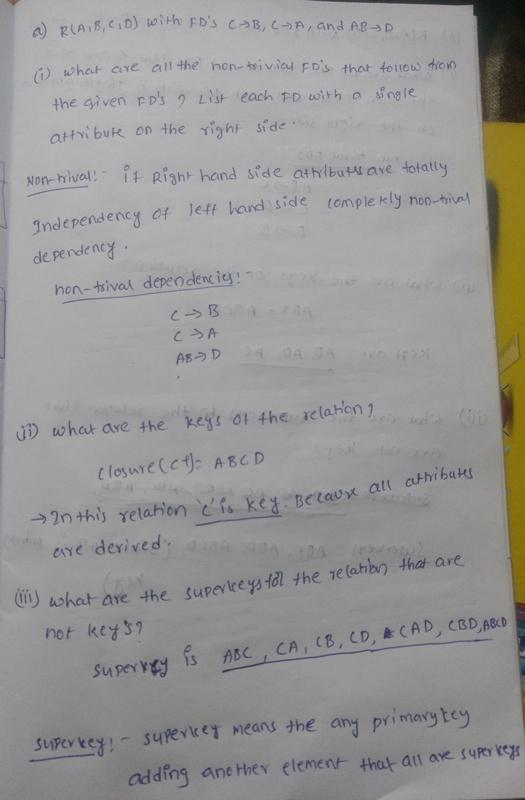
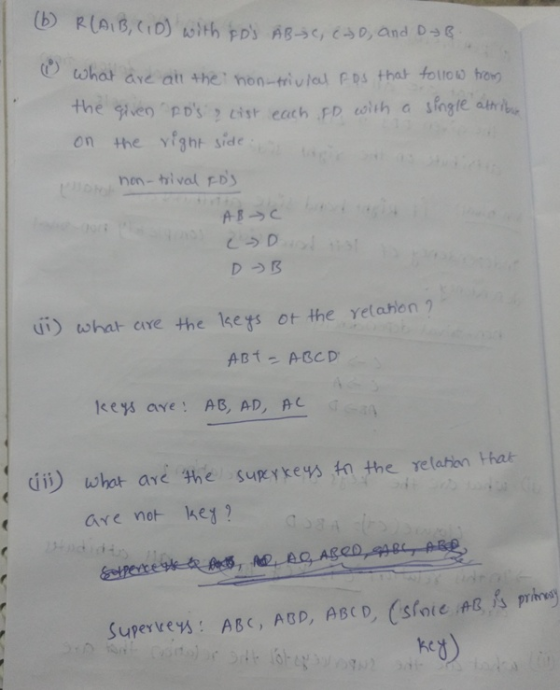
Below are two relations. Each relation has a corresponding set of FDs that hold in the...
FD database Superkeys
R(A, B, C, D) with FDs A ? B, B ? C, B ? D(1) What are all the nontrivial FD’s that follow from the given FD’s? You should restrict yourself to FD’s with single attributes on the right side.(2) What are all the keys of R?(3) What are all the superkeys for R that are not keys?
For the following relations and set of FDs: 1. give a key for the relation; 2....
 For the following relations and set of FDs: 1. give a key for the relation; 2. state whether the relation is in BCNF, and if it is not state why: 3. give a set of relations in 3NF equivalent to the original relation 1. (33 points) What is the closure of (A,B) with respect to R(A,B,C,D,E,F,G)if R has the following functional dependencies? (a) GCDE AF BF - ABC FC G (b) D-AC-D A+B ABC 2 33 points for each of...
data base management systems
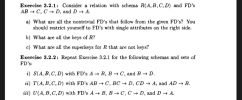 Consider a relation with schema S(A, B, C, D) with FD's A-t B, B -t C, and B ___.D. a) What are all the non trivial FDs that follow from the given FD's? You should restrict yourself to FD's with single attributes on the right side. b) What are all the keys of R? c) What are all the superkeys for R that are not keys?
For the relation R(A,B,C,D,E) with the following FDs: A → B, C → D, AB →...
For the relation R(A,B,C,D,E) with the following FDs: A → B, C → D, AB → C, BC → A 1. List all non-trivial FDs following from the above. (2 marks) 2. Generate all possible keys for R. (2 marks) 3. Check whether R is in BCNF. If it is in BCNF, explain the criteria you used. If it is not in BCNF, convert it into BCNF, showing the new relations and their FDs. (5 marks)
Assume that R(A, B, C, D, E, F) has been decomposed into S(A, C, E, F)...
 Assume that R(A, B, C, D, E, F) has been decomposed into S(A, C, E, F) and other relations. If the dependencies for R are: AB rightarrow C, C rightarrow E, E rightarrow D, D rightarrow F, F rightarrow D. (a) Find ALL non-trivial functional dependencies that hold in S (b) Determine the keys and superkeys of S (c) For each one of your functional dependencies from part a) indicate if it is a BCNF violation, a 3NF violation or...
please do question 4. Note that we follow the convention of denoting the set of attributes...
 please do question 4.
Note that we follow the convention of denoting the set of attributes {A, B, C} by ABC when we write FDs but not when we write schemas. Given the following set set F of FDs on schema R= (A, B, C, D, E,G): A + BC AB + CD B +C E →D G +C EG → AD Answer the following questions. Questions 1-4 require a formal proof or disproof. A proof may be given either...
please do question 4.
Note that we follow the convention of denoting the set of attributes {A, B, C} by ABC when we write FDs but not when we write schemas. Given the following set set F of FDs on schema R= (A, B, C, D, E,G): A + BC AB + CD B +C E →D G +C EG → AD Answer the following questions. Questions 1-4 require a formal proof or disproof. A proof may be given either...
Consider the following definition of equivalent sets of functional dependencies on a relation: “Two sets of...
Consider the following definition of equivalent sets of functional dependencies on a relation: “Two sets of functional dependencies F and F’ on a relation R are equivalent if all FD’s in F’ follow from the ones in F, and all the FD’s in F follow from the ones in F’.” Given a relation R(A, B, C) with the following sets of functional dependencies: F1 = {A B, B C}, F2 = {A B, A C}, and...
Language: SQL - Normalization and Functional Dependencies Part 4 Normalization and Functional Dependencies Consider the following relation R(A, B, C, D)and functional dependencies F that hold o...
 Language: SQL - Normalization and Functional
Dependencies
Part 4 Normalization and Functional Dependencies Consider the following relation R(A, B, C, D)and functional dependencies F that hold over this relation. F=D → C, A B,A-C Question 4.1 (3 Points) Determine all candidate keys of R Question 4.2 (4 Points) Compute the attribute cover of X-(C, B) according to F Question 43 (5 Points) Compute the canonical cover of F.Show each step of the generation according to the algorithm shown in class....
Language: SQL - Normalization and Functional
Dependencies
Part 4 Normalization and Functional Dependencies Consider the following relation R(A, B, C, D)and functional dependencies F that hold over this relation. F=D → C, A B,A-C Question 4.1 (3 Points) Determine all candidate keys of R Question 4.2 (4 Points) Compute the attribute cover of X-(C, B) according to F Question 43 (5 Points) Compute the canonical cover of F.Show each step of the generation according to the algorithm shown in class....
Given the following relation schemas and the sets of FD's: a- R(A,B,C,D) F={ABẠC,C7D, D´A, BC+C} b-...
 Given the following relation schemas and the sets of FD's: a- R(A,B,C,D) F={ABẠC,C7D, D´A, BC+C} b- R(A,B,C,D) F={BẠC, BD, AD>B} C- R(A,B,C,D) F={AB-C, DC+D, CD+A, AD+B} d- R(A,B,C,D) F={AB=C, C+D, D™B, DE} e- R(A, B, C, D, E) F= {AB+C, DB+E, AE>B, CD+A, ECD} In each case, (i) Give all candidate keys (ii) Indicate the BCNF violation Give the minimal cover and decompose R into a collection of relations that are BCNF. Is it lossless? Does it preserve the dependencies?...
Consider the following relations for course-enrollment database in a university: STUDENT(S-ID,S-Name, Department, Birth-date) COURSE(C-ID, C-Name, Department)...
Consider the following relations for course-enrollment database in a university: STUDENT(S-ID,S-Name, Department, Birth-date) COURSE(C-ID, C-Name, Department) ENROLL(S-ID, C-ID, Grade) TEXTBOOK(B-ISBN, B-Title, Publisher, Author) BOOK-ADOPTION(C-ID, B-ISBN) (a) Draw the database relational schema and show the primary keys and referential integrity constraints on the schema. (b) How many superkeys does the relation TEXTBOOK have? List ALL of them. (c) Now assume each COURSE has distinct C-Name. (i) If C-ID is a primary key, what are the candidate keys and the unique keys...
 For the following relations and set of FDs: 1. give a key for the relation; 2. state whether the relation is in BCNF, and if it is not state why: 3. give a set of relations in 3NF equivalent to the original relation 1. (33 points) What is the closure of (A,B) with respect to R(A,B,C,D,E,F,G)if R has the following functional dependencies? (a) GCDE AF BF - ABC FC G (b) D-AC-D A+B ABC 2 33 points for each of...
 Assume that R(A, B, C, D, E, F) has been decomposed into S(A, C, E, F) and other relations. If the dependencies for R are: AB rightarrow C, C rightarrow E, E rightarrow D, D rightarrow F, F rightarrow D. (a) Find ALL non-trivial functional dependencies that hold in S (b) Determine the keys and superkeys of S (c) For each one of your functional dependencies from part a) indicate if it is a BCNF violation, a 3NF violation or...
 please do question 4.
Note that we follow the convention of denoting the set of attributes {A, B, C} by ABC when we write FDs but not when we write schemas. Given the following set set F of FDs on schema R= (A, B, C, D, E,G): A + BC AB + CD B +C E →D G +C EG → AD Answer the following questions. Questions 1-4 require a formal proof or disproof. A proof may be given either...
please do question 4.
Note that we follow the convention of denoting the set of attributes {A, B, C} by ABC when we write FDs but not when we write schemas. Given the following set set F of FDs on schema R= (A, B, C, D, E,G): A + BC AB + CD B +C E →D G +C EG → AD Answer the following questions. Questions 1-4 require a formal proof or disproof. A proof may be given either...
 Language: SQL - Normalization and Functional
Dependencies
Part 4 Normalization and Functional Dependencies Consider the following relation R(A, B, C, D)and functional dependencies F that hold over this relation. F=D → C, A B,A-C Question 4.1 (3 Points) Determine all candidate keys of R Question 4.2 (4 Points) Compute the attribute cover of X-(C, B) according to F Question 43 (5 Points) Compute the canonical cover of F.Show each step of the generation according to the algorithm shown in class....
Language: SQL - Normalization and Functional
Dependencies
Part 4 Normalization and Functional Dependencies Consider the following relation R(A, B, C, D)and functional dependencies F that hold over this relation. F=D → C, A B,A-C Question 4.1 (3 Points) Determine all candidate keys of R Question 4.2 (4 Points) Compute the attribute cover of X-(C, B) according to F Question 43 (5 Points) Compute the canonical cover of F.Show each step of the generation according to the algorithm shown in class....
 Given the following relation schemas and the sets of FD's: a- R(A,B,C,D) F={ABẠC,C7D, D´A, BC+C} b- R(A,B,C,D) F={BẠC, BD, AD>B} C- R(A,B,C,D) F={AB-C, DC+D, CD+A, AD+B} d- R(A,B,C,D) F={AB=C, C+D, D™B, DE} e- R(A, B, C, D, E) F= {AB+C, DB+E, AE>B, CD+A, ECD} In each case, (i) Give all candidate keys (ii) Indicate the BCNF violation Give the minimal cover and decompose R into a collection of relations that are BCNF. Is it lossless? Does it preserve the dependencies?...
Most questions answered within 3 hours.
-
Where is the error in this code sequence?
String s1 = "Hello";
String s2 = "ello";...
asked 11 months ago -
Financial data for Joel de Paris, Inc., for last year
follow:
Joel de Paris, Inc.
Balance...
asked 11 months ago -
Consider this reaction:
Al2(SO4)3 (aq)+ BaCl3
(aq) Al2Cl6 (aq)- +
3BaSO4(s) . What is the...
asked 11 months ago -
Suppose that Savneet is considering increasing her
recent random sample from 20 car rentals to 40...
asked 11 months ago -
Trucks arrive at an unloading terminal at an average rate of 120
per hour.
Trucks arrive...
asked 11 months ago -
Why are methanol and ethanol completely soluble in water while
octanol is not very little soluble....
asked 11 months ago -
A facilities manager at a university reads in a research report
that the mean amount of...
asked 11 months ago -
When the CuSO4 is rehydrated by adding water to the anhydrous
compound, is this an endothermic...
asked 11 months ago -
A ray of sunlight is passing from diamond into crown glass; the
angle of incidence is...
asked 11 months ago -
A block of mass 0.249 kg is placed on top of a light, vertical
spring of...
asked 11 months ago -
how do the kidneys compensate in the presences of acidosis
a) trigger hyperventilate
b) reserve acid...
asked 11 months ago -
Question 501 pts
The rental rate of capital to the firm increases. Which of the
following...
asked 11 months ago