
Homework Answers

Add Answer to:
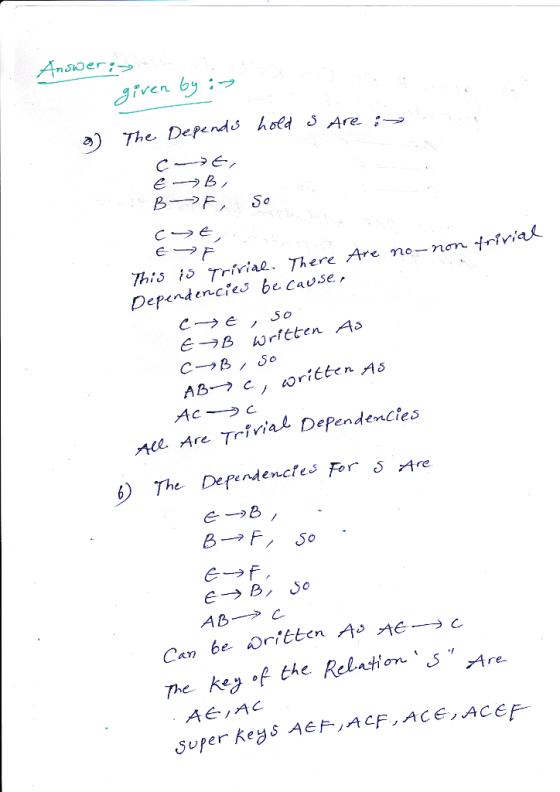
Assume that R(A, B, C, D, E, F) has been decomposed into S(A, C, E, F)...
Consider a relation R with five attributes A, B, C, D, and E. You are given...
Consider a relation R with five attributes A, B, C, D, and E. You are given the following functional dependencies: A → B, BC→E, and ED→A. (a) Is R in BCNF? If it is not, decompose it into a collection of BCNF relations. 2: BCNF and 3NF (3 points) Consider the relation schema R with attributes A, B, C, and D and the following functional dependencies: AB→C, AC→B, B→D, BC→A. (a) Is R in BCNF? If it is not, decompose...
Given the following relation schemas and the sets of FD's: a- R(A,B,C,D) F={ABẠC,C7D, D´A, BC+C} b-...
 Given the following relation schemas and the sets of FD's: a- R(A,B,C,D) F={ABẠC,C7D, D´A, BC+C} b- R(A,B,C,D) F={BẠC, BD, AD>B} C- R(A,B,C,D) F={AB-C, DC+D, CD+A, AD+B} d- R(A,B,C,D) F={AB=C, C+D, D™B, DE} e- R(A, B, C, D, E) F= {AB+C, DB+E, AE>B, CD+A, ECD} In each case, (i) Give all candidate keys (ii) Indicate the BCNF violation Give the minimal cover and decompose R into a collection of relations that are BCNF. Is it lossless? Does it preserve the dependencies?...
Language: SQL - Normalization and Functional Dependencies Part 4 Normalization and Functional Dependencies Consider the following relation R(A, B, C, D)and functional dependencies F that hold o...
 Language: SQL - Normalization and Functional
Dependencies
Part 4 Normalization and Functional Dependencies Consider the following relation R(A, B, C, D)and functional dependencies F that hold over this relation. F=D → C, A B,A-C Question 4.1 (3 Points) Determine all candidate keys of R Question 4.2 (4 Points) Compute the attribute cover of X-(C, B) according to F Question 43 (5 Points) Compute the canonical cover of F.Show each step of the generation according to the algorithm shown in class....
Language: SQL - Normalization and Functional
Dependencies
Part 4 Normalization and Functional Dependencies Consider the following relation R(A, B, C, D)and functional dependencies F that hold over this relation. F=D → C, A B,A-C Question 4.1 (3 Points) Determine all candidate keys of R Question 4.2 (4 Points) Compute the attribute cover of X-(C, B) according to F Question 43 (5 Points) Compute the canonical cover of F.Show each step of the generation according to the algorithm shown in class....
Let, R=(A,B,C,D,E,G) and let F be {A→BDG, BG→DE, B→D, D→A}. Argue that R is not in...
Let, R=(A,B,C,D,E,G) and let F be {A→BDG, BG→DE, B→D, D→A}. Argue that R is not in BCNF by finding one functional dependency in F that violates the definition of BCNF. Add one more non-trivial dependency to F so that R is in BCNF with respect to the new set of dependencies.
Consider a relation R(A,B,C,D,E) with the following functional dependencies: 8. AB C BCD CDE DEA (a) Specify all candidate keys for R. (b) Which of the given functional dependencies are Boyce-Codd No...
 Consider a relation R(A,B,C,D,E) with the following functional dependencies: 8. AB C BCD CDE DEA (a) Specify all candidate keys for R. (b) Which of the given functional dependencies are Boyce-Codd Normal Form (BCNF) violations'? (c) Give a decomposition of R into BCNF based on the given functional dependencies. (d) Give a different decomposition of R into BCNF based on the given functional dependencies. (e) Give a decomposition of R into 3NF based on the given functional dependencies.
Consider a...
Consider a relation R(A,B,C,D,E) with the following functional dependencies: 8. AB C BCD CDE DEA (a) Specify all candidate keys for R. (b) Which of the given functional dependencies are Boyce-Codd Normal Form (BCNF) violations'? (c) Give a decomposition of R into BCNF based on the given functional dependencies. (d) Give a different decomposition of R into BCNF based on the given functional dependencies. (e) Give a decomposition of R into 3NF based on the given functional dependencies.
Consider a...
Consider a relation R with ve attributes A, B, C, D, and E. You are given...
Consider a relation R with ve attributes A, B, C, D, and E. You are given the following functional dependencies: A->B, BC->E, and ED->A. (a) List all keys for R. (10 points) (b) Is R in BCNF? If it is, explain why. If is not, decompose it into a collection of BCNF relations. (20 points) (c) Is R in 3NF? If it is, explain why. If it is not, convert it into a collection of 3NF relations. (20 points)
Question 1: Functional Dependencies [7 marks Consider a relation R on attributes (A, B, C, D,...
 Question 1: Functional Dependencies [7 marks Consider a relation R on attributes (A, B, C, D, E, F,G, H) and the following functional dependen- cies. B →G C →D DE →GC → EF DEF → H (a) What is the closure of [F, G, Hy? (b) List all of the candidate keys of R under the dependencies above. (c) List all of the FDs above that are 3NF violations (d) List all of the FDs above that are BCNF violations....
Consider a relation R(A,B,C,D,E) with the following functional dependencies: 8. AB C BCD CDE DEA (a)...
 Consider a relation R(A,B,C,D,E) with the following functional dependencies: 8. AB C BCD CDE DEA (a) Specify all candidate keys for R. (b) Which of the given functional dependencies are Boyce-Codd Normal Form (BCNF) violations'? (c) Give a decomposition of R into BCNF based on the given functional dependencies. (d) Give a different decomposition of R into BCNF based on the given functional dependencies. (e) Give a decomposition of R into 3NF based on the given functional dependencies.
For the relation R(A,B,C,D,E) with the following FDs: A → B, C → D, AB →...
For the relation R(A,B,C,D,E) with the following FDs: A → B, C → D, AB → C, BC → A 1. List all non-trivial FDs following from the above. (2 marks) 2. Generate all possible keys for R. (2 marks) 3. Check whether R is in BCNF. If it is in BCNF, explain the criteria you used. If it is not in BCNF, convert it into BCNF, showing the new relations and their FDs. (5 marks)
Consider the schema R=(A, B, C, D, E) and let the following set F of functional...
 Consider the schema R=(A, B, C, D, E) and let the following set F of functional dependencies hold for R: F= {A → BC, CD → E, B D } Problem 3 Suppose that the schema R=(A, B, C, D, E) is decomposed into R/ - (A, B, C) and R=(A, D, E). Show if this decomposition is a lossless decomposition with respect to the given set of functional dependencies F.
 Given the following relation schemas and the sets of FD's: a- R(A,B,C,D) F={ABẠC,C7D, D´A, BC+C} b- R(A,B,C,D) F={BẠC, BD, AD>B} C- R(A,B,C,D) F={AB-C, DC+D, CD+A, AD+B} d- R(A,B,C,D) F={AB=C, C+D, D™B, DE} e- R(A, B, C, D, E) F= {AB+C, DB+E, AE>B, CD+A, ECD} In each case, (i) Give all candidate keys (ii) Indicate the BCNF violation Give the minimal cover and decompose R into a collection of relations that are BCNF. Is it lossless? Does it preserve the dependencies?...
 Language: SQL - Normalization and Functional
Dependencies
Part 4 Normalization and Functional Dependencies Consider the following relation R(A, B, C, D)and functional dependencies F that hold over this relation. F=D → C, A B,A-C Question 4.1 (3 Points) Determine all candidate keys of R Question 4.2 (4 Points) Compute the attribute cover of X-(C, B) according to F Question 43 (5 Points) Compute the canonical cover of F.Show each step of the generation according to the algorithm shown in class....
Language: SQL - Normalization and Functional
Dependencies
Part 4 Normalization and Functional Dependencies Consider the following relation R(A, B, C, D)and functional dependencies F that hold over this relation. F=D → C, A B,A-C Question 4.1 (3 Points) Determine all candidate keys of R Question 4.2 (4 Points) Compute the attribute cover of X-(C, B) according to F Question 43 (5 Points) Compute the canonical cover of F.Show each step of the generation according to the algorithm shown in class....
 Consider a relation R(A,B,C,D,E) with the following functional dependencies: 8. AB C BCD CDE DEA (a) Specify all candidate keys for R. (b) Which of the given functional dependencies are Boyce-Codd Normal Form (BCNF) violations'? (c) Give a decomposition of R into BCNF based on the given functional dependencies. (d) Give a different decomposition of R into BCNF based on the given functional dependencies. (e) Give a decomposition of R into 3NF based on the given functional dependencies.
Consider a...
Consider a relation R(A,B,C,D,E) with the following functional dependencies: 8. AB C BCD CDE DEA (a) Specify all candidate keys for R. (b) Which of the given functional dependencies are Boyce-Codd Normal Form (BCNF) violations'? (c) Give a decomposition of R into BCNF based on the given functional dependencies. (d) Give a different decomposition of R into BCNF based on the given functional dependencies. (e) Give a decomposition of R into 3NF based on the given functional dependencies.
Consider a...
 Question 1: Functional Dependencies [7 marks Consider a relation R on attributes (A, B, C, D, E, F,G, H) and the following functional dependen- cies. B →G C →D DE →GC → EF DEF → H (a) What is the closure of [F, G, Hy? (b) List all of the candidate keys of R under the dependencies above. (c) List all of the FDs above that are 3NF violations (d) List all of the FDs above that are BCNF violations....
 Consider a relation R(A,B,C,D,E) with the following functional dependencies: 8. AB C BCD CDE DEA (a) Specify all candidate keys for R. (b) Which of the given functional dependencies are Boyce-Codd Normal Form (BCNF) violations'? (c) Give a decomposition of R into BCNF based on the given functional dependencies. (d) Give a different decomposition of R into BCNF based on the given functional dependencies. (e) Give a decomposition of R into 3NF based on the given functional dependencies.
 Consider the schema R=(A, B, C, D, E) and let the following set F of functional dependencies hold for R: F= {A → BC, CD → E, B D } Problem 3 Suppose that the schema R=(A, B, C, D, E) is decomposed into R/ - (A, B, C) and R=(A, D, E). Show if this decomposition is a lossless decomposition with respect to the given set of functional dependencies F.
Most questions answered within 3 hours.
-
Where is the error in this code sequence?
String s1 = "Hello";
String s2 = "ello";...
asked 10 months ago -
Financial data for Joel de Paris, Inc., for last year
follow:
Joel de Paris, Inc.
Balance...
asked 10 months ago -
Consider this reaction:
Al2(SO4)3 (aq)+ BaCl3
(aq) Al2Cl6 (aq)- +
3BaSO4(s) . What is the...
asked 10 months ago -
Suppose that Savneet is considering increasing her
recent random sample from 20 car rentals to 40...
asked 10 months ago -
Trucks arrive at an unloading terminal at an average rate of 120
per hour.
Trucks arrive...
asked 10 months ago -
Why are methanol and ethanol completely soluble in water while
octanol is not very little soluble....
asked 10 months ago -
A facilities manager at a university reads in a research report
that the mean amount of...
asked 10 months ago -
When the CuSO4 is rehydrated by adding water to the anhydrous
compound, is this an endothermic...
asked 10 months ago -
A ray of sunlight is passing from diamond into crown glass; the
angle of incidence is...
asked 10 months ago -
A block of mass 0.249 kg is placed on top of a light, vertical
spring of...
asked 10 months ago -
how do the kidneys compensate in the presences of acidosis
a) trigger hyperventilate
b) reserve acid...
asked 10 months ago -
Question 501 pts
The rental rate of capital to the firm increases. Which of the
following...
asked 10 months ago